Every man who has gone through the process of marrying an Igbo woman has heard some version of the same warning: prepare your money, prepare your mind, and prepare for surprises. That warning is not entirely without basis, but it is also not the full picture. The question of what constitutes an acceptable dowry amount for Igbo traditional marriage in 2026 does not have a single, fixed answer, and any source that gives you one is misleading you.
- The Distinction Between Bride Price and the Engagement List
- State-by-State Variation: How Much Do Families Actually Collect
- The Total Engagement List in 2026: What to Realistically Budget
- What Makes a Dowry Amount Acceptable
- Negotiation and the Role of Family Elders
- Inflation and How It Has Changed the Real Cost
- What the Law Says About Igbo Bride Price
- Practical Guidance for Grooms Planning in 2026
- The Acceptable Amount Is One Both Families Can Live With
What is true is this: Igbo traditional marriage operates on a system where the bride price, in its strict monetary form, is often symbolic and relatively modest, while the broader engagement list, covering drinks, fabric, food items, cash gifts to various family groups, and other requirements, is where most of the real financial weight sits. Understanding the difference between these two things is the first step to approaching an Igbo traditional marriage with clarity.
What Dowry Amount Is Acceptable for Igbo Traditional Marriage

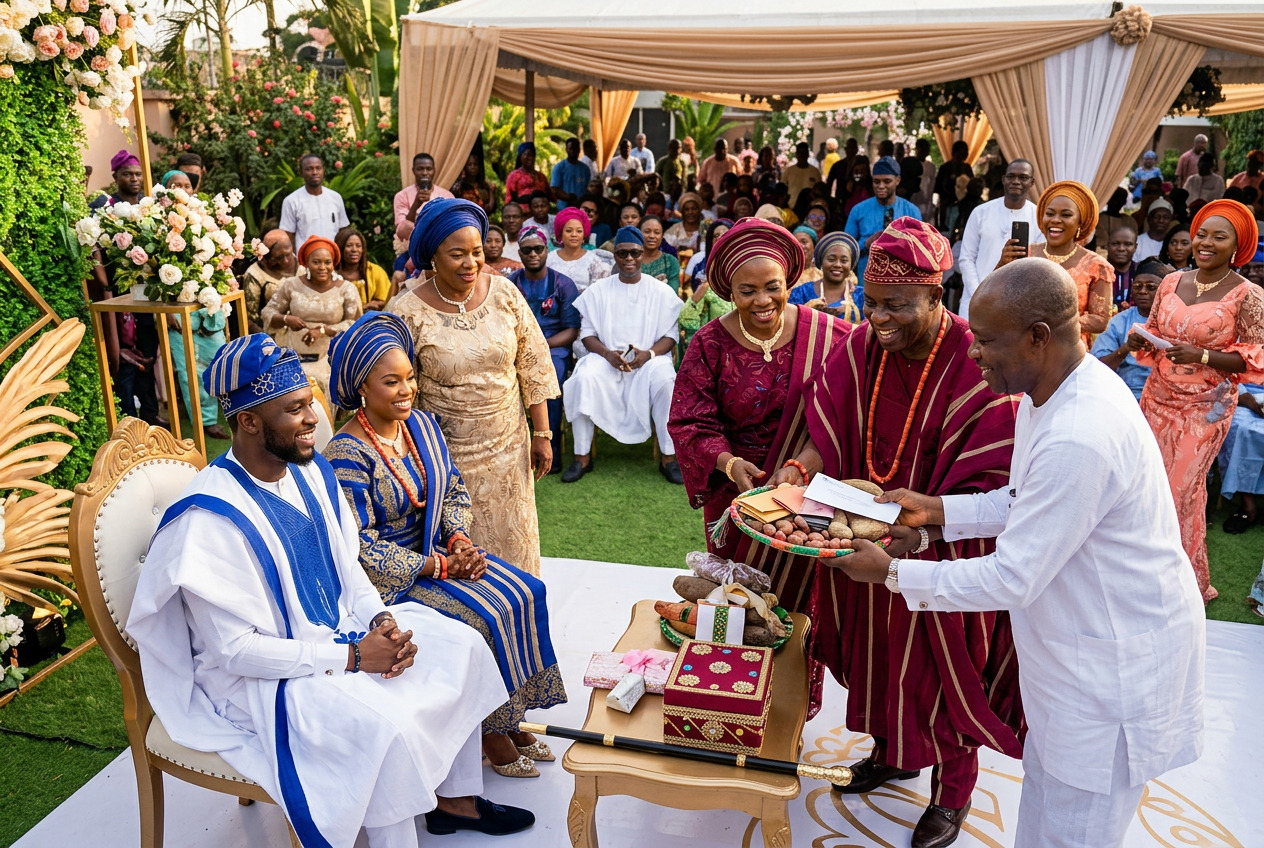
The acceptable dowry amount for Igbo traditional marriage in 2026 varies significantly across communities, states, and families. There is no single figure that applies across all of Igbo land. What you will find instead is a pattern: a legally and culturally recognised bride price that tends to be low and symbolic, layered on top of a customary engagement list that reflects local tradition, family expectations, and, increasingly, economic conditions shaped by years of naira inflation.
The Distinction Between Bride Price and the Engagement List
Many people use the terms dowry, bride price, and engagement list interchangeably. In the context of Igbo marriage, they are not the same thing.
The bride price, known as Ime Ego, is the formal monetary payment made by the groom’s family to the bride’s family. This is the payment that gives the marriage its legal standing under Igbo customary law. Without it, a marriage is not formally recognised. However, what most families and community laws have consistently established is that the bride price itself is a token sum, not a commercial transaction. The principle underlying it is that a woman’s worth cannot be quantified.
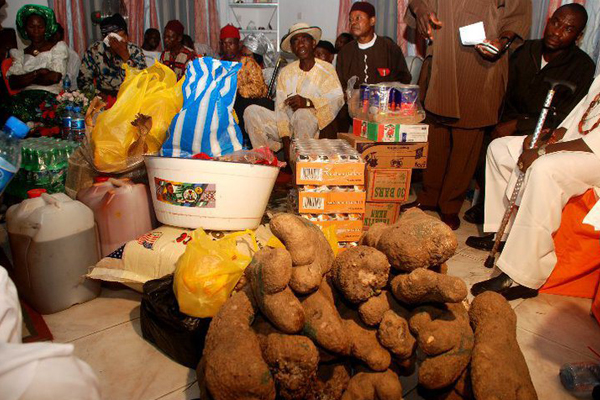
The engagement list, on the other hand, is a comprehensive document given to the groom’s family by the bride’s family. It typically covers drinks (palm wine, beer, malt, hot drinks), food items, fabrics for the bride and her female relatives, cash gifts to the Umunna (the groom’s father’s kinsmen), the Umuada (daughters of the lineage), the young adults, and various other groups within the family and community. The total cost of fulfilling this list is where the actual financial preparation becomes significant.
Legally, the Nigerian courts and customary law frameworks recognise only the bride price as binding. A traditional ruler in Izzi, Ebonyi State, pointed out publicly that the extended item list, running into millions in some cases, is not supported by state marriage laws, which in many southeastern states still formally prescribe a bride price of sixty naira. That legal figure is obviously outdated, but it signals the official position: the list is custom, not law.
State-by-State Variation: How Much Do Families Actually Collect
Igbo land spans five states in southeastern Nigeria: Anambra, Imo, Enugu, Abia, and Ebonyi. Each state contains dozens of distinct communities, and each community can have its own traditions. Generalising across all of them is difficult, but some patterns are worth knowing.
Enugu State: Communities in Enugu are generally regarded as among the least financially demanding in the entire Igbo-speaking zone. In several parts of the state, beyond the symbolic presentation of kolanut, palm wine, and the formal family meeting, very little is demanded as a cash bride price. The engagement list may require items and drinks, but the overall financial outlay tends to be manageable by most standards.
Ebonyi State: The Ebonyi approach to marriage is often grounded in the philosophy that marriage should not be treated as a commercial arrangement. In Edda, for instance, a suitor is expected to demonstrate hardiness by working on the prospective in-laws’ farm alongside friends, not by presenting cash. In parts of Ohaozara LGA, the suitor provides a box of clothing for the bride. The cash component of bride price in Ebonyi communities frequently does not exceed 100 naira as a formal amount, though the full requirements of the list may involve more spending.
Anambra State: Anambra presents a mixed picture. Some communities, like Neni in Anaocha LGA, have formally codified a bride price ceiling of five thousand naira. The Nnewi community by-law similarly references the limitation of dowry law from 1956, which caps formal bride price. In practice, however, the broader engagement list in Anambra communities can be extensive. One resident from the Ogbaru area noted that as a native, a man should not spend more than one hundred thousand naira in total to marry, including all drinks and requirements. Experiences for non-indigenes, though, can vary sharply depending on the family.
Imo State: Imo, particularly the Mbaise communities occupying three local government areas, carries a reputation as one of the more financially demanding areas for marriage. Vanguard’s reporting in early 2025 noted that marrying from Mbaise can approach or exceed one million naira when all components of the list are fulfilled, especially if the woman is highly educated. Educated daughters do attract higher demands in some families as an implicit acknowledgement of investment in her upbringing. In Umuaka, Njaba LGA, the total cost of the introduction and formal marriage ceremony reportedly runs above three hundred thousand naira for both indigenes and non-indigenes.
Abia State: Parts of Abia, particularly in Arochukwu, have a formal symbolic bride price set at 30 shillings in keeping with pre-decimal currency traditions. The critical point is this: if you complete the entire list, present all the required items, and neglect the 30 shillings, the marriage is not complete under that community’s custom. The symbolic amount is what legally seals it.
The Total Engagement List in 2026: What to Realistically Budget
Giving a single national figure for the total cost of an Igbo traditional engagement list is not reliable, and any source that claims otherwise is not accounting for variation. What can be said with reasonable confidence is the following range, based on available reporting and community accounts:
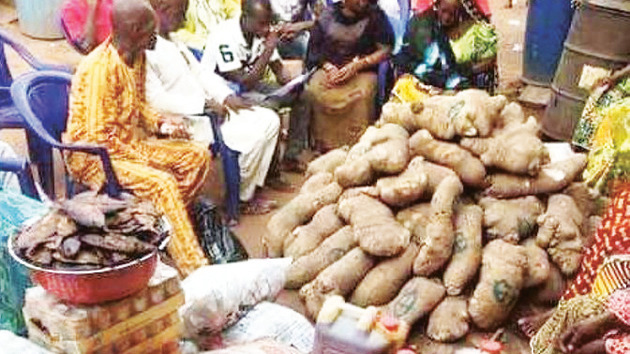

At the lower end, communities in Enugu, Ebonyi, and parts of Anambra with codified regulations may require a total outlay of between fifty thousand and one hundred and fifty thousand naira when all items, drinks, and cash presentations are added up.
In mid-range communities across Anambra, Abia, and sections of Imo, a groom’s family can expect to budget between three hundred thousand and six hundred thousand naira for the full engagement list.
At the higher end, particularly in Mbaise and some Imo communities where the list is extensive and education of the bride is factored in, the total can reach between eight hundred thousand and one point two million naira or more.
These ranges are approximations. Nigeria’s inflation over the past three years has consistently pushed the cost of fabrics, alcohol, food items, and everyday goods upward, meaning a figure that was accurate in 2022 or 2023 may need revision. The only reliable way for a groom to determine actual costs is to collect the official list from the bride’s family and personally price each item at the nearest market.
What Makes a Dowry Amount Acceptable
The word acceptable here carries two dimensions: acceptable to the community in terms of custom, and acceptable to both families in terms of fairness and sustainability.
On the community side, the engagement list itself is the document of acceptable requirements. Whatever is on it is what is expected to be presented. Arriving with less than what is listed, or substituting lower-quality items, is considered disrespectful and will typically be rejected. The purpose of the list is not merely financial: it is a declaration to the community that the groom’s family is serious, prepared, and capable.
On the family side, Igbo custom traditionally provides room for negotiation. Most families will meet the groom’s family at the table, discuss what they are asking, and either maintain their position or adjust it based on relationship dynamics and financial reality. According to actor and Mbaise chieftain Kanayo O. Kanayo, over 85 per cent of Igbo communities do not have a fixed written bride price. Families decide what is appropriate based on individual circumstances. Parents who want their daughter to be happy in her marriage are generally not interested in destroying the groom financially before the marriage even begins.
The formal government-stamped document recording the bride price in many communities records sixty naira as the official figure, preserving the principle that the exchange is symbolic. The community understands that the real work is in fulfilling the list. But the bride price figure itself confirms the marriage under law.
Negotiation and the Role of Family Elders
In formal Igbo marriage procedure, neither the bride nor the groom negotiates the bride price directly. The discussions are conducted by the elders on both sides. The groom’s father or designated family representative engages with the bride’s father and, critically, the Umunna of the bride’s family.
This structure exists for a reason. Removing the couple from the financial negotiation keeps their relationship from being complicated by money disputes. The elders are expected to reach an agreement that honours tradition without placing an impossible burden on the younger generation. In communities with community-wide rules or by-laws, those rules serve as a framework that prevents individual families from making demands that go well beyond what is considered normal.
The Nnewi community, for example, has a published by-law that specifies exactly how many gallons of palm wine, kegs of ngwo, cartons of beer, and bottles of spirits are expected at each stage of the marriage process, along with the cash gifts for specific relatives. Any deviation from these figures is technically prohibited, and violations carry a penalty. This kind of formal documentation is not universal, but it shows how some communities have moved to protect the integrity of the tradition by limiting excess.
Inflation and How It Has Changed the Real Cost
The naira’s steep decline in value since 2023 has had a direct effect on the practical cost of completing an Igbo marriage list. Most items on the list, whether George fabric, wax print wrappers, cases of beer, bottles of quality Scotch whisky, palm wine, and even everyday household goods, have risen in price substantially.
This means that a community whose list has not been formally revised may still carry requirements that were last updated when the naira was significantly stronger, but which now cost multiples of the original expectation. A family asking for four kegs of palm wine in 2018 and the same family asking for four kegs of palm wine in 2026 may be placing a very different financial demand without realising it, simply because market prices have moved.
Several cultural and community leaders, including elders in Anambra and Ebonyi, have publicly acknowledged this reality and called for the revision of marriage lists to reflect both traditional values and economic conditions. Social media movements under tags like ReduceBridePrice have also brought this conversation into public discourse, with many young Nigerians arguing that the current financial demands are a contributing factor to delayed marriages and high bachelor rates among men in their thirties.
What the Law Says About Igbo Bride Price
Under Nigerian customary law, the payment of bride price remains the foundational act that gives an Igbo traditional marriage its legal validity. Courts in Nigeria have upheld this position. A lawyer speaking to Legit.ng confirmed that bride price is both a valid and lawful customary marriage practice, and that payment of it is what gives a customary law marriage its binding character.
The same legal perspective draws a clear line, however, between the bride price and the list. The items on the engagement list, the fabrics, drinks, and cash gifts to the various kinship groups, are customs that vary by community. They are not enforceable as legal obligations in the formal sense. A marriage cannot be declared invalid simply because a groom did not present the full engagement list. What invalidates it, legally, is non-payment of the bride price itself.
Practically, though, a groom’s family that shows up with the bride price but without completing the list will find that the marriage does not proceed. Community approval and family consent matter independently of legal technicalities. The law provides the floor; community expectations provide the rest of the structure.
Practical Guidance for Grooms Planning in 2026
Given all of the above, a groom approaching an Igbo traditional marriage in 2026 would be well served by the following approach:
First, collect the official list from the bride’s family as soon as it is issued. Do not rely on a friend’s list from even a year ago, because prices change and lists are community-specific.
Second, take the list to the market and price each item individually. Do not make assumptions about bulk discounts or availability.
Third, engage your family elders in the discussion process. If any item on the list seems unusual, excessive, or outside what is known to be normal for that community, this is the stage at which to raise it, through the elders, not directly.
Fourth, understand that the bride price itself, the formal cash amount, is typically a small and symbolic figure. The financial weight lies in the list. Budget accordingly.
Fifth, account for naira volatility when setting your budget. Build a buffer of between fifteen and twenty per cent above your priced estimate to absorb any price changes between your market research and the date of the ceremony.
The Acceptable Amount Is One Both Families Can Live With
There is no single acceptable dowry amount for Igbo traditional marriage, and there has never been. What exists is a principle, carried across centuries of Igbo customary practice, that the bride price is symbolic, that the engagement list is the substantive expression of commitment, and that the ultimate measure of acceptability is the agreement reached between two families through their elders.
In a country where inflation has consistently made life more expensive, those families who understand this principle, and who approach the negotiation with both respect for tradition and awareness of financial reality, are the ones who manage to carry out the process without it becoming an obstacle to marriage itself. The ceremony of Igba Nkwu is meant to be a celebration. The financial preparation for it should be challenging enough to demonstrate seriousness, not so crushing that it defeats the purpose.
For anyone planning in 2026, the real answer to what is acceptable is this: what the bride’s community requires by custom, what the bride’s family agrees to after discussion, and what the groom’s family can genuinely provide. That intersection is where the acceptable amount lives.