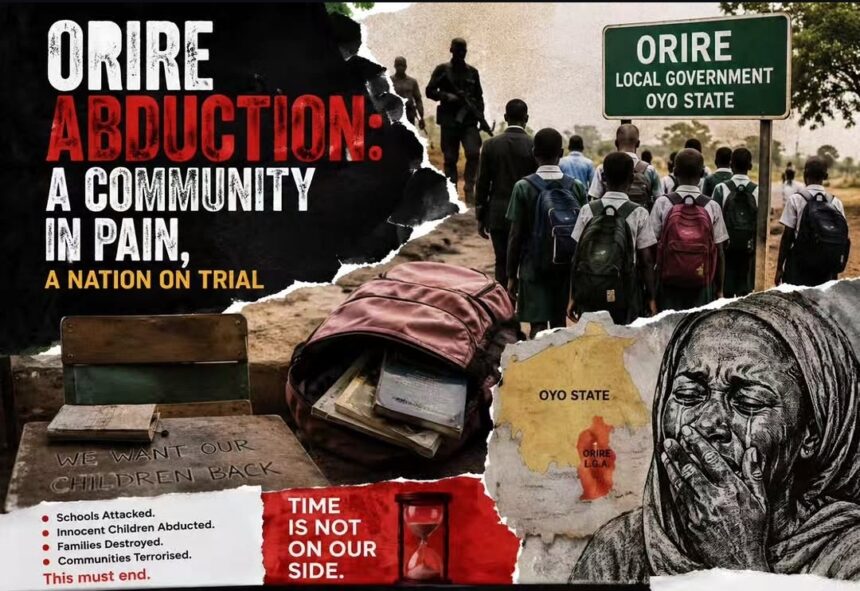
A month after terrorists abducted pupils and teachers from Ahoro-Esinle and Yawota communities in Oriire Local Government Area of Oyo State, uncertainty continues to define daily life for families, residents and authorities involved in efforts to secure their release.
What began as a shocking security incident on May 15, 2026, has evolved into a prolonged humanitarian and security challenge, with relatives of the victims enduring weeks of unanswered questions about the fate of their loved ones.
The crisis has steadily transformed from an emergency requiring immediate intervention into a lingering ordeal marked by anxiety, emotional strain and cautious hope.
At the centre of the uncertainty is the belief that the abductees are being held within forest corridors linked to Oyo National Park, a vast and difficult terrain that has complicated rescue operations and widened the sense of separation between families and those in captivity.
The impact of the incident has extended beyond affected households, altering social and economic activities across surrounding communities.
Residents continue to carry out farming activities, but many now do so with heightened caution amid fears of further attacks.
Movement between settlements has also become more restricted as concerns over security influence routine decisions.
Neighbouring schools have equally felt the consequences of the abduction, with some parents increasingly weighing safety considerations against educational needs.
The emotional toll intensified further following reports that one of the abducted teachers, Michael Oyedokun, was killed while in captivity.
His death introduced a more sombre dimension to the crisis and reinforced concerns about the risks confronting those still being held.
As the situation persisted, public concern expanded beyond Oriire, attracting reactions from community leaders, socio-political groups and government officials.
The Aare Ona Kakanfo of Yorubaland, Gani Adams, described the incident as evidence of a changing security landscape in the South-West.
He said, “What is happening in these rural communities is no longer isolated. It shows that areas once considered safe are now exposed, and we must urgently strengthen coordination among all security stakeholders to prevent further deterioration.”
The national publicity secretary of Afenifere, Mr Jare Ajayi, also expressed concern over the duration of the captivity and the pace of intervention efforts.
He said, “It is painful that after more than a month, these children and their teachers are still in captivity. The response has not matched the urgency of the situation, and we cannot afford to allow armed groups to expand into more communities.”
Offering another perspective, the Director-General of the DAWN Commission, Seye Oyeleye, stressed the importance of ensuring that rescue efforts do not place the captives at greater risk.
He said, “Every effort must prioritise the safety of the captives. In a situation like this, the method of intervention is as important as the outcome, and we must avoid any action that could endanger innocent lives.”
While civic groups and stakeholders continue to express concern, security agencies have maintained that efforts to secure the victims’ release remain active.
The Oyo State Government has repeatedly stated that it is working closely with federal authorities and security agencies to address the situation.
The Governor of Oyo State, Seyi Makinde, described the abduction as a deeply troubling experience for both the government and residents of the state.
He said, “Today marks exactly one month since the children and their teachers were abducted. It has been a traumatic and depressing situation for us as a government and for the people of Oyo. We are here to continue to cooperate with the federal authorities, especially the Nigeria Police Force, to solve this problem.”
The Deputy Inspector-General of Police, South-West, Olagoke Fayoade, reaffirmed the commitment of the Nigeria Police Force to the rescue operation.
Fayoade said, “The Nigeria Police Force remains fully committed to this rescue effort. No officer engaged in this operation will relent until the abducted pupils and teachers are safely reunited with their families.”
The timeline of events reflects the growing significance of the crisis, beginning with the abduction on May 15, followed by the visit of the Inspector-General of Police on May 17, the killing of a teacher and condemnation by President Bola Tinubu on May 18, visits by Governor Makinde and a Federal Government delegation on May 30 and May 31 respectively, a teachers’ strike and protests on June 1, and a demonstration led by social media activist VeryDarkMan in Ibadan on June 16.
Beyond the immediate goal of rescuing the victims, the incident has reignited discussions about rural security, emergency response systems and the protection of vulnerable communities in parts of the South-West.
For security agencies, the situation remains a test of operational effectiveness, while for policymakers it underscores the challenge of strengthening coordination across multiple levels of government.
For families of the abducted pupils and teachers, however, the issue remains deeply personal as each passing day is measured not by official updates but by the hope of reunion.
As rescue efforts continue, residents of Oriire remain united by a shared expectation that those taken from their communities will return home safely and that the uncertainty that has defined the past month will eventually give way to resolution.