Every year, thousands of Nigerians go through the Schengen visa process with full documents, paid fees, and genuine travel plans, then come back empty-handed. In 2024, the European Commission confirmed that 45.9 percent of all Schengen visa applications from Nigeria were rejected. That is nearly one in two. It is the third-highest refusal rate in the world, behind Bangladesh and Senegal, and it went up from 40.8 percent the year before. People are not applying more carelessly. The documentation requirements have not become easier. The demand for European travel from Nigeria is genuinely growing, with 111,201 applications filed in 2024 alone. Yet the rejections keep climbing.
- What a Multiple Entry Schengen Visa Actually Gives You
- Which Embassy Do You Submit To?
- The Documents You Need to Get Right
- The Cascade System: How You Graduate to a Longer Visa
- What the 45.9 Percent Rejection Rate Means for Nigerian Applicants
- The Most Common Reasons Nigerian Applications Fail
- How to Book Your Schengen Visa Application Appointment in Nigeria
- The True Cost of Applying from Nigeria
- What Happens After You Submit
- Building the Travel Record That Changes Your Options
Part of the problem is that many Nigerian applicants still treat the Schengen visa as a single-step exercise: gather documents, show up, submit. What the process actually rewards, especially for a multiple entry visa, is something more specific: a demonstrated travel history, a financial profile that reads as stable over time, and an application that leaves no plausible reason for doubt about the applicant’s intention to return home. This is not a game that gets easier by guessing how to play it. You need to understand the rules, particularly if what you want is not just a one-time visa but the kind of multiple entry stamp that lets you travel back and forth across Europe without restarting the process each time.
Schengen Visa Application from Nigeria

The Schengen visa application from Nigeria works the same way it does for every other country that requires one, with a few Nigerian-specific realities layered on top. This guide covers the full process, with particular focus on what it takes to qualify for a multiple entry visa, why so many Nigerian applications fail, and what applicants who succeed tend to do differently.
What a Multiple Entry Schengen Visa Actually Gives You
A standard Schengen visa allows you to stay in the Schengen area for a maximum of 90 days in any rolling 180-day period. That rule does not change based on what type of visa you hold. The difference with a multiple entry visa is not more time inside Europe, it is the flexibility to enter, leave, and re-enter the Schengen area as many times as you want during the visa’s validity period, without applying for a new visa each time.
On a single entry visa, the moment you leave the Schengen area, your visa is spent. It does not matter if you had 60 days left on it. One exit means it is done. A double entry gives you two shots before the same thing happens. A multiple entry visa, sometimes written as MULT on the visa sticker, means you can come and go freely for as long as the visa is valid, subject to never exceeding 90 days in any 180-day window.
Multiple entry visas come in three validity lengths: one year, two years, and five years. A one-year visa is typically the entry point. From there, a well-used travel history opens the door to the two-year and eventually the five-year version. Getting to five years takes time, but it fundamentally changes how you relate to Schengen travel. You are no longer re-applying before every trip. You are traveling on a standing authorization that Europe has extended because your record has earned it.
The 90/180 rule applies regardless. A five-year multiple entry visa does not mean five years of continuous stay in Europe. It means you can enter and exit freely over five years, while each visit must still end before you cross 90 days in any 180-day period. Nigerians who misunderstand this distinction have faced overstay flags that effectively disqualify them from future applications.
Which Embassy Do You Submit To?
There is only one correct answer to this: you apply to the embassy or visa application centre of the Schengen country where you will spend the most time during your trip. If you are spending two weeks in Germany and three days in the Netherlands, your application goes to Germany. If you are visiting multiple countries for equal lengths of time, then you apply to the embassy of the country you enter first.
This matters because each Schengen country has its own consulate in Nigeria, its own processing centre, and in some cases, its own reputation for how it handles Nigerian applications. France receives the most applications from Nigerians, with 55,833 submissions in 2024. But Switzerland had the highest approval rate for Nigerian applicants that year, at 79.40 percent, meaning that if your trip legitimately takes you to Switzerland as your primary destination, your statistical odds improve considerably compared to some other countries.
In Nigeria, applications go through Lagos or Abuja depending on which consulate has territorial responsibility for where you live. Germany processes applications through its Embassy in Abuja for residents of FCT and several northern states, while the Consulate General in Lagos handles applications from Lagos, Ogun, Oyo, and surrounding states. France’s applications go through TLScontact in Abuja. Spain uses BLS International. Most others use VFS Global. Check the specific country’s Nigerian mission website before you book an appointment, because submitting to the wrong centre wastes time and does not get your application processed.
One common misconception is that you can simply pick whichever Schengen country is easiest to get a visa from, regardless of where you actually plan to travel. Embassies check. If your itinerary shows you spending ten days in Paris but you applied through the German consulate because you thought they were easier, that discrepancy alone can raise flags and contribute to a refusal.
The Documents You Need to Get Right
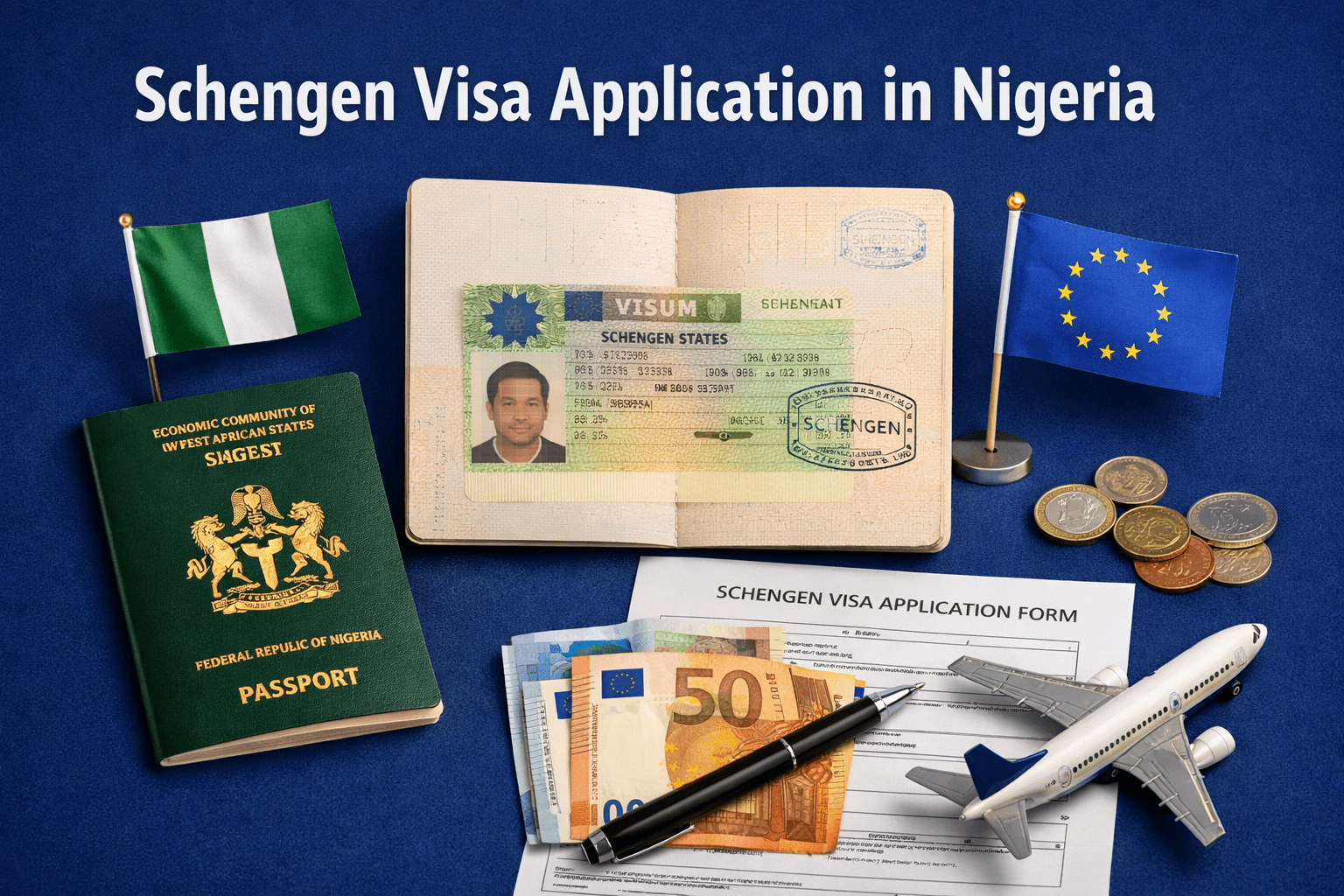

The core document requirements for a Schengen visa are set at the EU level and apply across all 27 Schengen member states, though individual consulates occasionally ask for extras. Your passport must be valid for at least three months after your intended departure from the Schengen area. For multiple entry applications specifically, the passport must be valid for at least three months after your departure from the last country visited. If your passport expires in less than six months, renew it before you start the visa process.
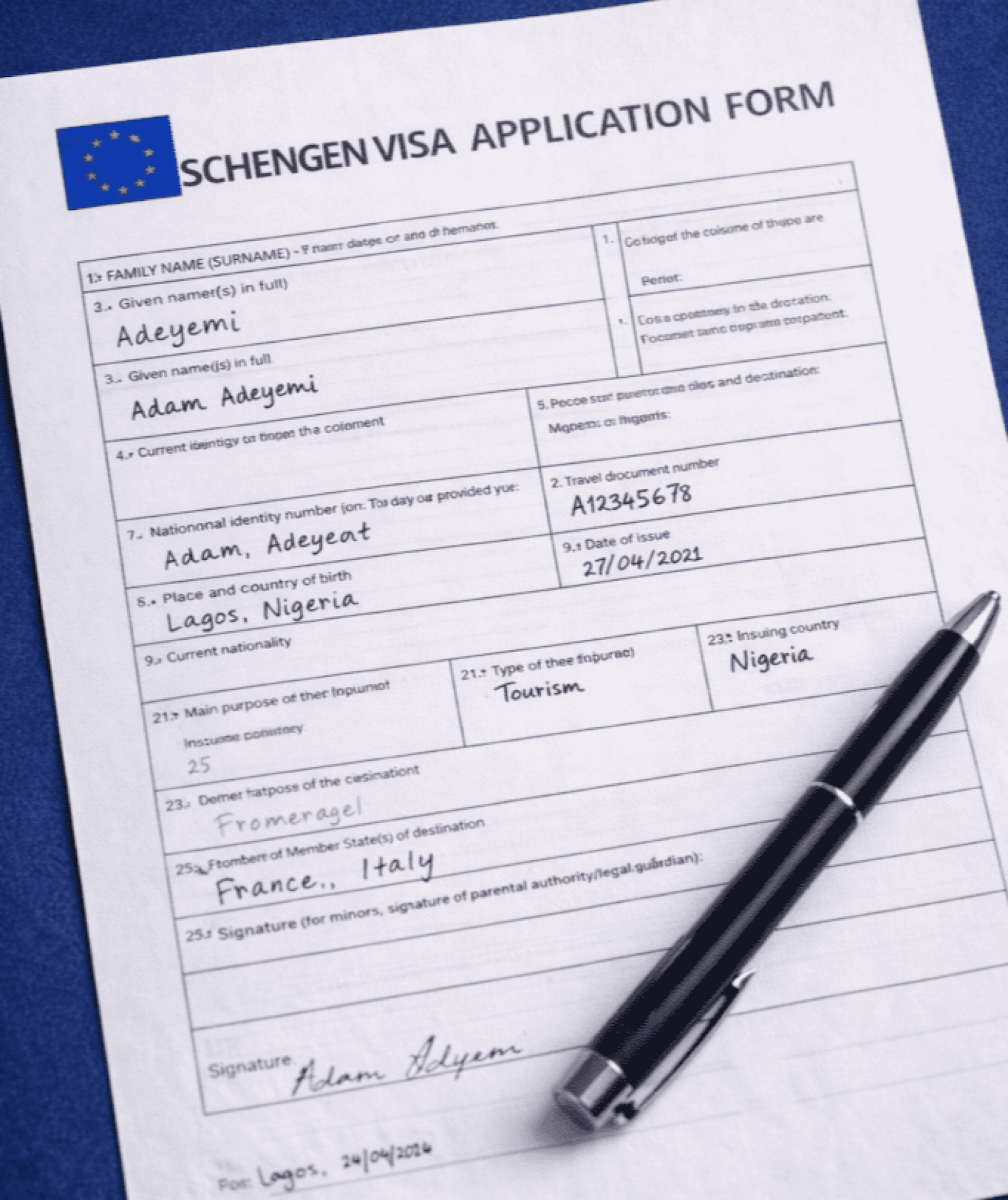
You will need a completed Schengen visa application form, signed in ink. Two recent passport photographs taken against a white background. Travel insurance covering at least 30,000 euros in medical expenses, valid across the entire Schengen area and for the full duration of your stay. Round trip flight bookings, though most consulates accept a reservation rather than a purchased ticket. Hotel bookings or a confirmed accommodation letter covering every night of your stay. Bank statements for the last three to six months, typically showing funds equivalent to between 50 and 100 euros per day of your trip. A cover letter explaining your travel purpose, your itinerary, and your reasons for returning to Nigeria.
For employed applicants: a letter from your employer confirming your position, salary, and approved leave. For business owners: CAC registration documents, recent tax clearance, and evidence of business activity. For self-employed individuals and freelancers, this is where many Nigerian applications become vulnerable, because statements like ‘self-employed’ without corresponding documentation of income, clients, and financial stability do not reassure a visa officer. Bank statements alone are not enough if the inflows look irregular or unexplained.
Proof of ties to Nigeria is the document most Nigerian applicants underestimate. This is anything that demonstrates your life is planted in Nigeria and you have real reasons to come back: property ownership documents, a letter from an employer, school enrollment if applicable, evidence of children or dependent family members, even a business you demonstrably run. Visa officers assessing Nigerian applications are specifically looking for evidence that you are not a migration risk. Strong ties documentation directly addresses that concern.
Biometrics are mandatory if you are applying for the first time or if more than 59 months have passed since your last Schengen visa biometric submission. If you gave fingerprints within the last 59 months for a valid Schengen visa, you may not need to appear in person and the application can be submitted by a representative. When in doubt, confirm with the specific consulate, as exceptions vary.
The Cascade System: How You Graduate to a Longer Visa
The EU updated its Visa Code in February 2020 to introduce what is now referred to as the cascade system, a structured set of rules that determines how and when visa applicants qualify for progressively longer multiple entry visas. Before this update, the path to a multi-year visa was vague and largely at the discretion of individual consulates. The 2020 reform made it mandatory: once an applicant meets the criteria, the consulate must issue the corresponding visa.
The cascade works in three tiers. You become entitled to a one-year multiple entry visa after you have held and lawfully used three Schengen visas within the previous two years. A two-year multiple entry visa follows once you have held and properly used a one-year multiple entry visa within the previous two years. To qualify for a five-year visa, you need to have held and lawfully used a two-year multiple entry visa within the previous three years. The conditions on each tier are the same: the visa must have been used, meaning you actually traveled on it, and respected, meaning you did not overstay and returned home before it expired.
A visa that was issued but never used does not count toward the cascade. An overstay at any point resets your progress and raises a separate flag in the Visa Information System, the EU’s database where all Schengen visa records are stored for five years. Even a day over your authorized stay will show up when your next application is reviewed.
For Nigerians who are applying for the first time, the realistic expectation is a single entry visa matching your specific trip dates. That is the standard starting point, not an insult or a judgment. The path to multiple entry begins after that first trip, used cleanly and documented. On your next application, explicitly request multiple entry in Section 27 of the application form and address the request in your cover letter with a genuine reason, business travel, regular family visits, academic activities. If you meet the cascade criteria, the consulate is legally required to honor it. If you do not yet meet it but have a strong justification, some consulates, Germany and the Netherlands in particular, have a reasonable track record of issuing discretionary multiple entry visas for applicants who demonstrate a genuine need and a clean first-trip record.
What the 45.9 Percent Rejection Rate Means for Nigerian Applicants
The number itself is striking, but the context matters. The European Commission’s 2024 data confirms that Nigeria’s Schengen rejection rate rose from 40.8 percent in 2023 to 45.9 percent in 2024, making it the third-highest globally. Over the 15 years from 2009 to 2024, more than 1.1 million Schengen visa applications were filed from Nigeria, and 491,844 of them were rejected, a cumulative denial rate of 42.1 percent. Nigerians collectively spent roughly 5.18 million euros on rejected applications during that period, money that is non-refundable regardless of the outcome.
The rate is not uniform across destination countries. Belgium rejected 62.32 percent of Nigerian applications in 2024, the highest of any Schengen country for Nigerian applicants. Switzerland was on the opposite end at 79.40 percent approval. France rejected a large number in absolute terms, 24,101 Nigerian applications denied, because it also received the most submissions from Nigeria. The lesson is not to avoid France but to understand that the volume of applications going in means the standards being applied are high, and a weaker-than-average application will not survive the competition.
The rising rejection rate from Nigeria is connected to multiple factors. One is documentation quality: incomplete applications, insufficient proof of financial means, and weak ties-to-Nigeria evidence are consistently cited as grounds for refusal. Another is the perception of migration intent, which is an assessment that visa officers make based on the full picture of an applicant’s profile. Younger applicants without stable employment, recent graduates, or people who have previously overstayed any visa in any country are statistically more likely to receive refusals. The system is not generous to profiles that look like they might not return.
The Most Common Reasons Nigerian Applications Fail
Refusal letters from Schengen consulates in Nigeria tend to cite a set of recurring reasons. The most common is failure to provide reliable evidence of sufficient financial means. This does not simply mean having money in an account. It means having money that looks like it was genuinely yours before the application, with consistent inflows over several months, and no sudden large deposits in the weeks before submission that appear staged. A salary account showing three months of consistent income reads very differently from an account that received a large transfer five days before the application.
The second most common ground is doubt about the applicant’s intention to return to Nigeria. This is the ties-to-country issue, and it comes down to what the officer can see in the file. Property ownership, a position at a reputable employer, children in school in Nigeria, a running business with verifiable operations: these are the things that create confidence. The absence of them, especially for younger applicants, creates the opposite.
Travel insurance that does not meet the minimum coverage of 30,000 euros, or that has coverage gaps, is another consistent rejection trigger. Some Nigerian applicants submit insurance policies that cover only certain countries or specify areas that exclude portions of the Schengen zone. The requirement is clear: full Schengen area coverage, 30,000 euros minimum, valid for the entire intended stay.
Purpose of travel being unclear or inconsistent is also a factor. If your cover letter says you are traveling for tourism but your bank statements show business-level financial flows, or if your itinerary does not match the hotel bookings submitted, these contradictions undermine the entire application. Every document in your file should tell the same story coherently.
Finally, there is the question of previous rejections. If you have been refused a Schengen visa before, you are required to disclose it on the application form. Concealing a prior refusal is a grounds for immediate rejection and can result in bans. If you were refused previously, address it in your cover letter, explain what has changed, and demonstrate that the grounds for the earlier refusal no longer apply.
How to Book Your Schengen Visa Application Appointment in Nigeria
Most Schengen countries no longer accept direct walk-in applications at their Nigerian embassies. Instead, they route applications through appointed visa processing centres, primarily VFS Global and BLS International, depending on the destination country. Germany operates through its consulates in Lagos and Abuja directly, with appointments booked on its official portal. France uses TLScontact. Spain operates through BLS International. Finland, Switzerland, and several others use VFS Global.
Appointment slots are one of the genuine pain points of the Schengen process in Nigeria, particularly in Lagos, where demand is high. You must book through the official portal of the relevant visa centre, not through third-party agents who claim to guarantee appointment slots. The booking is free. Anyone charging you for access to a government appointment system is either a tout or operating an unofficial service. You can submit your application as early as six months before your intended travel date, and the recommended minimum is three to four weeks before departure, given processing times.
Processing takes a minimum of 15 calendar days from the date your application is received. In individual cases it can extend to 45 days if the consulate needs to consult with other Schengen states, which is a procedure that applies to nationals of certain countries and can take up to 14 additional calendar days. Plan your application timeline accordingly. Do not purchase non-refundable flights before your visa is approved. Most consulates explicitly tell applicants this. A confirmed reservation is sufficient for the application.
On the day of your appointment, bring originals of every document plus one complete set of photocopies. Late arrivals are not accommodated at most centres and the appointment must be rebooked. If you are submitting biometrics for the first time, your physical presence is mandatory. For those whose biometrics are already on file from within the past 59 months, a third party may submit on your behalf with a copy of the previously issued visa sticker.
The True Cost of Applying from Nigeria


The standard Schengen visa fee is 90 euros for adult applicants. For children between the ages of 6 and 11, the fee is 45 euros. Children under 6 are exempt. This fee increased from 80 euros, which was the previous rate until June 2024. It is the same whether you are applying for a single entry, double entry, or multiple entry visa. The type of visa does not affect the application fee.
The 90-euro fee is only one part of what you will actually spend. VFS Global and BLS International charge service fees on top of the visa fee. Spain’s BLS International centre currently charges NGN 28,800 per application as a service fee. Other centres have their own rates. The naira equivalent of the 90-euro visa fee changes with the exchange rate and must be confirmed at the time of application, since embassies and centres adjust the naira rate without fixed notice.
Travel insurance for a Schengen trip from Nigeria typically costs between NGN 1,500 and NGN 67,000 depending on the provider, the duration of coverage, and whether you buy from a local Nigerian insurer or an international provider. Passport photographs cost between NGN 2,000 and NGN 5,000. If you request courier delivery of your passport, that is an additional NGN 5,000 to NGN 10,000 depending on your location. Factor in transport to the visa centre in Lagos or Abuja if you do not live nearby.
The non-refundable nature of the fee deserves to be taken seriously. If your application is rejected, the 90 euros is gone. This is not a complaint process where you get your money back if the refusal was unreasonable. Preparing a strong, complete application is not just about the visa outcome. It is also about protecting real money that the current naira exchange rate makes significant. A rejected application from Lagos now costs upwards of NGN 150,000 or more when all associated costs are totaled.
What Happens After You Submit
After your appointment, you will receive a receipt confirming your application was submitted. Most visa centres provide a tracking link or reference number that lets you monitor the status online. Standard processing is 15 calendar days from submission, though this clock starts from when the consulate receives your file, not from when you dropped it at the processing centre.
If your application is approved, you will be notified to collect your passport. The visa sticker will show the validity period, the number of entries, and the territory it covers, which is usually marked as SCHENGEN STATES. Read the sticker carefully. Confirm the entry type, the dates, and the duration of stay. Any discrepancy should be raised immediately with the issuing consulate before travel.
If your application is refused, you will receive a standard refusal form that states the grounds for the decision. You have the right to appeal within 30 days of receiving the refusal. The appeal process and the body to appeal to will be specified on the refusal letter, as it varies by country. An appeal does not require you to pay the visa fee again, but it does require a substantive response to the specific grounds for rejection. Simply resubmitting the same documents will not produce a different result.
For Nigerians who receive a refusal and intend to reapply, the minimum practical advice is this: understand specifically why you were refused, address those reasons with documentary evidence, wait until your situation has genuinely changed if the grounds were about employment or financial stability, and do not reapply within a short window purely on hope. The records of your previous application, including the refusal, are visible to the next consulate that reviews your file.
Building the Travel Record That Changes Your Options
The Schengen visa system is designed to reward history. A Nigerian applicant with a clean first trip to Europe, a consistent employment or business record, stable finances, and a file that holds together under scrutiny is not working against impossible odds. Even at a 45.9 percent national refusal rate, the other 54.1 percent of applications that were approved came from somewhere. The approved applications have something in common: they gave the visa officer no compelling reason to refuse.
The path to a multiple entry visa, and eventually to the two-year and five-year versions that genuinely change how you travel, runs through exactly that same logic. Each approved trip that you use cleanly, each departure that respects the authorized stay, each application that is fully documented and internally consistent, builds the record that the cascade system is specifically designed to reward. The EU did not create the cascade system to keep Nigerians out. It created it to identify applicants whose track record justifies extended access. The work of becoming one of those applicants starts with the very first application.
What no amount of good preparation can overcome is a profile that the evidence simply does not support. A visa application is not a negotiation. It is a case made on paper, and the strength of the case is entirely in the documents. For Nigerian applicants navigating this in 2026, that is both the frustrating reality and the most actionable one. The process has rules. Learn them, meet them, and the multiple entry Schengen visa becomes a realistic outcome rather than a distant one.