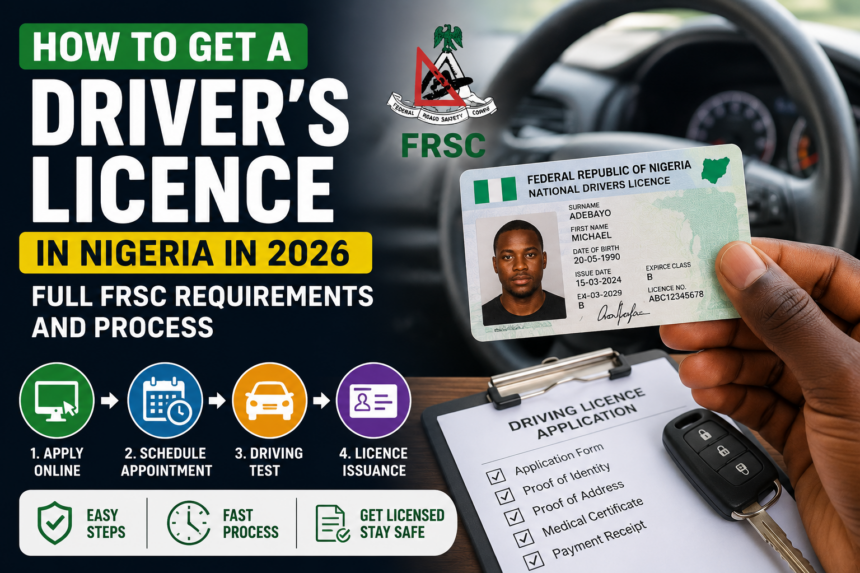
Every year, thousands of Nigerians sit in queues at Driver’s Licence Centres across the country, only to be turned back because they missed one step somewhere. Not the VIO test, not the biometric capture, just a certificate from the wrong driving school, or a payment made to the wrong account, or a portal that nobody explained properly. The process itself is not complicated. What makes it feel complicated is that most people go in without knowing what the full picture looks like.
- What the FRSC Actually Controls and Why It Matters
- The Driving School Requirement That Trips Most People Up
- Documents You Need Before You Open the Portal
- How the FRSC Portal Works: From Application to Payment
- What Happens at the Driver’s Licence Centre
- Biometric Capture: The Step Your Whole Application Depends On
- Your Temporary Licence and When the Permanent Card Arrives
- How Much Getting a Driver’s Licence Actually Costs in 2026
- If You’re in Lagos, There Is an Extra Layer You Cannot Skip
- Renewing, Replacing, or Verifying a Nigerian Driver’s Licence
- Getting This Right the First Time
The Federal Road Safety Corps has been issuing driver’s licences in Nigeria since 1988, and the system has changed significantly from what it used to be. Everything now runs through a central online portal. Payments go through Remita. Your biometrics are stored in a national database. The card in your wallet is linked to a digital record that law enforcement can verify on the spot. Which means the days of walking around with a fake or uncaptured licence and getting away with it are numbered.
This guide walks through every requirement, every office, every fee, and every stage of the process, for first-time applicants and people looking to renew or replace an existing licence.
How to Get a Driver’s Licence in Nigeria in 2026

Getting a driver’s licence in Nigeria in 2026 means dealing with multiple agencies, a specific sequence of steps, and costs that go beyond just the licence fee itself. The FRSC portal is where the formal application happens, but before you even open that website, there are requirements you need to have sorted. Understanding this from the start is what separates a smooth process from a frustrating one.
What the FRSC Actually Controls and Why It Matters
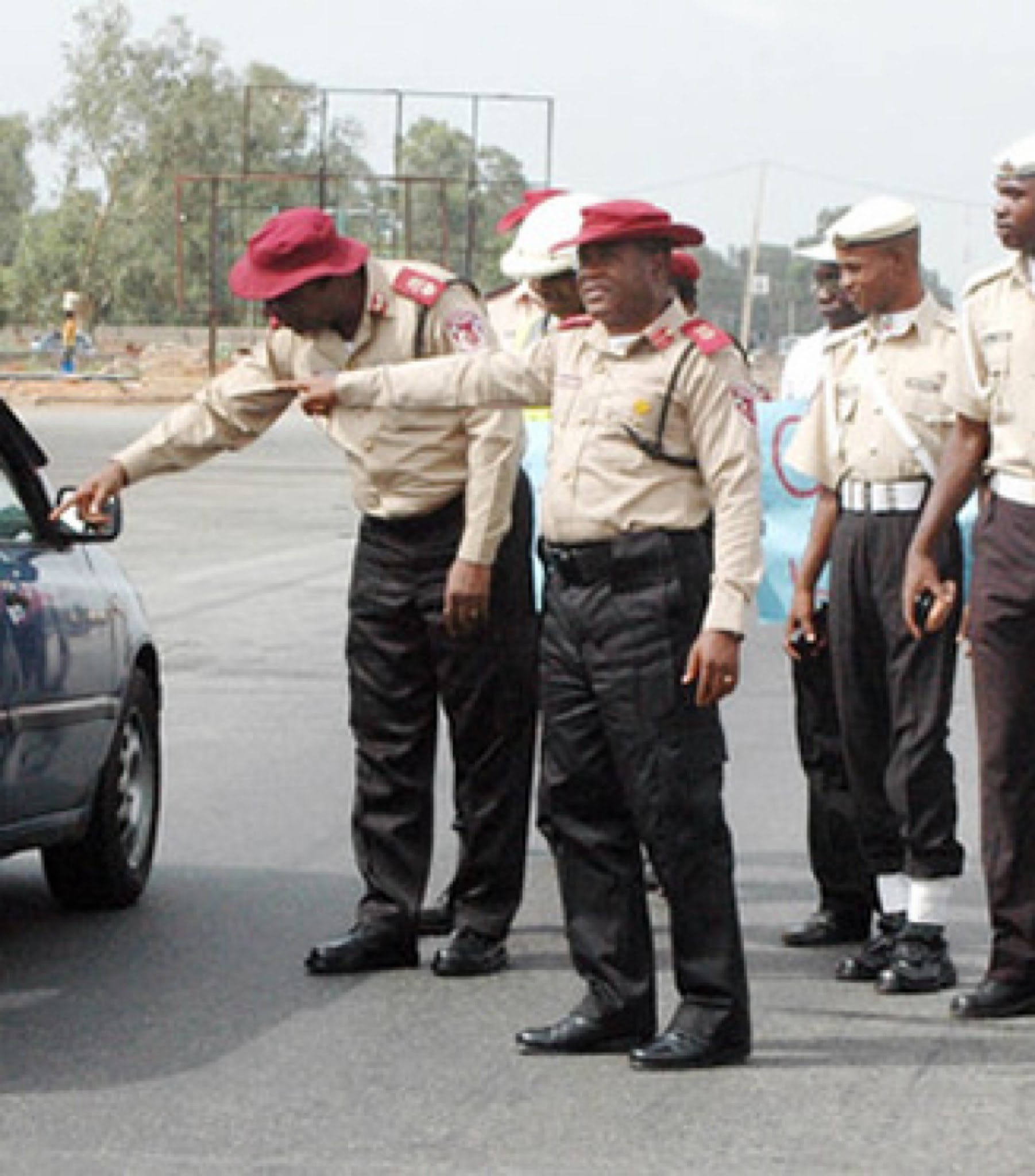

The Federal Road Safety Corps is the agency that produces Nigerian driver’s licences, maintains the biometric database, and handles all digital processing. But it does not work alone. The Board of Internal Revenue (BIR), or its equivalent in each state, Lagos uses the Motor Vehicle Administration Agency (MVAA), handles payment confirmation and endorsement. The Vehicle Inspection Office (VIO) conducts the practical driving test. All three have to sign off before a licence is issued.
The FRSC’s role is specifically in biometric capture and production. When your fingerprints, photograph, and signature are taken at a Driver’s Licence Centre (DLC), that data goes into the national database. The physical card is produced from that database. This is why a licence without biometric capture is essentially worthless, the card may look real, but it will not match anything when checked against the FRSC system.
The formal portal for all applications and renewals is nigeriadriverslicence.frsc.gov.ng. The older nigeriadriverslicence.org domain also redirects there. If anyone asks you to make a payment or submit documents outside of this portal, that is not an official process. The portal generates a Remita Retrieval Reference (RRR) for every payment, which is how transactions are tracked. Any payment made without a portal-generated RRR is not in the system.
This matters because unofficial agents are a known problem. They typically charge between ₦60,000 and ₦100,000 to handle the process on someone’s behalf, and while some do get the job done, others pocket the money and produce cards that fail FRSC verification. The system is designed to be done by the applicant directly. Understanding the process means you do not need anyone to do it for you.
The Driving School Requirement That Trips Most People Up
Before anything else happens, before the portal, before payment, before any office visit, a first-time applicant must complete training at an FRSC-accredited driving school. This is not optional and it is not just a formality. The driving school certificate is required to even start the online application form. The portal asks for the certificate number at the very beginning. Without it, the form does not proceed.
An FRSC-accredited driving school is one that has been inspected, registered, and issued an official accreditation number by the Federal Road Safety Corps. Not every driving school in Nigeria qualifies. Training at an unaccredited school, regardless of how thorough it is, produces a certificate that the FRSC system will not recognise. Applications submitted with unaccredited certificates are typically rejected at the DLC stage, after the applicant has already spent time and money on other parts of the process.
The standard training covers road signs and traffic regulations, defensive driving techniques, basic vehicle handling, right of way rules, and emergency response basics. There are both theory sessions and supervised practical driving. Most programs run between four and six weeks, though some schools offer accelerated schedules. Costs typically range from ₦15,000 to ₦35,000 depending on the school and the number of practical lessons included. Schools with modern simulators and facilities tend to sit at the higher end.
Once training is completed and the internal exit test is passed, the driving school issues a certificate and uploads the trainee’s record digitally into the FRSC system. This digital upload is what matters most, because at the DLC, FRSC officers verify the training record electronically before proceeding with biometric capture. If the school failed to upload properly, the application stalls even if you have a physical certificate in your hand. Before enrolling in any school, confirm their accreditation status directly with an FRSC office or ask to see their accreditation number.
Documents You Need Before You Open the Portal
First-time applicants need to gather several things before starting the online application. The driving school certificate number is the first, it unlocks the application form. Beyond that, you need your National Identification Number (NIN), a valid phone number that is linked to your NIN, your blood group, your home address, and next-of-kin details. These are all filled in on the application form.
For the physical visit to the DLC, you will need your printed acknowledgement slip from the portal, a means of identification (National ID card, international passport, or voter’s card), and your eye test certificate from an FRSC-approved clinic. The eye test is a vision acuity check conducted at the DLC or at an approved clinic. It confirms that your eyesight meets the minimum standard for driving. The test typically costs between ₦500 and ₦3,500 depending on where it is done.
A medical certificate is also required in some states. For standard private vehicle licences, the eye test is usually sufficient. For commercial licence classes, particularly Class C and above, a more detailed medical assessment may be required, including a blood pressure check. The FRSC’s own processing guidelines list a vision acuity test and blood pressure assessment for hypertension as part of the DLC health check for commercial applicants.
The name on your application form must match your NIN exactly. This is a common source of delays. If the names differ even slightly, say a middle name missing or an initial instead of a full name, the biometric capture may not proceed. Sort out any NIN discrepancies before starting the application, not after you get to the DLC.
How the FRSC Portal Works: From Application to Payment
Go to nigeriadriverslicence.frsc.gov.ng and select New Driver’s Licence. You will be asked whether you already have a licence. Select No. The form then asks for your driving school certificate number. Enter it and the system pulls up the application form. Fill in your personal details, full name as it appears on your NIN, date of birth, home address, phone number, blood group, NIN, and next-of-kin information. You also select your preferred licence type and duration.
Nigerian driver’s licences are available in two durations: three years or five years. You make this choice at the application stage, and it affects how much you pay. After filling in all details, you select the Driver’s Licence Centre closest to you. This is the DLC where you will go for biometric capture. Submit the form, review your details on the confirmation page, then proceed to payment.
Payment goes through Remita. You can pay directly online with a Visa, Mastercard, or Verve card. You can also generate a Remita Retrieval Reference (RRR) and pay at any participating bank branch over the counter, if you prefer not to pay online. After payment, print your acknowledgement slip. This slip is your evidence of payment and is required at the DLC. The portal also generates a temporary licence document at this stage, but it is the physical DLC visit that makes the licence real.
One thing worth knowing: the application stores your data on the portal, but nothing moves forward until the DLC visit happens. Paying online does not mean your licence is being processed. Biometric capture is the actual trigger that starts production.
What Happens at the Driver’s Licence Centre
The DLC is where several offices converge to complete the process. When you arrive, you will present your acknowledgement slip, your driving school certificate, your means of identification, and your eye test certificate. A BIR or MVAA officer reviews your documents and endorses the application. The VIO officer then conducts or verifies the driving test result. For first-time applicants, this is where the practical road test takes place, testing your ability to handle the vehicle, navigate traffic, and apply road safety rules correctly.
If you pass the VIO test, the next stop is the FRSC officer for biometric capture. If the VIO test is failed, the application does not proceed. You would need to schedule a retest. This is worth taking seriously, show up prepared, not just with documents but with actual driving competence. Some applicants train for a few weeks with a good driving school and still struggle at the VIO test because they did not get enough practical experience on real roads before the test day.
The VIO driving test fee is approximately ₦1,000 to ₦2,200 depending on the state. This is a small amount, but it is a separate charge from the licence fee itself. Carry cash for any ancillary charges at the DLC because some state-level fees are paid on-site rather than through the portal.
Biometric Capture: The Step Your Whole Application Depends On
Once the VIO endorsement is done, you proceed to the FRSC officer at the DLC for biometric capture. This is where your fingerprints are scanned, your photograph is taken, and your signature is recorded. All of this goes directly into the national driver database. Your physical licence card will be produced from this data. If any discrepancy appears at this stage, name mismatch with NIN, incomplete driving school upload, or duplicate records, the capture officer flags it and you may need to return after corrections are made.
The most common reason biometric capture stalls is a name inconsistency between the NIN record, the driving school certificate, and the application form. These three sources must match. Another frequent issue is an incomplete digital upload from the driving school. The school’s system should have uploaded your training record before you get to this point, but not all schools are reliable about it. If the FRSC system cannot find your training record, capture does not proceed. This is another reason why choosing an established, genuinely accredited school matters.
You must appear in person for biometric capture. No proxy, no representative, no workarounds. Biometric data is literally your body, fingerprints, face, signature. The process exists precisely because the licence is supposed to be tied to a specific, verifiable individual. Once capture is completed successfully, you are issued a temporary driver’s licence that is valid for 60 days while the permanent card goes into production.
Your Temporary Licence and When the Permanent Card Arrives
The temporary licence is a printed document that authorises you to drive legally while your permanent card is being produced. It is valid for 60 days. During this period, the FRSC processes your data, prints the card, and dispatches it to the relevant BIR or MVAA office. Law enforcement is aware that temporary licences exist and should recognise them at checkpoints, though in practice, having it alongside your acknowledgement slip and payment receipt makes things cleaner.
Collection of the permanent card is done at the BIR or MVAA office of the state where you applied, not necessarily at the DLC itself. FRSC sends an SMS notification to the phone number linked to your application when the card is ready. If you do not receive a notification within the 60-day period, you can track your application status on the portal using your application reference number and date of birth. The tracking page shows the current stage: pending capture, captured, in production, or ready for collection.
If your card is delayed beyond 60 days, visit the DLC where you did your capture and inquire. Delays can happen when a state command has a backlog of applications in production, or when there are supply chain issues with card materials. These are bureaucratic slowdowns, not usually problems with individual applications. Persisting through official channels is the right approach rather than paying an agent to escalate things informally.
How Much Getting a Driver’s Licence Actually Costs in 2026
The official FRSC portal fees for a motor vehicle (Class B) licence are ₦15,000 for three years and ₦21,000 for five years. For motorcycles and tricycles, the fees are lower: ₦7,000 for three years and ₦11,000 for five years. These figures are published on the FRSC portal and cover the application, biometric capture, and the licence card itself.
But the licence fee is only part of what a first-time applicant actually spends. Driving school training costs between ₦15,000 and ₦35,000. The eye test at an approved clinic costs between ₦500 and ₦3,500. The VIO driving test costs roughly ₦1,000 to ₦2,200 depending on the state. Add any passport photograph costs, transport to and from the DLC across possibly two or three visits, and the total for a first-time applicant comes to somewhere between ₦45,000 and ₦50,000 at the lower end.
The 5-year licence is the better value. Yes, the upfront cost is higher, but renewing a 3-year licence twice over a 6-year period means more portal visits, more DLC trips, more capture sessions, and more time off work or other commitments. The fee difference between a 3-year and a 5-year licence is ₦6,000. That gap disappears quickly when you factor in transport, time, and the psychological cost of going through the process again sooner than necessary.
For renewal applicants, the FRSC charges ₦6,350 for a 3-year renewal and ₦10,350 for a 5-year renewal at official rates, though actual amounts paid at various DLCs may differ slightly due to state-level processing charges. If your biometric data is already in the system from a previous capture, some renewal cases qualify for a bypass capture option on the portal, which simplifies the renewal significantly. This bypass is only available up to the second renewal cycle, the third time, a fresh application is required.
If You’re in Lagos, There Is an Extra Layer You Cannot Skip
Lagos operates differently from other states when it comes to driver’s licences. The Lagos State Drivers’ Institute (LASDRI), established under a state law, requires all drivers in Lagos to be certified by their institute. This applies to both commercial and private drivers. Before you can complete biometric capture at an FRSC DLC in Lagos, you must have a valid LASDRI certificate.
LASDRI operates through its own portal at lasdri.org and has multiple offices across the state, in Oshodi, Badagry, Ikorodu, Lagos Island, and Epe. First-time applicants need to apply for a learner’s permit through LASDRI, attend a LASDRI training session, and collect the LASDRI certificate before proceeding to the FRSC DLC. The LASDRI training covers Lagos-specific traffic laws, road signs, and the specific regulations governing driving in the state. It is a one-day session for most private vehicle applicants.
For commercial drivers in Lagos, LASDRI requires annual recertification. A bus driver, cab driver, or any professional driver operating in the state must renew their LASDRI certification yearly. This is separate from and on top of the FRSC licence renewal cycle. Driving commercially in Lagos without a current LASDRI certification is a separate traffic offence under state law.
This Lagos-specific requirement adds to both the cost and the time of getting a licence for anyone based in the state. Budget extra days and extra fees if you are going through the process in Lagos. The LASDRI fee varies by category, but the process itself is straightforward once you know it exists. The mistake most people make is showing up at the FRSC DLC in Lagos without the LASDRI certificate, only to be turned back and told to start over.
Renewing, Replacing, or Verifying a Nigerian Driver’s Licence
Renewal can begin up to 30 days before the expiry date. The process follows broadly the same steps as a new application, portal visit, payment, DLC visit for biometric refresh, but it is faster because your data is already partially in the system. The portal asks for your existing licence number and date of birth to pull up your record. You update any changed information, pick a DLC, generate a payment reference, and proceed.
If your licence is lost, stolen, or badly damaged, a replacement requires a police extract documenting the loss or damage, a sworn affidavit, and payment of the replacement fee at the FRSC portal. You then go through biometric capture again at a DLC. Carry the police report number to every office you visit during this process, it is the document that establishes the legitimate reason for the replacement request.
To verify whether a licence is genuine and active in the FRSC database, visit ndlverification.frsc.gov.ng. Enter the licence number or RID number and the system returns whatever record exists in the database. Employers who hire drivers, fleet managers, and anyone who has doubt about a licence they have been shown can run this check in minutes. A licence that does not return a matching record from the FRSC database, regardless of how real the card looks, is not in the system.
The verification portal also matters for applicants who want to confirm their own record was captured correctly. After collecting your permanent card, run a check to confirm that the biometric data matches, the licence is marked as active, and your details are accurate. Errors do happen during data entry, and catching them early is much easier than trying to correct a record years later when you are standing at a checkpoint.
Getting This Right the First Time
The Nigerian driver’s licence process is not the bureaucratic nightmare it has a reputation for being, as long as you understand what is required before you start. The driving school comes first. Then the portal, the payment, the DLC visit, biometric capture, and collection. Each stage depends on the previous one. Skipping or shortchanging any step means going back to the beginning of that stage.
For Nigerians in cities like Lagos, Port Harcourt, and Abuja, where enforcement at checkpoints is consistently active, a valid licence with confirmed biometric capture is not just a legal requirement, it is protection against impromptu demands, fines, and the general hassle of being stopped without the right papers. An FRSC licence that verifies cleanly in the database is worth the four to eight weeks it takes to process properly.
The official portal, the accredited driving schools, the DLC, and the verification database are all functional and accessible. The process exists. The system works when used correctly. Getting it done through the proper channels, budgeting realistically, and showing up prepared at each stage is how most people who successfully get their licence do it.