In October 2021, Masai Ujiri stood on a court in Isolo, Lagos, and said something that has stayed with people in Nigerian basketball circles ever since. “Every kid may not play in the NBA eventually; I never played, but see where I am today.” He was there to unveil new basketball facilities at Ijeshatedo Grammar School and other Lagos locations, part of his Giants of Africa foundation’s commitment to building 100 courts across the continent. Courts at school compounds in Oworonshoki, Ilupeju, Ejigbo, Gaskiya College, and Abesan Mini Stadium have since followed. The message was deliberate: infrastructure alone cannot produce talent, but without it, the talent that already exists will keep being wasted.
- How to Get Better at Basketball When You Are Starting From Zero
- The Fundamentals That Actually Separate Good Players from Average Ones
- Building a Training Routine That Works Without a Fancy Gym
- Defense, Rebounding, and the Unglamorous Work Most Young Players Skip
- The Mental Side of Basketball That Nobody Talks About Enough
- What the Nigerian Basketball Scene Looks Like Right Now and Why It Matters for You
- Where to Get Noticed, Get Coached, and Get Better in Nigeria
- The Path Forward: What Consistent Improvement Actually Looks Like
Nigeria is not short on basketball talent. The D’Tigers have beaten the United States in an exhibition. Rivers Hoopers compete in the Basketball Africa League. Adem Bona, born Ikechukwu Stanley Okoro in Lagos in 2003, went from playing streetball with makeshift hoops to the Philadelphia 76ers, drafted in the second round of the 2024 NBA Draft, after a route through Turkey, Prolific Prep in California, and UCLA. The Nigerian basketball scene is producing players at a rate that is getting harder and harder for the rest of the world to ignore. But the players who actually get there are the ones who learned early how to train with intent, how to build skill without waiting for perfect conditions, and how to think about the game at a level beyond just running and jumping.
This is the conversation that does not happen enough on Nigerian courts. Everyone wants to ball. Far fewer people are serious about understanding how to get better.
How to Get Better at Basketball
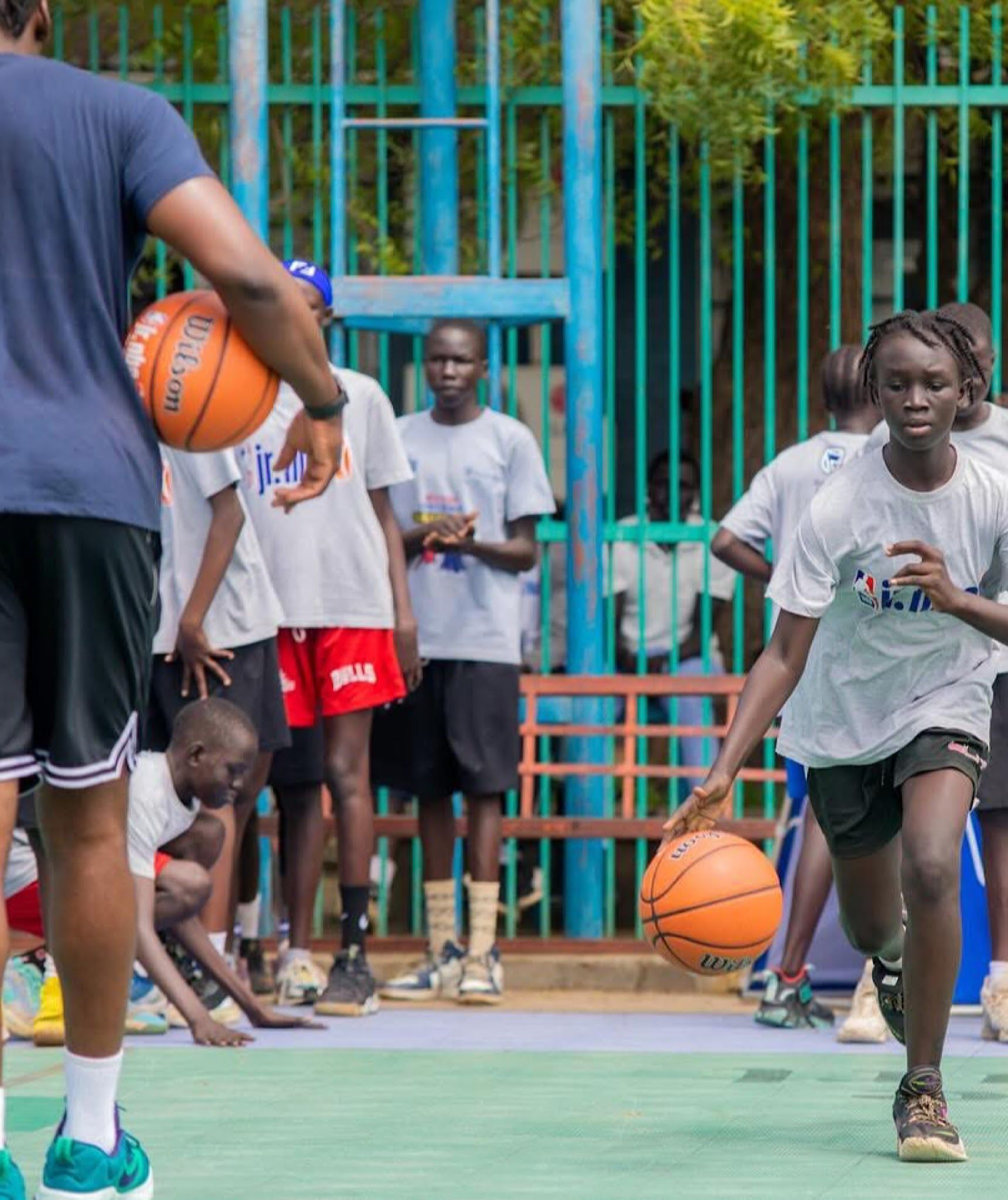

Knowing how to get better at basketball is not just about putting in hours, it is about knowing where to put them. Nigerian players who break through are almost always the ones who figured out very early that purposeful, structured practice is different from simply playing a lot. This guide covers the fundamentals, training habits, mental skills, and pathways that actually matter for young Nigerians who are serious about the game.
How to Get Better at Basketball When You Are Starting From Zero

Before Adem Bona became a professional basketball player, he was, by his own account, genuinely terrible at it. In a Pro Insight interview before his college career at UCLA, he described his earliest days on the court plainly: “I couldn’t shoot, I couldn’t dribble, my coordination was terrible. The only thing I could do was run because I used to play soccer. And I can jump.” He had never watched a basketball game the first time he played it. He was 13 years old, playing on Lagos streets, and he got better by repetition, by moving to Turkey at 13 to train properly, and eventually by outworking almost everyone he encountered. His story is not exceptional because of talent. It is exceptional because of what he did with the raw material once he recognized the opportunity.
The point of that story is practical. If you are starting from scratch, or close to it, the first thing you need to remove from your thinking is the idea that there is a correct time to begin or a minimum skill level you need before you can start training seriously. The only thing that matters in the beginning is exposure and repetition. You need to touch the ball constantly. Dribbling with your dominant hand, then your non-dominant hand. Not in games, not in front of anyone, just you and the ball at whatever space is available, a compound, a side street, wherever you have room to move.
The other starting principle is this: watch the game. Watch it obsessively. Not just highlight reels, watch full games, watch how players move without the ball, where they position themselves on defense, how they set screens, what they do after a missed shot. Adem Bona said he had never watched basketball when he first played it. He spent years after that making up for lost time, studying the game while developing the physical skills to play it. For a young Nigerian who has access to a phone and an internet connection, this part requires nothing but deliberate attention.
The Fundamentals That Actually Separate Good Players from Average Ones
There is a reason experienced coaches across the world say the same thing: fundamentals. It is not a vague word. It refers to a specific set of skills that, when executed consistently and correctly, make you a reliable basketball player regardless of how physically gifted you are. The players who dominate at secondary school level in Nigeria and who attract attention from scouts and development programs are almost never the most athletic ones. They are the ones who have mastered the basics well enough that they are not thinking about them during games.
Ball-handling is the first fundamental worth obsessing over. This does not just mean dribbling in a straight line, it means developing the kind of comfort with the ball that lets you control it under pressure, change direction without telegraphing the move, and keep your eyes up to read the floor. The drill that builds this fastest is simple: dribble for 20 to 30 minutes daily, alternating hands, changing speeds, using crossovers and behind-the-back moves until they become automatic. You should eventually be able to dribble without looking at the ball at all. That is the standard.
Shooting mechanics are the second. This is where a lot of Nigerian youth players fall short, not because they lack physical ability, but because nobody has corrected their form early enough and poor habits have calcified. The correct shooting motion has a few non-negotiable components: your shooting wrist should be loaded behind and under the ball as you rise into the shot, your elbow should be aligned with the basket, your follow-through should extend fully, and you should hold that follow-through until the ball hits the rim. These are not aesthetic preferences, they are the mechanics that create consistent arc and backspin on the ball. Practicing form shots close to the basket, starting from three to five metres out before moving further, should take up a significant portion of any serious training session.
Footwork is the third fundamental and probably the most undervalued on Nigerian courts. Good footwork means you are balanced before you catch the ball, that you know how to use a pivot foot to create space, that you can come off a screen with your feet already set to shoot, and that your defensive stance lets you move laterally without crossing your feet. None of this requires equipment or a proper gym. It requires attention, repetition, and the willingness to practice movements that feel boring until they become automatic.
Passing is often the tell for players who genuinely understand the game versus those who are just athletic. A young player who knows when to give up the ball, who can throw a sharp bounce pass under pressure or hit a teammate cutting to the basket with a no-look pass, stands out immediately. The way to build this skill is to practise passing against a wall with both hands, to play pickup games where you consciously look for the pass before the shot, and to study how point guards at every level distribute the ball in traffic.
Building a Training Routine That Works Without a Fancy Gym
One of the most honest things Adem Bona said about growing up in Nigeria was this: “We don’t have the basic stuff like the balls, the shoes, the gym.” He said it not as a complaint but as a statement of fact about the conditions that shaped him. He also went on to say that he believed Nigeria had the talent, the size, the athleticism, the raw material, but not yet the systems to develop it fully. What his journey actually demonstrated, however, is that the absence of systems does not have to be fatal. What matters is whether you build your own structure in the absence of an official one.
A structured daily training routine does not require a regulation court or a professional coach. What it requires is a plan with specific goals for each session. A basic daily framework for a serious young Nigerian player might look like this: 20 minutes of ball-handling and dribbling drills to open a session, then 30 minutes of shooting practice starting from close range and working outward, then 15 minutes of footwork and lateral movement drills, then 20 minutes of conditioning, sprints, box jumps on a step, or anything that builds the legs and lungs, and finally 10 minutes of free throws to close. That is about 95 minutes of deliberate work that can happen on almost any outdoor court.
The key word there is deliberate. Every rep in a training session should have a clear purpose. If you are doing crossover drills, you are practising the crossover until the movement is clean and quick, not just going through the motions. If you are shooting, you are following through every single time and tracking whether the misses are short, long, or to the sides to understand what needs correcting. Coaches at elite programs use the phrase “perfect practice” for a reason, mindless repetition does not create skill improvement. It reinforces whatever you are already doing, good or bad.
Recovery matters as much as the work itself, especially for teenage athletes. Sleep, food, and rest days are not optional, they are part of the training. A 16-year-old who trains hard six or seven days a week without adequate sleep and nutrition will plateau and often get injured. Two proper rest days per week, consistent meals that include protein and complex carbohydrates, and seven to eight hours of sleep will compound the benefits of training in ways that no amount of extra court time can substitute for.
Defense, Rebounding, and the Unglamorous Work Most Young Players Skip
Talk to any serious basketball coach, in Nigeria or anywhere else, and they will tell you the same thing: the fastest way to get more playing time is to become a player who makes the team better without the ball. Defense and rebounding are where this happens. These are also the areas that most young players in Nigeria, as in most countries, neglect because they are not the exciting parts of the game. Nobody goes to the outdoor court at Surulere to practice defensive footwork. But the players who develop these skills are the ones who stay on the floor.
Defensive fundamentals start with stance. Your feet should be shoulder-width apart, knees bent, weight on the balls of your feet. You should be able to move quickly in any direction from this position. When guarding someone with the ball, your goal is to stay between them and the basket, make them go the direction they are less comfortable going, and contest every shot without fouling. The drill that builds this is simple: face a wall, get into defensive stance, and shuffle laterally back and forth for 30-second intervals. It is tedious and effective.
Rebounding is a skill built on positioning, timing, and aggression. The first principle is that 80 percent of rebounds are taken inside the paint area closest to the basket, which means where you are when a shot goes up matters far more than how high you can jump. Boxing out, the technique of using your body to establish position between a defender and the basket before a shot lands, is the single most impactful rebounding habit you can develop. The player who boxes out every single time their teammate shoots will consistently collect more boards than a taller, more athletic player who simply watches the ball and hopes to outjump everyone. Coaches notice this immediately.
The Mental Side of Basketball That Nobody Talks About Enough
There is a specific kind of player that emerges in Nigerian youth basketball who is physically gifted, clearly talented, but inconsistent in a way that has nothing to do with skills or fitness. They play brilliantly in training and poorly when something is on the line. They make a mistake and carry it through the rest of the game. They overthink passes, second-guess shots, and visibly tighten under pressure. This is not a physical problem. It is a mental one, and it is more common than most people acknowledge.
Mental training for basketball starts with understanding that mistakes are a built-in part of the game at every level. The NBA’s best shooters miss roughly half their attempts over a full season. Turnovers happen to every point guard. Defensive lapses happen to everyone. The players who perform consistently under pressure are not the ones who make fewer mistakes, they are the ones who process mistakes quickly and reset. This is not a natural trait. It is a practiced skill. After every mistake in training or in a game, the mental habit to build is a quick acknowledgment of what went wrong, a conscious decision to let it go, and a full redirect of attention to the next play.
Visualization is another practical tool. Before a training session or a game, spending five to ten minutes mentally rehearsing your movements, seeing yourself catching the ball and shooting cleanly, executing a defensive stop, setting a screen and rolling to the basket, activates the same neural pathways as physical practice. Research in sports psychology has consistently shown this to be a genuine performance tool, not a motivational exercise. Players who visualize consistently tend to execute their practiced moves with more confidence in live situations.
Confidence itself is worth addressing directly, because Nigerian youth culture often doesn’t give young athletes the space to speak about mental struggles around performance. The fear of failure, the self-consciousness about making mistakes in front of peers, and the pressure that comes with being seen as a promising player are all real and all affect performance. Naming these things and understanding them as normal parts of development, not signs of weakness, is the beginning of managing them.
What the Nigerian Basketball Scene Looks Like Right Now and Why It Matters for You
The Nigerian Basketball Federation, established in 1963 and affiliated with FIBA Africa, has been building out its competition calendar with genuine seriousness. The 2025 program included U16 and U18 national camps for both boys and girls, national championship events, FIBA Zone 3 qualifier participation, and representation in the Basketball Africa League through Rivers Hoopers and Kwara Falcons. The Nigerian Premier Basketball League features 16 teams across two conferences, Savannah and Atlantic, with the top four advancing to a Final Eight playoff at the National Stadium Surulere. In 2025, Patrick Abah of Lagos Legends won the league’s Most Valuable Player award.
At the senior level, D’Tigers reached the quarterfinals of the 2025 FIBA AfroBasket tournament in Luanda, Angola, where they were eliminated by Senegal. The women’s team, D’Tigress, continued their dominance on the continent, winning their fifth consecutive FIBA Women’s AfroBasket title in Ivory Coast and qualifying automatically for the 2026 FIBA Women’s Basketball World Cup. Nigerian players are active in the NBA, in European leagues, and in the BAL. The diaspora connection between Nigerian heritage players like OG Anunoby, Precious Achiuwa, and Gabe Vincent and the domestic scene is genuine, many of them represent D’Tigers in international competitions.
For a young Nigerian player, understanding this landscape matters because it tells you where the pathway runs. From school-level competition to state tournaments to NBBF national events to professional league exposure to international camps, the steps exist. Giants of Africa courts across Lagos schools and community parks, including at Ilupeju Grammar School, Oworonshoki, Gaskiya College, Egan Grammar School, and several others, have expanded the physical infrastructure available to young players. The JR. NBA has hosted coaching clinics in Nigeria. NBA scouts have been attending Nigerian school competitions with increasing regularity.
What the landscape still lacks, honestly, is consistency of coaching quality and equipment access at the grassroots level. Adem Bona’s assessment, that Nigeria has the talent but not yet the platforms to fully develop it, remains accurate. What this means for a young player is that external systems may not always be available to you, and the ones that are will often be competitive for limited spots. Developing yourself independently, rather than waiting for a program to find you, is the only reliable strategy.
Where to Get Noticed, Get Coached, and Get Better in Nigeria
The Giants of Africa basketball camps, hosted annually across Nigeria with NBA coaches and local staff, are one of the most direct avenues for quality coaching that young Nigerians can access. The organization has run these camps in Nigeria, Kenya, and across 17 African countries since 2003. Their recently launched Dribble for Peace program is expanding their Nigerian presence further. Following their social media accounts and checking their website ahead of camp announcements is worth doing consistently if you are serious about getting a development camp spot.
The NBBF’s national championship events for U16 and U18 boys and girls are the formal competition pathways within the country. Getting into a state-level basketball program that competes in NBBF-affiliated events is the clearest route to national exposure. State associations vary significantly in how active they are, but Lagos, Rivers, Kano, and Abuja-based programs have historically been the most competitive. Rivers Hoopers, one of Nigeria’s top professional clubs, has a development pipeline worth tracking if you are in Port Harcourt.
The Ejike Foundation Basketball Programme has been running since 2005 and has produced players who have gone on to US collegiate basketball. The Raptors Basketball Academy in Lagos, which operates independently and competes in the Nigerian Premier League, provides year-round training and national tournament competition. Both programs have served thousands of Nigerian youth players and produced players who have earned overseas scholarships. If you are in Lagos specifically, identifying and applying to these programs early is a concrete step worth taking.
One underrated resource is YouTube. Coaches like those at Pro Skills Basketball, IMG Academy, and various university programs publish free training content that matches the quality of what gets taught in structured programs. A Nigerian youth player with a phone and discipline can access the same drill explanations and shooting mechanics breakdowns that players in the US use. The gap between Nigerian players and international players is increasingly a gap in structure and consistency of training, not access to information. That is a problem with a practical solution.
The Path Forward: What Consistent Improvement Actually Looks Like
Improvement in basketball is not linear and it is not fast. Adem Bona spent a year on Lagos streetball before catching the attention of a Turkish coach. He then moved to a completely new country at 13, learned a new language, played professional basketball in Turkey as a teenager, then moved to California, then played two years at UCLA before the NBA. The total timeline from his first basketball experience to his NBA debut in October 2024 was about 11 years. That is not an argument for patience in the passive sense. It is an argument for sustained, directed work over a long period.
For Nigerian youth players right now, the most important thing is to start building the habits that compound. Daily ball-handling. Consistent shooting mechanics practice. Deliberate study of the game through watching professional and college basketball. Participation in whatever competitive environment is available, from street games to school leagues to state competitions. And the mental habits, quick reset after mistakes, visualization, the ability to process pressure without freezing, that distinguish players who perform in training from those who perform when it counts.
The infrastructure is imperfect. The coaching at grassroots level is uneven. The courts Giants of Africa has built across Lagos schools and community parks are a real improvement but are not enough on their own. None of that changes what individual players can do with what is available to them. Nigerian basketball is genuinely producing players who reach the highest levels of the global game. The ones who get there are not waiting for conditions to be perfect. They are getting better right now, with what they have, in the environment they are actually in.