A debate that touches faith, public expression, safety, and the limits of government regulation has suddenly placed Nigeria’s religious community at the centre of a national conversation. What began as a legislative move aimed at regulating activities inside commercial vehicles has grown into a heated discussion involving some of the country’s most influential pastors, church leaders, lawmakers, and millions of Nigerians who are watching how the issue unfolds.
The controversy surrounding the proposed punishment for preaching, hawking, and trading inside commercial vehicles has created questions about where public safety measures should end and where personal freedoms should begin. While lawmakers have presented the move as part of efforts to reduce distractions on roads and improve passenger experiences, some Christian leaders believe the provision could affect the way religious messages are shared in public spaces.
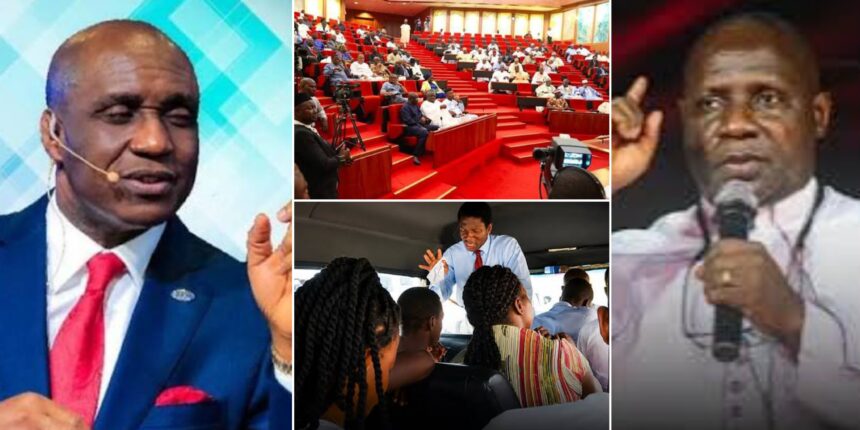
The reaction became louder after prominent clerics, led by Pastor David Ibiyeomie of Salvation Ministries, openly challenged the proposal during a church service. His remarks quickly attracted attention because of the strong language he used while addressing the issue, turning the proposed legislation into a major religious and social debate across Nigeria.
The bill that triggered the controversy
The disputed provision is contained in the Federal Road Safety Corps (FRSC) Amendment Bill, 2026, which was recently passed by the National Assembly. The bill introduces several changes relating to road safety regulations, including penalties for certain activities carried out inside commercial vehicles.
Under the proposed amendment, anyone found guilty of preaching, hawking, or trading inside a commercial vehicle could face a fine of ₦50,000, imprisonment of up to 6 months, or both penalties depending on the circumstances of the offence.
The provision places these activities under the same category because lawmakers argue that they can create distractions during journeys, interfere with passengers’ comfort, and potentially contribute to unsafe conditions inside moving vehicles.
The bill also contains other road related measures, including tougher consequences for some traffic violations and sanctions for motorists who refuse roadside breath tests conducted by officials of the Federal Road Safety Corps.
Despite the attention surrounding the preaching provision, the amendment is not yet an enforceable law. The National Assembly’s approval represents only one stage of the legislative process. The bill must still receive presidential assent before it can become legally binding across Nigeria.
How the controversy moved from parliament to churches
The conversation changed significantly after religious leaders began publicly reacting to the proposed legislation. For many pastors, the issue was not viewed simply as a transport regulation matter but as a question connected to religious freedom and the constitutional rights of Nigerians.
Nigeria’s constitution guarantees freedom of thought, conscience, and religion, including the freedom to manifest religious beliefs through worship, teaching, practice, and observance. This constitutional protection became a major reference point for those who argued that public preaching should not be restricted without careful consideration.
Pastor David Ibiyeomie became one of the strongest voices against the proposal after addressing his congregation during a church service. His comments reflected deep concern that religious activities could face unnecessary limitations if the provision eventually becomes law.
The pastor questioned the intention behind the move and argued that Christians should not be prevented from spreading their faith in public spaces while other religious groups are allowed similar expressions.
David Ibiyeomie’s strong reaction


During his sermon, David Ibiyeomie described the proposed law as unacceptable and criticised lawmakers over the decision to include preaching among activities that could attract punishment inside commercial vehicles.
He said, “It is a stupid law.”
The pastor also questioned the judgment of those responsible for the legislation, saying he did not understand the reasoning behind the decision.
“I don’t know where they kept their brains,” he said while expressing his disagreement with the proposal.
Ibiyeomie argued that Christianity has a constitutional right to public expression and insisted that religious freedom should apply equally to all Nigerians regardless of faith.
According to him, restrictions should not be placed on Christians while other religious practices receive tolerance.
“Allow Christians alone. As we allow Muslims, also allow Christians,” he said.
“If Muslims can also raise their microphone, we are free to preach. There is freedom of religion. Nobody is warning the Muslims. You should not stop us from preaching,” he added.
The pastor maintained that the issue was bigger than a transport regulation because he believed it touched on the ability of religious groups to practise their faith openly.
He urged Christians not to remain silent if the proposed measure eventually becomes law, warning that religious communities must speak up whenever they believe their rights are being affected.
Ibiyeomie’s warning to journalists, politicians
During his remarks, the cleric also appealed to journalists covering his statement to report his words accurately and avoid presenting his comments in a misleading way.
“Don’t edit what I said. Put it as I said it. We want peace. Don’t turn my words,” he said.
His comments came amid concerns that his strong criticism of the bill could be interpreted beyond the issue of the proposed transport regulation.
The pastor insisted that his position was based on his understanding of religious freedom and not influenced by political or ethnic considerations.
“I will never be a tribalistic preacher. Never,” he declared.
Ibiyeomie further stated that he had consistently spoken on national matters regardless of which administration was in power, arguing that his views were not shaped by political loyalty.
He also criticised some Christian leaders who he claimed had become less vocal because of relationships with political figures.
“Most preachers can’t talk because they’ve taken money from the leaders. Go and ask your president if I’ve taken one dime from him so I can talk. You can’t take money from a man and talk to him,” he said.
The pastor’s statements immediately became one of the biggest talking points surrounding the proposed legislation, drawing attention from religious circles, political commentators, and members of the public.
Concerns over religion, security, economy
Beyond the proposed restriction on preaching inside commercial vehicles, David Ibiyeomie also used the opportunity to address wider national concerns. He argued that Nigeria was facing more urgent challenges that required government attention rather than focusing on activities carried out by religious individuals during public transportation.
The pastor mentioned insecurity, terrorism, and economic hardship as issues he believed should receive stronger attention from authorities. According to him, religious expression should not become the focus of government intervention while citizens continue to struggle with major national problems.
He maintained that preaching remained a responsibility many Christians considered important because evangelism forms a major part of Christian practice. For him, preventing such activities in public spaces without considering religious rights could create a feeling of unfair treatment among believers.
The cleric also raised concerns about what he described as attempts by some individuals to change Nigeria’s religious identity. He alleged that there were efforts aimed at turning the country into an Islamic nation, although such claims remain part of his personal argument and have generated different reactions from Nigerians.
“They want to turn Nigeria into an Islamic nation. Some people think I’m joking. It’s coming, but it can never be. Nigeria will never be an Islamic nation,” he said.
Ibiyeomie further stated that some Christians would rather leave the country than accept restrictions they believe affect their ability to practise their faith freely.
“If you want peace, as you practise your religion, practise your Christianity,” he said.
Other pastors begin reacting
David Ibiyeomie’s position quickly opened a wider conversation among Christian leaders, with different voices emerging from within the religious community. While some pastors expressed concern about possible restrictions on evangelism, others approached the matter from a public order perspective.
The reactions showed that there was no single position among Nigerian pastors regarding the proposed legislation. Some leaders focused on the importance of protecting religious freedom, while others acknowledged the need for regulations that could reduce disturbances inside commercial vehicles.
Pastor James Nsima of the Redeemed Christian Church of God’s Grace Arena was among those who offered a different perspective. While he supported the idea of controlling activities that could inconvenience passengers during journeys, he questioned whether criminal penalties were the best approach.
Nsima argued that preaching could still take place through more personal forms of evangelism without disrupting other commuters. He suggested that religious messages could be shared quietly through one on one conversations rather than through activities that involve an entire bus.
His position highlighted a different side of the debate, where the concern was not necessarily against preaching itself but about balancing religious expression with the comfort and safety of passengers.
CAN leaders watch the development
The Christian Association of Nigeria, CAN, has remained a major organisation expected to provide a broader response from the Christian community. The association has historically spoken on issues involving religious freedom, national policies, and matters affecting churches across the country.
The proposed FRSC amendment has placed CAN leaders in a position where many Nigerians are watching for their official reaction and possible engagement with government authorities.
The issue has attracted attention because of the sensitive nature of religion in Nigeria, a country where Christianity and Islam are both widely practised and where debates around equal treatment of religious groups often generate strong public reactions.
Religious leaders have frequently argued that freedom of worship goes beyond activities inside churches and includes the ability to express faith in public spaces. However, government officials have often maintained that public regulations are designed to protect safety and order rather than target specific religious communities.
The debate surrounding the bus preaching provision has therefore become a test of how Nigeria balances constitutional freedoms with regulations aimed at managing public activities.
Why lawmakers included preaching in the provision
Lawmakers who supported the amendment have argued that the provision was not created specifically against Christianity or any religious group. Their position is that preaching, hawking, and trading were grouped together because they involve activities that can distract passengers and create challenges during transportation.
Commercial buses across Nigeria frequently serve as spaces where different activities take place. Traders often enter vehicles to sell goods, while religious preachers sometimes use journeys as opportunities to deliver messages to passengers.
Supporters of the amendment argue that moving vehicles require attention and discipline, especially because drivers must focus on traffic conditions and road safety. They believe reducing activities that create distractions could contribute to safer transportation.
The inclusion of preaching alongside trading and hawking has, however, become the most controversial aspect of the bill because of its connection to religious freedom.
The legal stage ahead
Although the National Assembly has passed the amendment, the process is not complete. The bill must still reach the President for consideration before it can take effect.
If presidential assent is granted, the provision will become part of Nigerian law and enforcement procedures can begin nationwide.
If assent is withheld, the bill will not immediately become law. The National Assembly would then have the option of considering further constitutional steps, including a possible override process.
Until that stage is completed, preaching inside commercial vehicles remains legal and no person can be punished under the proposed provision.
The controversy surrounding the bill is therefore still developing, with religious leaders, lawmakers, and Nigerians watching closely to see the next decision that will determine whether the disputed provision becomes part of Nigeria’s legal framework.