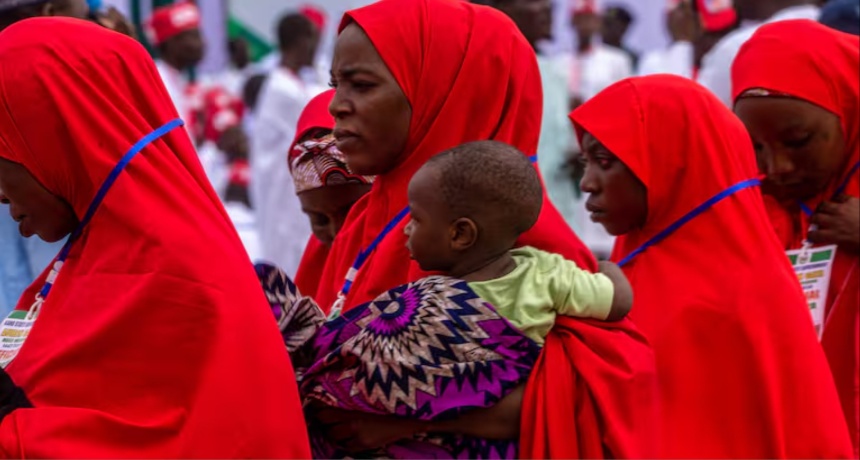
For Haruna Bashir, this past weekend wasn’t just another wedding. Months earlier, he lost his wife and six children in a brutal attack. On Saturday, in a hall packed with drumming, ululating relatives and hundreds of other couples dressed in matching fabric, he got married again, this time with the Kano State Government footing the bill.
Bashir was one of 1,500 couples who tied the knot on Friday and Saturday under Kano’s state-sponsored mass wedding programme, an initiative that has quietly become one of Governor Abba Kabir Yusuf’s signature social welfare projects. The ceremony, organised by the Kano State Hisbah Board, brought together widows, widowers, divorcees, and low-income singles from all 44 local government areas of the state.
It’s the kind of story that sounds almost too tidy for 2026 Nigeria, a government picking up the tab for weddings while food prices climb and naira purchasing power keeps shrinking. But it’s real, it’s happened twice now under Yusuf’s administration, and it’s sparked as much conversation about scammers cashing in on the programme’s popularity as it has about the weddings themselves.
What Kano’s Mass Wedding Programme Actually Covers
According to Governor Yusuf, the state committed roughly ₦1.5 billion to this edition of the initiative, known locally as “Auren Gata”, loosely, “marriage for the privileged.” That figure isn’t just for the ceremony itself. Each couple reportedly walked away with:
- A dowry payment of ₦100,000
- An additional ₦100,000 start-up capital grant, meant to help newlyweds launch a small business
- Furniture and household items, including beds and kitchenware
- Free medical screening for both bride and groom before the wedding
- In some cases, wedding attire and transport for the furniture itself
Some reports peg the total support package per couple at closer to ₦1 million once everything is added up, including a few pilgrimage sponsorships and, for at least one couple, a house.
Yusuf described the household-support package during a reception held afterwards to distribute furniture and supplies to the newlyweds, framing it as part of a wider effort to ease the financial weight that marriage traditionally carries in northern Nigeria, where dowries and household furnishing obligations can run well beyond what many young people or widows can afford.
Why Kano Keeps Doing This
Mass weddings aren’t new in Kano. The tradition traces back more than a decade, to the era of former Governor Rabiu Musa Kwankwaso, and the Hisbah Board says it has facilitated over 4,000 marriages through similar programmes since 2012. Officials have consistently framed the exercise as a response to a specific set of social problems: a rising divorce rate, growing numbers of children born outside marriage, and widows or divorcees left financially stranded and socially isolated in a state where remarriage can carry high costs.
Kano’s population sits above 15 million, and poverty rates in the state remain high. Bride price expectations, coupled with the requirement that a groom’s family provide a fully furnished home, have historically pushed marriage out of reach for a lot of ordinary people, which is the gap this programme is designed to close.
This is the second mass wedding organised specifically under Yusuf’s administration, following an earlier edition. The governor called it a “bold social intervention aimed at restoring hope and supporting dignified family life in Kano.”
Kano’s Chief Imam, Professor Sani Zahraddeen, led prayers for the newlyweds during the ceremony, and Hisbah Commander-General Sheikh Dr Aminu Ibrahim Daurawa said the programme has “gained recognition within and outside Nigeria”, though he was also careful to remind couples that the state’s support comes with expectations, urging them toward patience, fairness, and stable homes.
One widow, Malama Ainau Mudi, 38, told reporters the day would stay with her for the rest of her life. Groom Abubakar Aliyu Musa put it more plainly, telling the Associated Press that many men in his position simply weren’t financially stable enough to marry without help.
Christians Are Eligible Too — Not Just Muslims
One detail that’s caused some confusion online: despite being run by the Hisbah Board, which enforces Sharia law in Kano, the programme is open to non-Muslims as well. Deputy Commander Mujahideen Aminuddeen confirmed that Christian couples have taken part before; three did in the October 2023 edition, and that eligibility isn’t tied to religion, even though the initiative is rooted in Islamic values around family and marriage.
How to Identify Genuine Beneficiaries — And Avoid the Scammers
Here’s the part that matters most for anyone actually trying to get involved: the programme has attracted fraudsters posing as officials, and the Hisbah Board has had to issue repeated public warnings because of it.
In the weeks leading up to registration, reports surfaced of individuals demanding payment from prospective applicants under the pretense of “facilitating” their registration. The Hisbah Board’s response was blunt. Deputy Commander-General Dr Mujahideen Aminuddeen told the public flatly: “The governor has paid for everything. Nobody should pay for anything because the entire programme is completely free.”
If you’re trying to figure out whether an offer related to the Kano mass wedding programme is legitimate, keep these points in mind:
1. Registration is free, full stop: No Hisbah official, no government representative, and no third party has ever been authorised to collect money for registration, placement, or “guaranteed” inclusion in the programme.
2. Genuine beneficiaries go through the Hisbah Board directly: Applications and vetting are handled through official Hisbah Board channels in Kano, not through individuals contacting people on social media or via phone claiming to have “connections.”
3. The programme specifically targets widows, widowers, divorcees, and low-income singles: It isn’t a general giveaway open to anyone with cash to spare on a middleman; it’s aimed at people who genuinely can’t afford marriage costs on their own.
4. Anyone demanding money should be reported. The Hisbah Board has urged victims and members of the public to report extortion attempts directly to the board or to security agencies for investigation.
5. Be skeptical of anything promising a “shortcut:” Scammers tend to prey on urgency and hope, promising to bump someone up a waiting list or secure a guaranteed slot for a fee. Genuine officials don’t operate that way, and the board has said so explicitly, more than once.
The scam warnings aren’t a one-off. Multiple outlets reported the same alert from Hisbah in the weeks before this year’s ceremony, which suggests fraudsters were actively working the programme’s popularity for profit right up until the wedding itself took place.
The Bigger Picture
Whatever one makes of the optics, a state government spending over a billion naira on weddings while inflation squeezes households across Nigeria- it’s hard to separate the programme from the very real economic pressure it’s responding to. For couples like Bashir and his new bride, Rahinatu Jamilu-Yunusa, the ceremony wasn’t really about spectacle. It was, as Daurawa put it, a chance to gradually return to normal life after tragedy.
Whether Kano expands the initiative further, and whether other states follow with similar schemes of their own, is worth watching. For now, if you or someone you know is trying to figure out whether they qualify, the safest move is simple: go through the Hisbah Board directly, and never pay anyone claiming to speed up the process.