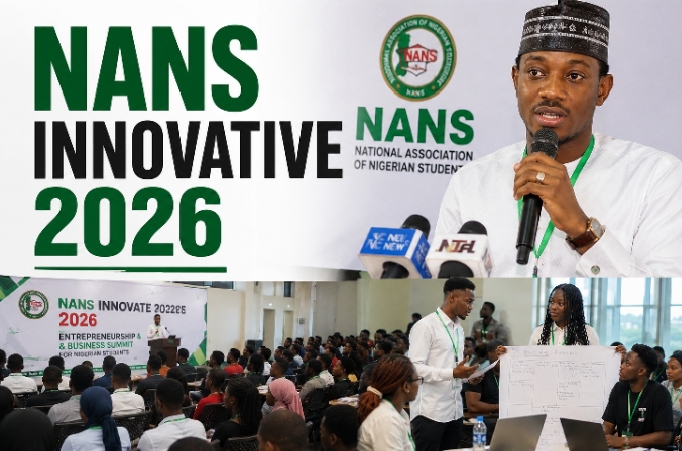
A fresh opportunity is opening a potentially important door for Nigerian students who are trying to turn an idea, a small venture, or an existing business into something bigger while still in school, with NANSInnovate 2026 placing student entrepreneurship at the centre of a national competition that could take promising ideas far beyond the campus where they started.
The programme has arrived at a time when many students are already selling products, offering services, trading goods, farming, creating digital businesses, or quietly working on ideas that could become sustainable ventures, yet the difficult question has always been where to find the resources, guidance, exposure and connections needed to move from simply having a business to building one that can compete on a larger stage.
That is where the details surrounding NANSInnovate 2026 become particularly interesting, because the opportunity is not presented as a simple application where every student who submits a form receives money, but as a structured entrepreneurship competition involving applications, screening, mentorship, networking, a Top 20 selection, a national pitch and business funding, with several important requirements applicants need to understand before submitting their entries.
The official portal is currently showing that entries are open, while the application process itself reveals just how seriously applicants are expected to present their businesses or ideas, from the student identification document to the business proposal, the tightly limited pitch and the information required about the venture, meaning preparation could matter considerably for anyone hoping to progress beyond the first stage.
NANSInnovate 2026 takes shape
NANSInnovate 2026 is being presented as a national entrepreneurship and business summit organised by NANS Headquarters for Nigerian tertiary students who are building businesses while studying or developing viable business ideas that they want to take further, with the programme designed to create a platform where students can learn, network, receive mentorship and compete for business funding.
The initiative is associated with NANS President Akinteye Afeez, popularly known as BABTEE, who announced the opening of applications on August 10, 2026, encouraging Nigerian students with existing ventures or promising business ideas to take advantage of the opportunity, while the official NANSInnovate portal identifies the programme as an entrepreneurship platform created under NANS Headquarters.
The central idea is straightforward, but the structure gives the opportunity greater depth than a basic funding application, because students are expected to pass through a competitive process before reaching the stage where funding and national exposure become possible, making the application itself the first step in a much longer journey.
August 13, 2026 status
As of August 13, 2026, the official NANSInnovate portal is displaying “Entries Open”, meaning students who meet the stated requirements can currently begin the application process through the dedicated platform.
The official application route is hosted on the NANSInnovate portal at grants.nanshq.org, while the application form is available through the apply section of the same website, giving students a direct route instead of relying on registration forms shared through unofficial social media accounts or private messages.
The distinction matters because opportunities involving large financial prizes can quickly attract people who claim to have special access to organisers or promise to secure spaces for applicants, yet the official NANSInnovate portal clearly states that entry is free and warns applicants not to pay anyone for participation.
Students should therefore treat the official portal as the starting point, particularly when filling in personal information, uploading documents and keeping the registration code generated after submission.
Who can apply
Eligibility is centred on Nigerian tertiary students, with the programme open to Nigerian citizens currently enrolled in recognised tertiary institutions, including universities, polytechnics and colleges of education across Nigeria’s 36 states and the Federal Capital Territory.
The opportunity is also significant because applicants are not required to already have a fully established company before they can participate, with the official application form allowing students to identify their business status as either “New, just an idea” or “Existing, already running”.
That distinction opens the door to 2 broad groups of students, those who are already operating businesses while studying and those who have developed serious business ideas but have not yet taken them fully into operation.
The second group should not interpret that eligibility as an indication that every idea will receive funding, because NANSInnovate remains a competition where applicants must first pass the selection process and ultimately compete for a place among the Top 20 finalists.
Business categories
NANSInnovate 2026 currently identifies 4 major business categories, covering Production or Manufacturing, Trading or Merchandise, Services and Agriculture.
Production or Manufacturing covers ventures involved in creating or producing physical products, while Trading or Merchandise covers businesses involved in buying, selling and distributing goods to customers.
Services covers businesses that provide services to individuals, organisations or other customers, while Agriculture covers agricultural and agribusiness ventures.
The categories make clear that NANSInnovate is not restricted to technology startups, meaning a student running a fashion business, food venture, agricultural operation, trading business, digital service or another viable service based enterprise can potentially fit within the programme’s stated structure.
Student identification requirement
The application process requires applicants to provide a valid student identification document, with the portal accepting the document in JPG, PNG or PDF format.
There is also a 2MB maximum file size for the student ID, which means applicants should check the size and readability of the document before attempting to upload it.
A blurry photograph, incomplete document or oversized file could create unnecessary problems during submission, so applicants should prepare a clear copy before beginning the form rather than waiting until the final stage to search for the required document.
The requirement also reinforces the student focused nature of the programme, since applicants are expected to demonstrate that they are genuinely enrolled in a recognised tertiary institution.
The business proposal requirement
One of the most important requirements is the business proposal, which the official application portal identifies as mandatory for applicants.
The proposal must be submitted in Microsoft Word format using the .docx extension, with a maximum length of 10 pages and a maximum file size of 5MB.
The portal also specifies Times New Roman, font size 12 and single line spacing, meaning applicants should not simply upload an old business document without checking whether it matches the stated submission requirements.
The proposal is particularly important because it gives applicants room to explain the business beyond the short pitch required elsewhere in the form, allowing the organisers to understand what the venture does, the problem it addresses, how it operates and why it deserves consideration.
The 100 word pitch
Another part of the application asks applicants to provide a pitch of no more than 100 words, making this one of the most tightly constrained sections of the entire process.
The pitch asks applicants to explain what the business is, why it matters and what they intend to do with the funding.
That means applicants have very limited space to communicate the core of their idea, so a long introduction about personal struggles or general ambitions would leave less room for the information that actually explains the business opportunity.
A strong 100 word pitch needs to make the business understandable quickly, showing the problem, the proposed solution, the people being served and the practical use of the funding without becoming a collection of empty promises.
Information applicants must provide
The application form requests personal information including the applicant’s full name, WhatsApp number, sex and email address, while the school section requests details such as institution, level, matriculation number and course.
The business section goes further by asking for the business name, line of business, business status, state of origin, years of operation, business location and staff count.
Applicants are also specifically asked to provide an active WhatsApp number because the organisers indicate that this channel will be used to reach participants.
Accuracy is therefore important throughout the form, particularly because the information supplied should correspond with the applicant’s real student status and business situation rather than being exaggerated to make the venture appear more established than it is.
Existing businesses can participate
Students already operating businesses have an opportunity to present ventures that have moved beyond the idea stage, and the application form gives applicants room to identify the business as an existing operation.
That distinction can be useful because an operating business may have evidence of actual activity, including customers, sales, products, services, staff, locations or other forms of traction that can help explain how the venture works.
Applicants should therefore use the proposal to demonstrate what has already been achieved instead of simply stating that they need money to expand.
A business proposal becomes more convincing when it connects the funding request to a specific business need, such as equipment, production capacity, inventory, distribution, marketing, technology, staffing or another clearly explained requirement.
New business ideas remain eligible
Students without an operating business are not automatically excluded, because the official form specifically recognises “New, just an idea” as a business status.
That gives students an opportunity to present ideas that are still being developed, provided those ideas are viable enough to withstand the competition’s screening and pitching process.
A new idea should therefore go beyond a general statement such as wanting to start a business, with the applicant explaining the customer problem, the proposed solution, the target market, the expected business model and how funding would help move the idea toward implementation.
The absence of years of operation does not necessarily prevent an applicant from presenting a strong case, but the proposal needs to show that the idea has been considered carefully and can become a practical venture.
CAC or SMEDAN certificate
Business registration evidence is another area where applicants should understand the difference between required and optional documents.
The NANSInnovate portal identifies CAC or SMEDAN certification as optional, meaning applicants who already have registration documents can provide them as evidence of their business status, while students without those certificates are not automatically prevented from applying.
That distinction is especially relevant for student entrepreneurs who operate small informal businesses while completing their education, because the programme does not make CAC or SMEDAN documentation a compulsory entry condition.
Applicants who have the documents should nevertheless ensure that the information corresponds with the business details supplied on the form.
The competition structure
The overall process can be understood as a sequence beginning with application, followed by review, selection of the Top 20, national pitching and the awarding of business funding or prizes.
That structure changes the way students should view the application, because submitting a form is not the same thing as receiving a grant.
The official programme is designed to identify promising student entrepreneurs and move the strongest entries toward a national stage where they can present their businesses or ideas.
The competition therefore creates a distinction between eligibility and selection, with eligibility allowing a student to enter while selection determines which applicants progress to the Top 20.
The Top 20 stage
The Top 20 finalists represent the group that reaches the national pitch stage, where their business ideas or existing ventures are expected to receive a much larger platform.
The programme describes the wider experience as combining learning, networking, mentorship, pitching and business funding, meaning the Top 20 stage is not simply another administrative step after submitting the form.
Reaching the finalists stage could place a student’s venture before investors, industry leaders, business experts and other entrepreneurs, creating an opportunity to explain the business to people outside the student’s immediate campus environment.
The national pitch is therefore one of the central moments of NANSInnovate 2026, because it turns the application from a written submission into an opportunity for public business presentation.
Millions of naira in prizes
NANS and fresh reports surrounding the August 2026 application opening describe the competition as involving cash prizes worth millions of naira for the strongest participants.
The important point is that the official NANSInnovate portal currently does not provide a detailed prize table showing an exact amount for 1st place, 2nd place or 3rd place.
That means applicants should be cautious with highly specific figures circulating online, particularly claims that a confirmed ₦100 million grand prize is already guaranteed.
The defensible position from the information currently available is that the Top 20 finalists will compete for cash prizes worth millions of naira, while a detailed official breakdown should be treated as unconfirmed until NANS publishes it through an official channel.
Why the funding claim matters
The difference between “millions of naira in prizes” and a specific confirmed prize figure is important because opportunity stories can quickly become distorted when an attractive headline gets repeated across social media.
NANSInnovate is clearly positioned around business funding, but the programme is not presented as an arrangement where every applicant receives money after submitting an application.
Applicants are competing for the opportunity to progress through the programme, reach the national pitch and compete for the available prizes.
Anyone preparing an application should therefore approach the process as a competition rather than assuming that completing the form creates an automatic entitlement to funding.
Free application
One of the clearest aspects of NANSInnovate 2026 is the cost of entry, with the official portal stating that entry is 100% free.
The programme also warns applicants never to pay anyone, while the FAQ states that NANS does not charge applicants for entry at any stage.
That means the application fee is ₦0.
Students should be particularly careful if someone contacts them through WhatsApp, Telegram, Facebook or another platform demanding payment for registration, guaranteed selection, special access or a place among the finalists.
The official warning is straightforward, and students should use it as a guide when dealing with anyone claiming to represent the programme.
Registration code after submission
Applicants who successfully submit the form receive a unique registration code that can be used to track the application.
The official portal provides an example format such as NANS Inv 2026 K7T, and applicants are instructed to save or screenshot their code after submission.
Keeping the code is important because losing it could make it more difficult to follow the application status later.
A dedicated status checking page is also available on the NANSInnovate platform, giving applicants a way to follow the progress of their submission rather than depending entirely on messages from third parties.
The application cannot be edited
Applicants should slow down before pressing the final submission button because the application page warns that the form cannot be edited after submission.
That means names, school information, business details, contact information, uploaded documents and other answers should be checked carefully before the application is finally sent.
The same applies to the 100 word pitch, where a small spelling mistake or missing information can become particularly noticeable because applicants have such limited space to explain their business.
Preparing the documents first and reviewing the completed form before submission is therefore a practical step that can prevent avoidable errors.
Mentorship opportunity
NANSInnovate is not built around cash prizes alone, with one on one mentorship listed among the programme’s features.
The organisers describe the initiative as an environment where student entrepreneurs can connect with people who have built businesses and gain access to knowledge that may help them develop their ventures.
For a student entrepreneur, that kind of exposure can be particularly useful because running a small business while studying often means making decisions without access to experienced business advisers.
The programme’s mentorship element therefore adds another layer to the opportunity, particularly for finalists who progress far enough to interact directly with mentors and business professionals.
Investor exposure
The programme also highlights interaction with investors, industry leaders and business experts, creating a route for student entrepreneurs to place their ideas before people who may have knowledge, networks or resources relevant to business growth.
That does not mean every finalist will automatically receive investment from an investor, and applicants should not interpret investor exposure as a guaranteed investment offer.
The important point is that NANSInnovate intends to create a national platform where student entrepreneurs can present their ventures beyond their immediate school communities.
For an ambitious student, that exposure can be valuable even before the question of prize money is considered.
The deadline question
The closing date requires careful attention because August 21, 2026 has appeared in social media discussions surrounding the opportunity, but the official NANSInnovate portal currently available for verification does not clearly display that date as a confirmed deadline.
For that reason, applicants should not treat August 21 as an officially confirmed closing date unless NANS subsequently publishes it on the official portal or through an official announcement.
The safest approach is to apply as soon as the application is ready rather than waiting for a deadline that may change or become clearer later.
Students should also monitor the official portal for any update concerning the closing of entries, selection stages, pitch dates or other programme instructions.
How to prepare the application
Preparation should begin with the documents because the student ID and business proposal are central requirements of the application.
The proposal should clearly explain the business, the problem being addressed, the target customers, the solution being offered, the business model, the current position of the venture and the reason funding is required.
Existing businesses can use actual evidence of activity where appropriate, while students with new ideas should focus on demonstrating that the concept has been thought through carefully and can realistically become a business.
The 100 word pitch should then condense the most important parts of the proposal into a clear explanation of what the business does, why it matters and how funding would be used.
What a strong application should communicate
A serious application should make it easy for a reviewer to understand the connection between the business problem and the proposed solution.
The applicant should be able to explain who needs the product or service, why those customers would choose it, how the business makes or intends to make money and what specific change the funding would create.
Existing ventures can describe their current operations and growth needs, while new ventures can demonstrate market understanding, customer demand and a realistic route toward launching.
The strongest presentation is unlikely to be the one containing the most complicated language, but the one that communicates the business clearly and directly while showing that the applicant understands what they are trying to build.
The opportunity for student entrepreneurs
Student entrepreneurship can often begin quietly, with a student selling products from a hostel, providing services through social media, supplying goods to classmates, running an agricultural project, building a digital service or testing a business idea between lectures.
NANSInnovate 2026 is designed to bring those kinds of ventures into a national entrepreneurship platform, giving eligible students a structured route to present what they are building.
The programme’s combination of free entry, mentorship, networking, investor exposure, national pitching and business funding makes it broader than a simple online application for financial assistance.
For students who already have a functioning venture or a serious business concept, the application provides an opportunity to put that work into a formal competitive setting.
What applicants should remember
The first fact to remember is that NANSInnovate 2026 is currently open as of August 13, 2026, and the application is available through the official NANSInnovate portal.
The second is that eligibility does not equal automatic funding, because applicants must pass through a competitive selection process before the Top 20 national pitch stage.
The third is that entry is free, with the official portal warning applicants not to pay anyone for participation.
The fourth is that the programme currently confirms cash prizes worth millions of naira but does not provide an official detailed prize breakdown confirming the widely circulated ₦100 million figure.
The fifth is that the application requires preparation, particularly the student ID, business proposal and 100 word pitch, while applicants should save the registration code immediately after submission.
Final word
NANSInnovate 2026 presents Nigerian tertiary students with a chance to place their businesses and serious business ideas on a national platform, with the programme combining a free application process with mentorship, networking, investor exposure, a Top 20 national pitch and the opportunity to compete for cash prizes worth millions of naira.
The opportunity is open as of August 13, 2026, but the details matter, particularly the fact that applicants are entering a competition rather than receiving automatic funding, while the official portal currently allows both existing businesses and new ideas to participate.
Students considering the opportunity should prepare their student ID, business proposal and 100 word pitch carefully, check every detail before submitting and save the registration code immediately after submission.
Most importantly, applicants should use the official NANSInnovate portal, avoid anyone demanding payment and distinguish verified programme information from figures circulating across social media, especially where specific prize amounts or closing dates have not yet been officially confirmed.
For eligible students with a business already running or an idea ready to be developed, the next step is straightforward, prepare the application properly, submit through the official platform and keep the registration details safe for the stages that follow.