Arsenal’s return to the summit of English football marked the culmination of a lengthy rebuilding project centred on identity, culture, leadership and a renewed connection between the club and its supporters.
The Premier League triumph ended a 22-year wait for the title and represented the outcome of several years of restructuring under manager Mikel Arteta and the club’s hierarchy.
An extensive account published by Arsenal detailed how Arteta, co-chair Josh Kroenke, sporting director Andrea Berta, the players and supporters contributed to the transformation that eventually delivered the championship.
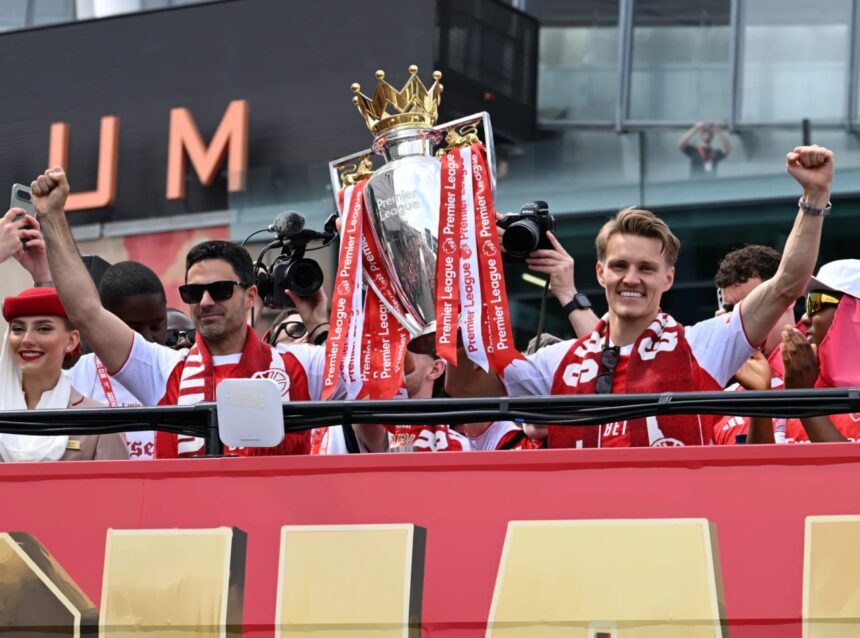
For Arteta, seeing captain Martin Ødegaard lift the trophy was a moment that surpassed the expectations he had carried throughout his time at the club.
Reflecting on the occasion, Arteta said, “It was much better.
“I was just looking at the players’ faces, how much it means to them, and to see them gathering together and lifting it. It was incredible.”
The achievement triggered celebrations on an extraordinary scale, with about one million supporters gathering in Islington for the club’s title parade.
The celebrations also extended beyond London, with Arsenal supporters in countries including Uganda, Kenya, India, China, Australia, Ethiopia and Nigeria joining in the celebrations.
Arsenal described the response as extending beyond football, with scenes including supporters climbing trees in London and a bishop in Lagos leading churchgoers in songs celebrating the club’s success.
Crystal Palace forward Eberechi Eze, who joined Arsenal during the title-winning campaign, said the achievement represented more than the success of a group of footballers.
“There are no words to describe this thing properly, what we’re feeling, what we’re going through, what this moment means,” Eze said.
“This isn’t just about winning the title as a group of players. This is about something that represents an area, represents values, represents people’s dreams… Arsenal is the culture club.”
Arteta’s appointment in 2019 was central to the club’s attempt to restore an identity that had become a major focus of discussions during his recruitment.
Kroenke recalled that his early conversations with Arteta concentrated heavily on culture and the need to reshape the club beyond matters on the pitch.
“When the time came to hire Mikel, the entire conversation we had with him was about culture and reinventing that,” Kroenke said.
“You could see him lock in. He had done his homework… and he understood there was a big task ahead of him.”
The approach influenced Arsenal’s recruitment strategy, with Berta saying the club wanted to strengthen not only the squad’s footballing ability but also its character.
“During the summer transfer window, a focus we both had, Mikel and I, was to improve the team technically. But first we wanted to improve it humanly, because for us, the group, its integrity and its maturity was the most important aspect.”
Captain Martin Ødegaard said the environment created within the squad encouraged players to support one another and maintain a collective commitment.
“We really care for each other. We really help each other. We fight for each other. We give everything, every single day, for each other,” Ødegaard said.
Arsenal’s campaign was also built around defensive strength, squad depth and important contributions from players including goalkeeper David Raya, defenders William Saliba and Gabriel Magalhães, and midfielder Declan Rice.
The team’s ability to maintain belief during difficult periods became another important feature of the title campaign, particularly as pressure increased following setbacks.
Arteta urged supporters to remain committed to the project during challenging moments, telling them, “Jump in this boat. It is going to be fun. A lot of incredible things are going to emerge.”
The decisive phase came in the closing weeks of the season, when Arsenal remained in contention despite setbacks before Manchester City’s defeat to Bournemouth helped open the way for the title to be secured.
Rice’s declaration after Arsenal’s defeat to City, “It’s not done,” became a rallying point for the team during the final stages of the campaign.
Berta said the club’s belief in its ability to win the championship had remained intact throughout the season.
“We never lacked the conviction that this was and would be our season,” Berta said.
Arsenal’s account ultimately presents the championship as the result of a sustained process involving the club’s ownership, management, players and supporters rather than the product of a single successful campaign.
The title was secured after years of rebuilding aimed at strengthening relationships within the club, reconnecting with its history and creating a culture in which different parts of the Arsenal community could identify with the same ambition.
The club summarised the achievement as a collective effort, stating, “They won by unity, with everyone playing their part to the best of their ability.”