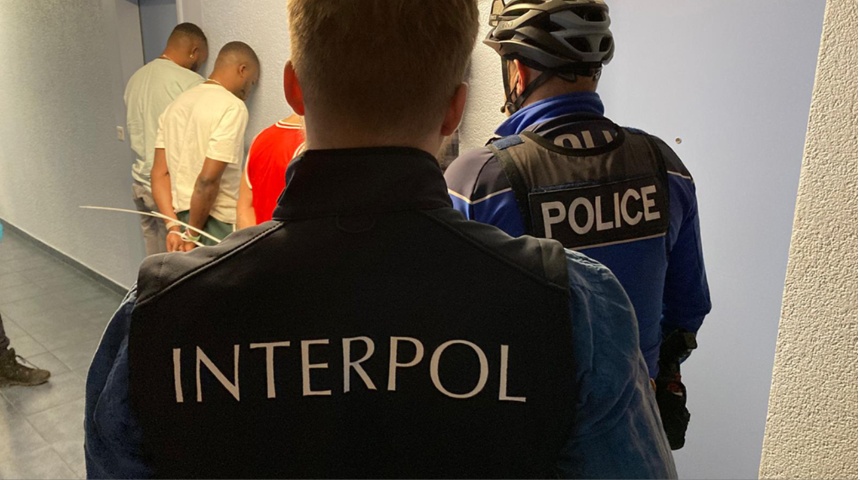
For eight months, as the rest of the world carried on with its normal activities, police forces on six continents have been quietly preparing a file which in the end will cover 22 countries. The outcome, which has now been announced, is Operation Jackal IV: INTERPOL’s most recent and biggest joint operation aimed at West African organised crime networks, the leading one being the Nigerian-based syndicate called Black Axe.
When the operation ended in June 2026, the investigators had secured 58 arrests, marked 263 suspects for further investigation, frozen hundreds of bank accounts, and uncovered a criminal economy which INTERPOL states now produces billions of dollars each year. For Nigeria, a country long linked with the origins of Black Axe even though the group has spread out to become a real global organisation, the operation is at the same time a blow to its reputation and a trial of the extent of its own law enforcement cooperation.
What Operation Jackal IV Actually Was
Operation Jackal IV took place from November 2025 to June 2026 and was organised by INTERPOL’s Financial Crime and Anti-Corruption Centre. It consisted not of a single raid or a one-night operation but of a continuous, month-long activity based on the sharing of intelligence and involving agencies from Austria, Argentina, Australia, Canada, Côte d’Ivoire, France, Germany, Indonesia, Ireland, Italy, Japan, Malaysia, the Netherlands, Nigeria, Portugal, South Africa, Spain, Sweden, Switzerland, the United Arab Emirates, the United Kingdom and the United States.
The mandate was wide in scope yet specific in aim: it involved tracing illicit financial flows, identifying high-value targets, seizing the criminal assets and providing the prosecutors with the evidence they needed so that they could actually secure charges. Throughout, INTERPOL’s role was not mainly about breaking down doors but rather about connecting the dots, passing on financial intelligence to the national police forces, organising specialised training in the area of money-laundering investigations, and combining cases which no one country on its own could have solved.
Tomonobu Kaya, the director of INTERPOL’s Financial Crime and Anti-Corruption Centre, explained the reasoning behind the operation in simple terms: “Operation Jackal IV shows what can be achieved through international cooperation”. The idea is very clear in that organised fraud networks are able to move money across borders more quickly than any one police force could keep up with, and therefore the only way to disrupt them is to follow the money as it moves across those same borders, in collaboration.
Why Black Axe Keeps Coming Up
Black Axe is not a typical street gang. Instead, INTERPOL refers to it as a highly organised and hierarchical organisation which earns billions of dollars each year not by carrying out one or two major robberies, but through thousands of smaller operations carried out in dozens of countries, including romance scams, fraud involving cryptocurrency and investments, schemes known as business email compromise, and money laundering arranged for others. A Europol statement mentioned earlier this year states that the group’s leadership consists of Nigerians, a fact which continues to link the organisation with its country of origin even though its presence has expanded to Europe, North America, Asia, the Gulf and other regions.
INTERPOL has not been dealing with the group for the first time. Operation Jackal III, which took place from April to July 2024, covered 21 countries and resulted in about 300 arrests, more than 700 bank accounts being frozen, and the seizure of approximately $3 million in assets. Although Operation Jackal IV had fewer arrests in absolute terms, it may have been more extensively reaching, since it identified 263 suspects, nearly four times as many as the number who were actually taken into custody, indicating that the financial trail being pursued by the investigators now extends well beyond those currently in prison.
Where the Arrests Happened
South Africa obtained the largest amount in the entire operation. In Johannesburg, the police carried out raids on seven sites which were associated with a syndicate carrying out romance and investment scams mainly directed at retirees in English-speaking countries. The investigators stated that the organisation had developed an internal structure almost like that of a company, with individuals given specific roles as “conversion” agents, whose job it was to attract the victims, and “retention” agents, who were responsible for making sure they continued to pay. The single raid resulted in 39 arrests and, according to authorities, nearly $2.67 million was seized, together with 257 bank accounts being blocked.
Although Argentina’s contribution appeared to be different, it was probably just as important. There, investigators found 196 individuals who were linked to a Crime-as-a-Service operation accused of providing website domains and money-laundering facilities to criminal organisations in West Africa, in other words functioning as a back-office supplier for fraud networks based elsewhere. This investigation resulted in 17 arrests and highlighted a trend which INTERPOL had pointed out on several occasions during the operation: criminal groups were increasingly outsourcing specialised tasks, usually via the dark web, rather than carrying out all the aspects of a scam themselves.
In Romania the authorities shut down a scam operated through a call centre which promised victims abnormally high returns on stocks and cryptocurrency; according to INTERPOL this scheme made use of many of the same psychological tactics linked to fraud rings associated with Black Axe elsewhere.
A Troubling New Pattern: Sextortion of Minors
Besides the number of arrests, INTERPOL states that Operation Jackal IV has revealed a genuinely alarming change in criminal methods. It has been reported that organised crime groups from West Africa are increasingly using sextortion against minors, some of whom are as young as 14. According to INTERPOL, the pattern is terribly consistent in that the offenders make contact with children on social media, take some time to build up a trust relationship with them, and then persuade the children to send explicit images or videos. After possessing this material, the threat changes to a financial one: you have to pay up, or it will be sent to your family and friends.
This is a marked difference from the romance scam and business email compromise fraud which Black Axe and similar groups have usually been associated with, and it indicates that these organisations are expanding their range of criminal activities into areas that are more difficult to detect and, simply put, cause much greater harm to victims who are children.
Where Nigeria Fits Into the Picture
The fact that Nigeria is on the list of the 22 countries taking part is important, not merely in a symbolic sense. Black Axe’s leadership has on numerous occasions been linked to nationals of Nigeria, and Nigerian law enforcement authorities, via bodies such as the Economic and Financial Crimes Commission, have in recent times co-operated closely with INTERPOL and with partner agencies like the FBI in cases concerning fraud suspects associated with Nigeria. This kind of cooperation has already yielded results, for example in the arrest of Nigerian nationals who were wanted overseas for multimillion-dollar wire fraud and money-laundering schemes.
Nigeria’s situation is complex since it is at the same time one of the sources of the fraud networks that are under investigation, suffers reputational harm each time “Nigerian cybercrime” appears in the international press, and is in fact a real partner in the work to dismantle those same networks. Although Operation Jackal IV does not resolve that contradiction, it does demonstrate Nigerian authorities attending the table as a participating jurisdiction rather than simply as a subject of foreign investigations, a difference which is important for the way the country’s cooperation is seen around the world.
INTERPOL has been careful to regard the 58 arrests and the 263 identified suspects as preliminary figures. A large number of the cases arising from Jackal IV are still being actively investigated, and the authorities expect the totals to increase as the financial data and communication records that have been seized are completely analysed. This is usually the way such operations proceed, with the initial figures relating to arrests being published first, followed later, sometimes even years later, by the more meticulous work of building cases that can be used in prosecution against the wider network of suspects.
At the moment, Operation Jackal IV remains the fourth major coordinated attack on Black Axe and its associated networks, and this underlines a trend that has become more and more evident: dismantling organisations of this kind demands a kind of continuous, cross-border financial investigation which no single country’s police force is capable of carrying out on its own. It will probably be up to the extent to which the financial trail resulting from this operation the investigators are still able to trace whether Operation Jackal V takes place, and to how many of the 263 suspected individuals eventually end up in court rather than merely being included in a case file.