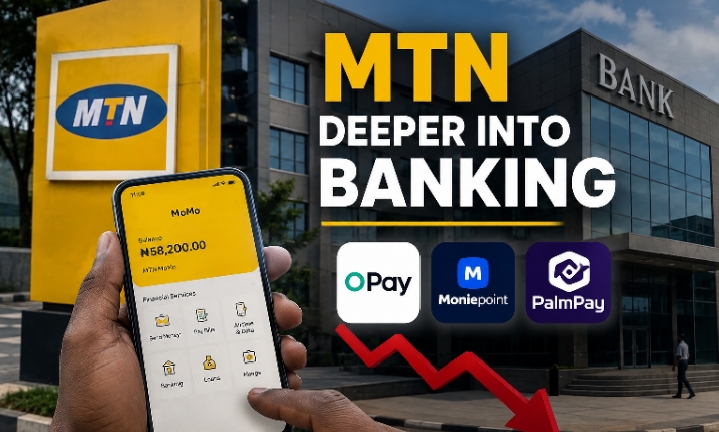
The Nigerian financial technology market has spent years watching telecom companies move closer to the money sitting inside customers’ phones. MTN’s latest move gives the story a much bigger dimension because the company is now looking beyond payments toward lending and potentially banking licences across selected African markets.
This direction could place one of Africa’s biggest telecommunications groups directly inside a market already crowded with powerful fintech brands, established banks and payment companies that have spent years building customer habits, merchant relationships and financial ecosystems. The next stage is likely to be less about who can move money fastest and more about who can control what happens before, during and after that transaction.
The August 25 Development
On August 25, 2026, MTN Group CEO Ralph Mupita revealed that the company is considering obtaining banking licences in selected African markets as part of a broader push into lending. The statement immediately raises the stakes around MTN’s financial services ambitions because the company would be moving closer to becoming a direct financial institution rather than remaining largely dependent on banking partners for parts of its lending strategy. Although the plan is expected to develop gradually, the direction is clear enough to attract attention because MTN already has something many financial technology companies spend enormous amounts of money trying to build. That is a huge customer distribution network spread across several African markets.
The important part of the announcement is not simply the possibility of another licence appearing beside MTN’s existing financial services operations. It is the possibility that MTN could eventually lend from its own balance sheet. This would give the company greater control over how credit is designed, distributed and managed. It could also potentially allow it to use information generated through its existing payments ecosystem to understand customers more closely. That creates an entirely different competitive question because once a telecommunications company can connect subscribers, wallets, merchants, payments and credit, the boundary between telecoms and financial services becomes increasingly difficult to separate.
The Bigger MTN Strategy
MTN’s emerging strategy can be understood as a sequence that begins with the mobile phone and gradually moves deeper into the customer’s financial life. It starts with telecommunications, moves into mobile money, then payments, merchant services, broader digital services and eventually lending and banking. Each stage gives the company another reason to keep customers within its ecosystem and another opportunity to earn revenue from activity that previously happened elsewhere.
That sequence matters because MTN does not have to convince millions of people to download a financial application before it can begin the conversation. The company already has a relationship with customers through its telecommunications business. Its MoMo platform gives it a financial doorway through which that relationship can become more valuable. The central challenge is therefore no longer simply distribution but conversion. Having access to a large customer base is one thing. Convincing those customers to actively save, transfer, receive payments, pay merchants and borrow through the same ecosystem is another matter entirely.
MoMo’s Bigger Ambition
MTN’s June 2026 partnership with Ant International adds another important piece to the picture because the agreement is expected to support the transformation of MoMo into a broader super app ecosystem. Plans involve mini apps, stronger fraud prevention, digital finance, commerce and lifestyle services. Nigeria is expected to be an important market for the rollout.
That development gives the banking conversation more context because MTN is not simply trying to create a better wallet where people send money and pay bills. The broader ambition is to make MoMo a gateway through which customers can access several services without constantly leaving the ecosystem. Once a wallet becomes connected to payments, commerce, merchant services and credit, the value of the customer rises because the company can participate in several parts of that customer’s financial activity rather than earning from a single transaction.
Why OPay Is Sitting Close to the Story
OPay has become one of the most recognisable fintech names in Nigeria because it has built a financial ecosystem around everyday transactions. Customers use the platform for transfers, bills, airtime, data, payments and other services. Its merchant and agent networks also extend its reach beyond smartphone users into physical commerce.
The CBN lists OPay Digital Services Limited among licensed mobile money operators. This places it firmly inside the regulated financial technology structure. Industry estimates cited in 2026 have put OPay’s user base above 60 million and its valuation around $2.75 billion. These figures illustrate the scale of the business even though user numbers and valuation estimates can vary depending on the source and measurement used.
MTN therefore would not be entering a market waiting for customers. OPay already has customers who understand what its platform is for. That gives the fintech a valuable advantage because financial behaviour becomes stronger when people develop habits around a platform. Customers who regularly use OPay for transfers, bills and payments may have less reason to change simply because another company has entered the same space.
MTN’s Distribution Advantage
MTN’s strongest weapon is different because its relationship with customers starts somewhere else. It starts with telecommunications. That distinction could become important if the company succeeds in converting more of its massive subscriber base into active financial customers.
The potential sequence is straightforward. A customer uses an MTN SIM. The customer begins using MoMo. The customer sends and receives money through the wallet. The customer pays bills. The customer starts paying merchants. The customer keeps more financial activity within the ecosystem. Eventually, the customer receives an offer for credit. The power of that sequence lies in the fact that every new service can make the next service easier to introduce.
OPay has had to build a fintech distribution network. MTN already possesses telecommunications infrastructure, retail channels, agents, brand recognition and customer relationships across several markets. This gives the telecom company a distribution advantage that would be difficult for a pure fintech to reproduce from scratch.
OPay’s Strongest Defence
OPay’s biggest protection is the financial habit it has already created. Customers do not necessarily choose OPay because they need telecommunications services. They choose it because they have learned to use the platform for financial activity. That distinction could become valuable when MTN tries to turn telecom customers into financial customers.
The battle could therefore come down to habit as much as reach. A customer may have an MTN line while using OPay for financial transactions. MTN will have to give that customer a convincing reason to move more of those activities into MoMo. That could mean better convenience, stronger merchant acceptance, competitive credit products, attractive services and an ecosystem that feels useful enough to become part of everyday life.
Moniepoint’s Different Position
Moniepoint presents a different challenge because its strongest relationship is not necessarily with the ordinary consumer looking for a wallet. Its relationship is heavily connected to businesses and merchants that need financial tools to run their operations.
The company has built its platform around POS services, merchant payments, business accounts, agent banking, business banking, credit, payroll and other services that can become deeply connected to how a business operates. A 2026 industry analysis cited Moniepoint as processing approximately ₦412 trillion in 2025 while serving millions of businesses. That scale shows why its position matters when the conversation turns toward merchant payments and lending.
A business that depends on a financial platform for collections, payments, records, payroll and credit has a different reason to stay than a consumer who simply wants to transfer money. That makes Moniepoint’s relationship potentially harder to disrupt with basic wallet services alone.
Lending Changes the Equation
Payments can create enormous transaction volumes. Lending introduces another layer because a platform that sees financial activity may have the information needed to understand how money moves through a customer or business. This remains subject to applicable regulation, privacy rules and responsible credit practices.
A merchant receiving payments every day creates a financial trail that can reveal transaction frequency, cash flow patterns, business activity and repayment behaviour. That information can potentially help a lender determine whether credit should be offered and under what conditions. This is one reason lending has become such an important part of the competition between financial technology companies.
MTN’s plan to potentially lend from its own balance sheet becomes particularly interesting here because the company could eventually combine telecommunications relationships, MoMo activity, merchant transactions and financial behaviour into a broader customer picture. This creates the possibility of credit products being offered directly through an ecosystem that customers already use.
PalmPay’s Position
PalmPay is another major name that cannot be removed from this story because it occupies much of the same consumer financial territory as OPay. The CBN lists PalmPay among licensed mobile money operators. Industry estimates cited by Techpoint place its user base above 35 million with approximately 15 million daily transactions.
PalmPay also has an important distribution relationship through the wider Transsion smartphone ecosystem. This gives it a different type of advantage from both MTN and OPay. MTN has telecommunications distribution. PalmPay has benefited from smartphone distribution. OPay has built fintech and agent distribution. Moniepoint has developed a strong merchant and POS network.
Those advantages mean the Nigerian market is not simply a contest between companies offering the same product. Each major player has built a different route into the customer’s financial life. MTN’s challenge will be to use its own route to become as deeply embedded in financial behaviour as the fintech companies already are.
Flutterwave’s Expanding Territory
Flutterwave occupies another part of the financial technology landscape because its strength has historically been tied closely to business payments and payment infrastructure. Its expansion into financial services means the company increasingly belongs in the same wider conversation.
A 2026 industry report valued Flutterwave at around $3 billion and reported that the company secured a Nigerian microlender licence in April 2026. Its acquisition of Mono earlier in 2026 added another important financial data capability to its wider strategy.
That combination matters because the direction of travel across the sector is becoming increasingly clear. Payments are no longer being treated as the final destination. Companies are looking at what can be built around transaction data, merchant relationships, credit and financial services. MTN’s move therefore arrives at a time when several major fintechs are already expanding beyond their original business models.
Paystack’s Growing Reach
Paystack has traditionally been strongly associated with business payments and infrastructure, particularly for companies that need to accept payments online and manage digital transactions. Its expansion into consumer services creates another route through which it can participate in the changing financial landscape.
Techpoint reported that Paystack powers more than 200,000 businesses across Africa and launched the Zap consumer app in 2025. This creates a model that connects its established merchant infrastructure with consumer facing financial activity.
MTN’s strategy moves from the opposite direction. It begins with mass consumer distribution and moves toward merchants, commerce and financial services. Both models can eventually meet at the same customer because businesses need consumers to pay them while consumers need businesses to accept their payments.
Interswitch’s Infrastructure Position
Interswitch occupies a different part of the market because its importance is closely tied to payment infrastructure rather than simply consumer wallet competition. The CBN lists Interswitch among licensed switching and processing companies.
That makes a direct comparison with OPay or PalmPay less straightforward because the businesses operate at different levels of the payment system. MTN’s broader financial ambition still matters because a larger telecom led ecosystem could eventually influence how payments, merchant services and financial products are distributed across the market.
The more MTN expands across financial services, the more important the infrastructure layer becomes because the company would not merely be competing for individual wallet users. It would be participating in a financial ecosystem that touches consumers, merchants and businesses at multiple points.
Kuda’s Digital Banking Space
Kuda represents another part of the market because its identity is much closer to digital banking. It gives customers a digital first alternative to traditional banking relationships.
Industry data cited by Techpoint puts Kuda above 7 million users. Its proposition overlaps with areas that MTN could eventually target more aggressively, including digital accounts, payments, savings and credit.
The difference is that Kuda entered the market with banking at the centre of its identity. MTN is approaching the same territory from telecommunications and mobile money. This means the two companies can arrive at similar financial products through very different routes.
The Customer Becomes the Real Prize
The deepest part of this competition is not actually the wallet, the POS machine or even the banking licence. It is ownership of the customer’s financial journey.
Traditional banking was built around the account, the branch, the card and the bank application. Digital finance is increasingly being organised around the phone, wallet, payments, merchant activity, savings, credit and commerce. This creates an environment where the company that controls more stages of the journey can potentially generate more value from the same customer.
A customer who uses MTN for telecommunications, MoMo for payments, MoMo for bills, MoMo for merchant transactions and eventually MoMo for credit becomes much more valuable to MTN than a customer who simply buys airtime. That is why the super app strategy matters alongside the banking licence discussion.
Ant International’s Role
The June 2026 partnership between MTN Group Fintech and Ant International could become an important part of that ambition because technology capable of supporting mini apps, fraud prevention, digital finance, commerce and broader ecosystem integration can help MTN develop the kind of environment that keeps customers within one platform.
Nigeria is expected to be an initial market for the partnership. This makes the development particularly relevant to the local fintech landscape where customers already have several competing choices for transfers, payments, banking, merchant services and credit.
The significance is therefore bigger than the technology itself because the success of a financial super app depends on whether customers find enough useful services inside it to make returning to the platform a natural part of their daily routine.
Merchant Payments Become Critical
Merchant payments could become one of the most important battlegrounds if MTN follows its consumer strategy with a serious push into business services.
A consumer wallet can generate transactions. Merchant acceptance creates an ecosystem because every payment connects a customer with a business. Once a company serves both sides of that transaction, it can begin offering additional services to both groups.
That is where Moniepoint becomes particularly relevant because its business relationship with merchants is already a major part of its strength. OPay and PalmPay also have extensive agent and merchant networks. MTN would need to build more than a consumer wallet if it wants to compete seriously across the wider financial ecosystem.
The Regulatory Layer
Competition will not take place outside regulation because Nigeria’s payment ecosystem has faced increasingly detailed supervision from the CBN. This includes stronger monitoring of payment terminals, geographic identification of POS terminals and transaction monitoring requirements.
The CBN’s reforms have specifically referenced operators including Moniepoint, OPay and PalmPay. This shows that the environment in which these companies operate is becoming more closely supervised as digital financial activity grows.
That matters for MTN because scale alone does not guarantee success. The company would need to manage capital requirements, licensing conditions, fraud risks, consumer protection obligations, transaction monitoring and other regulatory expectations as its financial ambitions expand.
Why Banking Licences Matter
A banking licence would change the nature of MTN’s relationship with financial services because it could give the company greater authority to develop and operate products within a regulated banking structure rather than relying entirely on partnerships for every stage of its financial offering.
The August 25 statement does not mean MTN is immediately becoming a bank across Africa. The plan is expected to be gradual. The fact that banking licences are being considered shows that the company’s ambitions have moved beyond simply adding another feature to MoMo.
That distinction is important because a telecom company exploring direct banking capabilities is thinking about the financial ecosystem at a much deeper level. This is particularly true when the same strategy is being connected to lending, merchant services, digital finance and super app development.
Traditional Banks Enter the Picture
The story becomes even larger once traditional banks are included because MTN’s potential banking ambitions could eventually bring the telecom company closer to institutions such as Access Bank, GTCO, UBA, FirstBank and Zenith. The competitive relationship would depend heavily on the licences, products and markets MTN eventually chooses to pursue.
Banks possess advantages that fintech companies do not automatically have. These include established deposit relationships, banking licences, capital structures, extensive financial products and long standing customer relationships.
MTN brings a different set of strengths. These include telecommunications distribution, brand recognition, mobile infrastructure and the ability to place financial services directly alongside everyday communication services.
The Sequence To Watch
The first development to watch is where MTN eventually seeks banking licences because the choice of markets would reveal where the company believes its customer base and financial ecosystem are strong enough to support deeper banking operations.
The second is whether Nigeria becomes one of the early markets for direct balance sheet lending because Nigeria already represents a major fintech battleground. MoMo’s planned super app development gives the country strategic importance within MTN’s wider financial ambitions.
The third is the rollout of the Ant International powered MoMo ecosystem because technology is one thing while customer adoption is another. The real test will be whether customers actually begin using more services through MoMo.
The fourth is merchant expansion because consumer payments alone would leave MTN competing heavily with OPay and PalmPay. Merchant services would take the company deeper into territory occupied by Moniepoint, Paystack and Flutterwave.
The fifth is direct credit because lending could be the point where MTN’s telecom distribution, financial transaction data and customer relationships become significantly more valuable.
The Bigger Financial Battle
Nigeria’s financial technology sector has already moved far beyond the period when fintech simply meant sending money through an application. Today’s major players are building ecosystems that combine payments, merchant services, accounts, credit, data, commerce and other financial products.
MTN’s entry therefore arrives at a moment when the industry is already moving toward convergence. OPay and PalmPay are building consumer ecosystems. Moniepoint is strengthening business finance. Flutterwave is expanding across payments and credit. Paystack is connecting merchants with consumers. Kuda is developing digital banking. Interswitch remains deeply connected to payment infrastructure.
That convergence means the lines separating telecoms, banking and fintech are becoming increasingly difficult to draw. MTN’s strategy could accelerate that process if the company succeeds in connecting its telecommunications customer base to a much broader financial ecosystem.
What MTN Could Eventually Build
Picture the journey from the customer’s perspective rather than from the company’s boardroom. The person starts with an MTN SIM. The person receives money through MoMo. The person pays a bill. The person buys airtime. The person sends money to another person. The person pays a merchant. The person keeps more funds inside the wallet. The person eventually qualifies for credit based on financial activity.
The same ecosystem could potentially serve a small business owner who accepts payments through MoMo, receives customer money, pays employees, manages business transactions and eventually accesses credit through the same financial platform.
That is where the strategy becomes much more powerful because MTN would no longer be selling separate services that happen to sit beside one another. It would be building a connected financial journey where each service increases the usefulness of the next one.
The Real Question
The central question is not whether MTN can launch another financial product because the company has already demonstrated that it can move into financial services. The bigger question is how far it intends to take the strategy.
If the company combines MoMo, the Ant International partnership, merchant services, direct lending and eventually banking licences, the result could be a financial ecosystem capable of competing across several layers of Nigeria’s digital economy at once.
That would put MTN in a position where its biggest asset is not necessarily any single financial product, but the ability to connect telecommunications, customers, merchants and financial services through one enormous distribution network.
The Road Ahead
August 25, 2026 may therefore become an important date in the story of MTN’s financial expansion because it marked a clearer public indication that the company is thinking beyond partnerships and considering a future in which it could hold banking licences and lend more directly.
June 2026 had already provided another important clue through the Ant International partnership and the planned development of MoMo into a wider super app ecosystem. This means the banking conversation is not appearing in isolation but alongside a broader strategy for expanding the role of financial services inside MTN’s digital ecosystem.
The next phase will reveal whether these pieces become one coherent machine or remain separate financial initiatives. That distinction could determine how seriously OPay, Moniepoint, PalmPay, Flutterwave, Paystack, Kuda, Interswitch and traditional banks eventually have to respond.
The Bottom Line
MTN is not simply moving toward banking because it wants another revenue stream. The company is exploring how far its telecommunications relationship with customers can be extended into payments, commerce, merchant services and credit. The possibility of banking licences gives that ambition a much more serious financial dimension.
OPay enters this contest with a strong consumer fintech habit. PalmPay brings substantial consumer reach and smartphone ecosystem connections. Moniepoint has a powerful merchant and business network. Flutterwave and Paystack occupy important business payment territory. Kuda brings a digital banking proposition. Interswitch remains deeply connected to payment infrastructure.
MTN brings something different. It has a telecommunications network capable of putting financial services in front of customers at enormous scale. If the company succeeds in turning that distribution into active financial behaviour, the Nigerian fintech market could become much more competitive than it is today.
The wallet may be where the journey begins. Lending could be where the real battle becomes visible. Once a company controls the customer’s payment activity, merchant relationship and access to credit, it is no longer simply competing to process transactions. It is competing to become part of the customer’s financial life. That is the direction MTN’s August 25, 2026 announcement now puts firmly on the table.