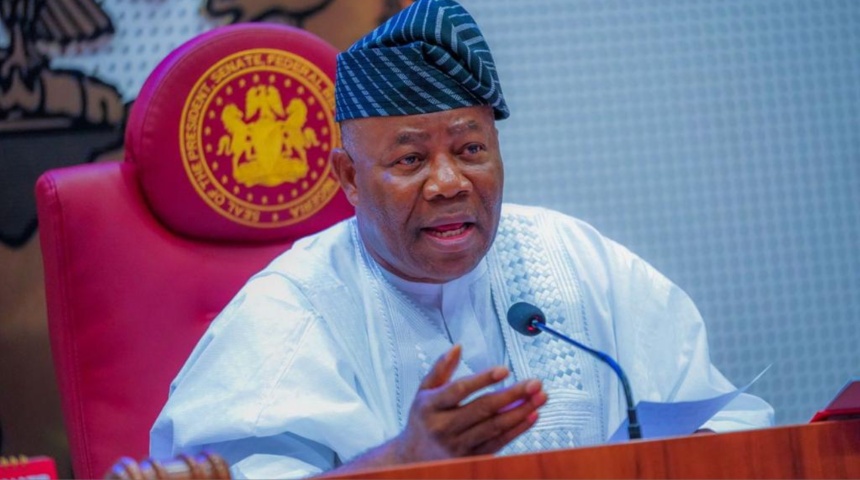
Senate President Godswill Akpabio has gone to the Department of State Services with a complaint that’s been building online for days: a graphic circulating on Facebook that has him warning Northern Nigerians they’ll “suffer the most” if President Bola Tinubu loses the 2027 election. He says he never said it, and now he wants the DSS to find out who did.
What the Petition Says
The petition landed at the DSS on Wednesday, signed on Akpabio’s behalf by his Chief of Staff, Chinedu Akubueze. It doesn’t mince words. The document describes the quote as fabricated, inflammatory, and built specifically to turn Northern Nigerians against him.
The image doing the rounds carries Akpabio’s photo, his official title as Senate President, and this line attributed to him: “Northerners, You Will Be The Ones To Suffer The Most, If You Allow Tinubu To Lose The Election.”
Akpabio’s office isn’t just denying it in passing. The petition lays out why the quote can’t be real: no date, no venue, no speech, no interview, no video or audio anywhere that backs it up. Nothing. As the document puts it, nobody has produced a credible source for a quote that’s been shared thousands of times.
Chasing the Source
What makes this petition more than a routine denial is how specific it gets about tracing the graphic’s origin. Akubueze’s letter names names. It points to a Facebook post by one Abdullai Musa, allegedly one of the earliest people to share the image, in a group called “Sheik Muhammad bin Uthman Group 24.” It also flags a post by Uzoma Chilaka that reportedly credited the material to a Boniface Uzoma Chilaka and an Engineer Ibrahim Umar Ammar, whose own verified Facebook account is said to have reproduced the graphic with similar commentary attached.
The DSS has been asked to dig into all of it: who designed the graphic, who uploaded it first, who funded or coordinated its spread, and who else pushed it along the way. Akpabio’s team wants the full distribution chain mapped out, not just a takedown.
Akpabio Speaks Out Directly
A day after the petition became public, Akpabio’s special adviser on media and publicity, Eseme Eyiboh, put out a statement in his boss’s voice, and it wasn’t gentle. Titled “Desperate and Dangerous Lie: Produce the Evidence or Withdraw It,” the statement called the whole thing an outright lie and something closer to sabotage than political criticism.
Eyiboh described what’s happening as calculated incitement, meant to stir up fear and hostility between Northern Nigerians and a president who happens to be from the South. He didn’t stop there. “The North is not an electoral weapon,” the statement reads in part. “The South is not an enemy. Ethnicity is not campaign ammunition.”
Akpabio is also urging ordinary Nigerians to slow down before hitting share. His point is a fair one, honestly: something getting reposted a thousand times doesn’t make it true. Reach isn’t proof.
Why This Is Landing Now
None of this is happening in a vacuum. Political temperatures are already rising ahead of 2027, and social media has become the main battlefield where campaigns, supporters, and outright bad actors fight for narrative control. A fabricated quote timed to inflame regional tension checks every box for that kind of warfare, whether it came from a rival camp, a mischief-maker, or someone just chasing engagement.
Akpabio himself has been a visible face of Tinubu’s re-election push, including trips north to sell the administration’s “Renewed Hope” agenda. That visibility cuts both ways. It makes him a target for exactly this kind of manufactured controversy, and it also means a fake quote like this one can travel fast precisely because people already associate him with the president’s camp.
For now, the ball is in the DSS’s court. Akpabio’s petition asks for an urgent probe, and given how quickly the story has spread across Nigerian media, there’s pressure on the agency to move rather than sit on it. Whether the investigation actually traces back to a real culprit, or whether the graphic’s origin gets lost in the usual maze of anonymous accounts and forwarded posts, is another matter entirely.
What’s clear is that this won’t be the last fake quote to hit a major political figure before 2027. If anything, it’s a preview of how messy the road to the next election is going to get, and how little verification some of that content will get before it’s already everywhere.