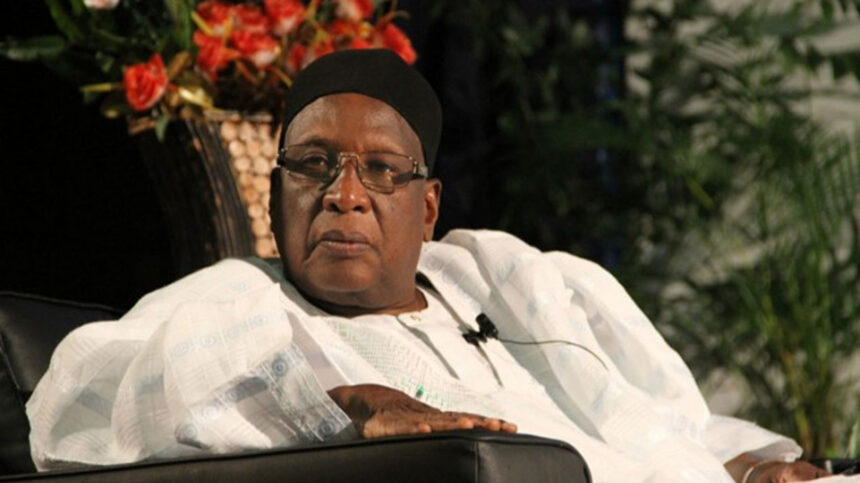
Bamanga Tukur has died. He was 90, three days shy of his 91st birthday, and for a man who spent five decades moving between ports, politics and boardrooms, the end came quietly, at his residence in Abuja, on Saturday, September 12, 2026.
His son, Awwal Tukur, broke the news in a family statement that read like a man trying to hold himself together. “It is with profound sadness and total submission to the will of Almighty Allah that the family announces the passing of our beloved father and patriarch,” the statement said, describing him as the family’s patriarch and thanking well-wishers for their prayers. He had reportedly been unwell since 2023, though the family kept the details of his illness private, as many Nigerian political families tend to.
By evening, condolences were pouring in from Aso Rock, from Adamawa State Government House, and from both feuding factions of the party he once led, proof, if any was needed, that Bamanga Tukur’s name still carried weight in rooms he hadn’t sat in for years.
Who Was Bamanga Tukur?
Alhaji Bamanga Muhammad Tukur was born on September 15, 1935, in what is now Adamawa State, in Nigeria’s far northeast. He held the traditional titles of Tafidan Adamawa and Wakilin Ganye, and if you ask anyone from that part of the country, those titles meant almost as much to him as anything he did in Abuja or Lagos.
He studied at the University of Pittsburgh in the United States, where he picked up a master’s degree, and later received an honorary doctorate in law from Benue State University. But it was his career, not his classroom years, that built his name.
Running the Ports at Their Worst Moment
In 1975, Tukur took over as General Manager and Chief Executive of the Nigerian Ports Authority. He couldn’t have inherited a messier job. Nigeria’s military government, flush with oil money, had ordered far more cement than the country’s harbours could physically unload, and by the time Tukur arrived, ships were stacking up offshore, some waiting months just to dock. It’s the kind of crisis that ends careers. Instead, it launched his.
Over the next seven years, Tukur pushed to expand port capacity and streamline how cargo moved through Nigeria’s harbours. The work earned him a rare distinction: he became the first African to serve as vice president of the International Association of Ports and Harbours, the global body for the industry. He left the NPA in 1982 with something more valuable than the title, though, an intimate, almost insider’s knowledge of how Nigerian ports actually worked, who ran them, and where the money moved.
He put that knowledge to use almost immediately. Somewhere around 1980 or 1981 (accounts differ slightly on the exact year), Tukur registered a shipping agency, Daddo Maritime Services, while he was still technically in charge of the ports it would go on to serve for the next four decades. A shipping agency doesn’t own vessels; it works the ground for the people who do, clearing customs, securing berths, arranging crew changes. It’s unglamorous, high-margin work, and it depends entirely on knowing the port system from the inside. Few people in Nigeria knew it better than Tukur did.
Governor of Gongola, Briefly
Politics called next. Tukur contested and won the governorship of the old Gongola State, now split into Adamawa and Taraba, in the 1983 elections, running on the ticket of the National Party of Nigeria. His time in office was short-lived. The military coup of December 31, 1983, which toppled President Shehu Shagari’s Second Republic government, ended his governorship after barely two months. It’s one of those footnotes in Nigerian political history that’s easy to miss, but it placed Tukur among a small group of elected governors whose tenures were cut off before they’d properly begun.
He resurfaced in government a decade later, serving as Minister of Industries under General Sani Abacha’s military administration between 1993 and 1995, another uncomfortable era to have served in, though Tukur, like many of his generation, moved between military and civilian Nigeria without much apparent friction.
The PDP Years, and the Split That Followed
When democracy returned in 1999, Tukur re-emerged as one of the PDP’s influential northern voices. It wasn’t until March 2012, though, that he took the job that would define his political legacy for a lot of younger Nigerians: National Chairman of the Peoples Democratic Party, installed with the backing of then-President Goodluck Jonathan.
It did not go smoothly. Tukur’s chairmanship coincided with one of the ugliest internal wars the PDP has ever fought. By 2013, a bloc of governors, senators and House members, led by former Vice President Atiku Abubakar, broke away entirely, forming what became known as the “New PDP.” There’s a strange twist buried in that history: Atiku had actually campaigned for Tukur’s 1983 governorship bid in Gongola. Thirty years later, he was leading the rebellion against him. The fracture badly weakened the PDP heading into the 2015 election, a race the party ultimately lost to Muhammadu Buhari and the APC, ending sixteen years of unbroken PDP rule.
Beyond party politics, Tukur built a reputation as a continental business figure. He founded BHI Holdings, also known as the Daddo Group, and became a founding member and later president and life patron of the Africa Business Roundtable. He also chaired the NEPAD Business Group, positioning himself as one of the more prominent private-sector voices in African economic policy circles for years.
The Reactions
President Bola Tinubu’s tribute, issued through his spokesperson Bayo Onanuga, called Tukur “a towering figure” whose career spanned “public administration, governance, industry, politics and pan-African business leadership.” Adamawa State Governor Ahmadu Fintiri went further, declaring three days of mourning across the state and ordering flags flown at half-mast, calling Tukur “a colossus” in the state’s development.
Inside the PDP, both warring factions, the one aligned with FCT Minister Nyesom Wike and the rival Interim National Working Committee under Kabiru Turaki, found themselves, for once, saying the same thing. Each issued statements calling his death an “irreplaceable loss,” and the Turaki-led camp added a detail that landed harder than most: Tukur’s final message to the party, delivered in his last months, was reportedly a plea to “keep the flag flying” and preserve the PDP’s place as a genuinely national platform. Whether that message will outlive the men currently fighting over the party’s structure is, at this point, an open question.
Burial
According to the family, Tukur’s remains will be taken to Adamawa State for burial in line with Islamic rites. Mourners, including political associates and family friends, had already begun gathering at his Abuja residence within hours of the announcement.
Bamanga Tukur outlived most of the era he helped shape, the port reforms of the 1970s, the short-lived Second Republic, the Abacha years, the PDP’s dominant decade, and its long, slow unraveling after. Whatever side of Nigerian politics you’re standing on, it’s hard to argue his death doesn’t close a chapter that stretched back further than most Nigerians alive today can remember.