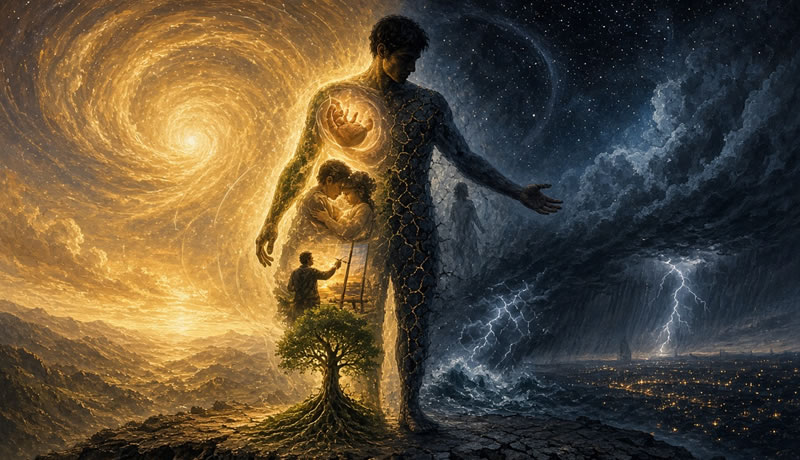
Humans have spent thousands of years asking the same question: what is the origin of our conflicted human condition?
We have always known that something is not quite right with us. We can be compassionate and cruel, self-sacrificing and selfish, cooperative and violently competitive. We love, we create music, art, philosophy and systems of justice, and yet we also wage wars, persecute one another, and repeatedly damage the very world on which we depend.
This contradiction has been one of the great focuses of human thought.
The ancient Greeks asked whether reason could govern our passions. Religious traditions developed moral systems intended to change human behavior. Enlightenment philosophers debated whether humans were naturally peaceful or naturally self-interested. Modern psychology and biology then attempted to understand the forces beneath our behavior.
The remarkable thing is that, despite all this effort, the fundamental question remains: why are we the way we are?
And if we cannot answer that question, how can we expect to change ourselves permanently?
The ancient dream of human transformation
For Socrates, the examined life was essential to becoming a better human being.
Plato imagined reason as something that could bring order to the competing forces within us.
Centuries later, Charles Darwin transformed our understanding of where we came from by explaining evolution through natural selection. But Darwin’s achievement also opened an even bigger question: how did a species produced by biological evolution become capable of morality, conscience, self-sacrifice, imagination — and destructive conflict?
That question has occupied scientists ever since.
The twentieth century produced an extraordinary range of attempts to answer it.
- Sigmund Freud explored the unconscious forces and aggressive impulses that complicate civilisation;
- Erich Fromm examined the psychological roots of destructiveness, arguing that humans’ need for connection, identity and meaning could be frustrated in ways that produce destructive behavior;
- Viktor Frankl explored the human search for meaning and the capacity to choose one’s response even under extreme circumstances;
- Abraham Maslow investigated human motivation and the possibility of moving beyond basic deficiency needs towards self-actualisation; and
- Konrad Lorenz, from an ethological perspective, investigated aggression and its evolutionary significance.
These approaches differed profoundly. But they shared something important: they treated human behavior as a problem worthy of understanding, rather than simply a moral failing to be condemned, and managed.
Humans have become better at managing ourselves — but have we been able to better understood ourselves?
Human civilization has achieved extraordinary progress in controlling behavior.
We have created laws because people cannot be trusted to follow their better instincts. We developed democratic institutions to balance the concentration of power. We established courts, treaties and international organisations to moderate violence. We developed education to cultivate reason and social responsibility.
These achievements matter enormously. But there is a philosophical problem lurking underneath them: if humans remains fundamentally conflicted, then our institutions are forever required to manage the symptoms of that conflict.
We can outlaw violence, but what produces the impulse towards violence?
We can negotiate peace treaties, but what repeatedly drives groups into conflict?
We can encourage tolerance, but why do humans become tribal, defensive and hostile in the first place?
We can tell people to love one another, but why is living according to that ideal so difficult?
These questions point towards something deeper than politics, economics or technology: they point towards the ‘human condition’.
The problem behind the problems
The human condition can be understood, in broad terms, as the unresolved problem of human behavior itself: the contradiction between our capacity for extraordinary goodness and our capacity for destructive behaviour.
And this may be the most important problem in the world because almost every other major problem is affected by human behavior.
Consider the chain: War is made by human beings; environmental destruction is driven by human choices; political polarization is intensified by human psychology; exploitation, corruption, prejudice and violence are human behaviors.
Even our attempts to solve these problems depend upon the motivations and limitations of the humans attempting to do the solving.
This does not mean that every problem has a psychological cause, or that practical solutions are unnecessary. It means that there is a deeper question that cannot indefinitely be avoided:
Can humanity fundamentally improve without fundamentally understanding itself?
This is the question biologist Jeremy Griffith has devoted his life’s work to investigating.
To account for the human suffering we see all around us, Griffith proposes a solution: an ‘Instinct vs Intellect’ explanation of the human condition, a treatise that is supported by the non-profit organization, FIX THE WORLD. His argument is that the emergence of the conscious human intellect created a fundamental conflict with our pre-existing instinctive system.
According to Griffith, once our conscious mind became capable of independently questioning, experimenting and understanding cause and effect, it inevitably began deviating from established instinctive patterns. He argues that this conflict produced the psychological tension that ultimately manifested as insecurity, defensiveness, anger, egocentricity and alienation.
The significance of his proposition is not simply that it attempts to explain why humans behave badly. It attempts to explain why a species capable of such extraordinary love and cooperation became psychologically troubled in the first place.
That is a very different question from simply asking how to control aggression.
From condemning ourselves to understanding ourselves
This is also where Griffith’s work takes a distinctly philosophical turn.
If destructive human behavior has an underlying cause, then perhaps humanity’s task is not to condemn itself endlessly for its failures, but to understand the origin of those failures.
That possibility has profound implications.
Instead of asking only: How do we stop human beings behaving badly?
We can ask: Why did human beings become psychologically troubled?
And if the second question can genuinely be answered, the first may become considerably easier to address.
The question that could define our future
Humanity has spent thousands of years trying to make the world better. We have changed our laws, our governments, our technologies and our institutions. We have accumulated an extraordinary body of knowledge about the universe and the biological world.
But perhaps the most consequential frontier is still ourselves.
Because if we want peace in our lifetime – or in the lifetime of our children – it is not enough to continually repair the damage caused by human conflict. We need to understand why we keep creating it.
That is why the human condition deserves to be regarded as more than an abstract philosophical puzzle. It is arguably the central question beneath the questions of war and peace, cooperation and competition, happiness and suffering, and humanity’s future.
The great hope is that human beings can change.
The great challenge is discovering what must be understood for that change to become possible.
And that makes the search for an explanation of the human condition one of the most important intellectual quests of our time.