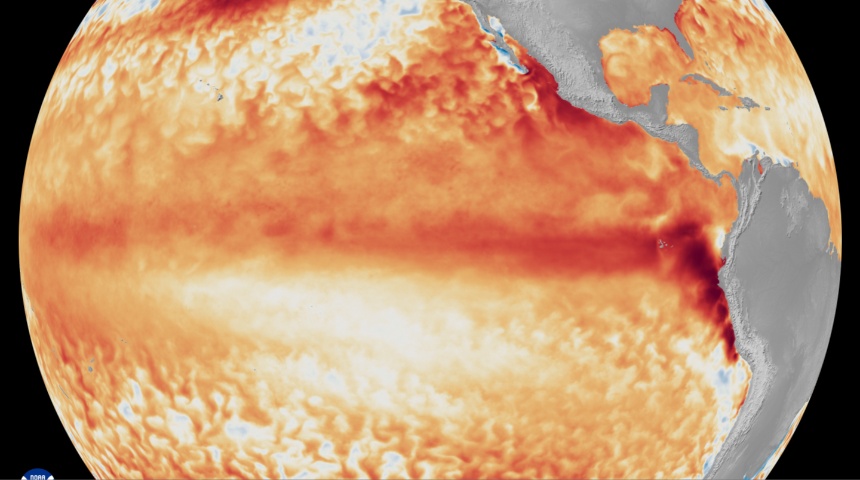
A weather pattern that starts in the Pacific Ocean, thousands of kilometres from Lagos, Kano or Port Harcourt, is now one of the biggest climate stories in the world. El Niño was declared in June and has strengthened since, with forecasters expecting it to keep building through the end of the year. For Nigerians who have lived through scorching dry seasons, sudden floods and years of rising food bills, the question is practical. What does this mean for us?
How strong is this El Niño?
The numbers from US forecasters are striking. NOAA’s Climate Prediction Center said in September that the chance of a very strong event this fall and winter was above 90 percent. It also gave a 75 percent chance that October to December would be stronger than any El Niño on record since 1950.
There is a wrinkle in how that is measured. NOAA moved this year to a relative index that subtracts the average warming of all tropical oceans. On the traditional measure the event is already the strongest on record, but on the relative measure 1982 and 2015 remain stronger, leaving 2026 in third place. It is still the strongest for this point in early October. Either way, this is a major event, and not one that fades quickly. NOAA expects it to last through March, with a 97 percent chance it persists through April.
What is El Niño, in plain language?
El Niño is a natural climate pattern marked by unusually warm water in the tropical Pacific. It comes back every two to seven years and can last anywhere from a few months to nearly two years.
In a normal year, trade winds push warm surface water towards the western Pacific. During El Niño those winds weaken and the warm water drifts back east. That shifts where storms form, and rain gets moved around the planet. Some regions flood, others dry out, and global temperatures tend to climb. This one arrived after a La Niña, the cooler opposite phase.
What has NiMet said?
Nigeria’s weather planning for 2026 started from a different assumption. When the Nigerian Meteorological Agency (NiMet) released its 2026 Seasonal Climate Prediction, it pointed to a largely neutral ENSO phase and normal rainfall across most of the country. Lagos State read the forecast as pointing to above-normal rainfall for the state.
The picture has since changed. NiMet’s August update says ocean observations confirm the onset of a strong El Niño, which it expects to dominate global climate patterns from August to October. Any plan built on the earlier neutral forecast deserves a second look.
Will it bring heat?
Probably, and on top of an already warm baseline. The previous strong El Niño in 2023 and 2024 came with record global temperatures, and a new one could push them higher still. Global temperatures usually peak a few months after El Niño itself does, so the hottest stretch could fall in 2027, around Nigeria’s usual dry-season heat in February to April.
Nigeria is not well set up for that. Heat stress can cause dehydration, heat exhaustion, heat stroke, breathing problems and heart complications. A Guardian Nigeria editorial pointed out that the country has no coordinated national heat response and no public cooling shelters, while much of the economy depends on outdoor labour. Market traders, okada riders, farmers and construction workers carry most of that risk.
What about rainfall?
This is where honesty matters. El Niño’s effect on Nigeria is less clear-cut than in places like Peru, Indonesia or Southern Africa. NOAA itself says that with an event this large, El Niño-type impacts become more likely but are not guaranteed.
For West Africa, analysts point to variable rainfall, stronger Harmattan winds and periodic heat stress. History offers a warning. During the 1997 to 1998 event, Nigerian cocoa farmers feared drought-fuelled bushfires across roughly 380,000 hectares of plantations, and the southwest recorded less rain than normal.
The regional outlook for the months ahead is mixed. It describes erratic rainfall, localised flooding and weaker crop prospects continuing into early 2027, with conflict remaining the main driver of hunger. That means some communities could face dry spells while others deal with flash floods, sometimes in the same season. Harmattan is also a factor, since NiMet officials have said it normally lasts until about the end of March.
What will happen to food prices?
The effect on farms comes with a delay, and that is the part many households miss. Agricultural damage from El Niño tends to show up six to twelve months after the event peaks, so pressure on crops and prices is still building. The World Food Programme expects the same. It says El Niño will peak between September and December 2026 but its effects will run through 2027 because planting and harvest cycles get disrupted. It projects nearly six million more people in West and Central Africa falling into acute food insecurity, a 12 percent rise. For context, the 2015 to 2016 El Niño hit the food security of an estimated 60 to 100 million people worldwide.
Cocoa is one crop in the firing line. Analysts at Schroders flagged the risk of drier conditions and stronger Harmattan winds hurting West African cocoa output.
For now, Nigeria’s price data looks calmer. The National Bureau of Statistics reported that headline inflation eased to 14.63 percent in September from 15.39 percent in August. Food inflation stood at 19.59 percent year on year, and food prices fell 1.55 percent month on month. The relief is uneven, though. Lagos recorded the highest annual food inflation at 34.40 percent.
Nobody should treat that as a guarantee either way. Schroders says the link between El Niño and farm prices is not strong or direct, and its own model overstated the effect in 2023. Fertiliser supply, energy costs, transport and insecurity can move prices as much as rainfall does.
What are the health risks?
The World Health Organization has called El Niño a significant public health threat. It rates malnutrition and cholera as very high risks where drought and flooding hit the same communities, and warns that extreme heat is dangerous for people with existing health conditions or little access to cooling or care. A cholera specialist cautioned that El Niño does not create cholera risk on its own but worsens weaknesses that are already there, such as poor sanitation and unsafe water.
Heavy rain and flooding also bring a risk of mosquito-borne illnesses such as malaria, dengue and chikungunya. In the north, the dry season brings a separate worry. NiMet has warned that extreme heat combined with dust in the air could raise the chance of meningitis outbreaks in northern Nigeria. In an earlier dry season the agency flagged Sokoto, Jigawa, Yobe and Borno as especially favourable for outbreaks.
What can Nigerians do now?
None of this is a reason to panic, but there is time to prepare.
Farmers should follow NiMet’s bulletins closely before the next planting season and think about water storage and drought-tolerant seed varieties. Households can drink enough water, avoid the midday sun, store drinking water safely and treat it where the supply is doubtful. Families in flood-prone areas should clear drains and use mosquito nets. People in the north should follow NCDC and state health ministry guidance on meningitis. Buying more than you need will not help, and it tends to push prices up for everyone.
Frequently asked questions
Will El Niño cause drought in Nigeria?
Not automatically. Its effect on Nigerian rainfall is less predictable than elsewhere, and some areas could see dry spells while others see floods. Watch NiMet’s updates for your region.
How long will El Niño last?
NOAA gives a 100 percent chance it continues through March and 97 percent through April.
Will El Niño make food more expensive in Nigeria?
It could, mainly through weaker harvests and costlier inputs in 2027. The link is real but not guaranteed, and conflict, fuel and fertiliser costs also matter.