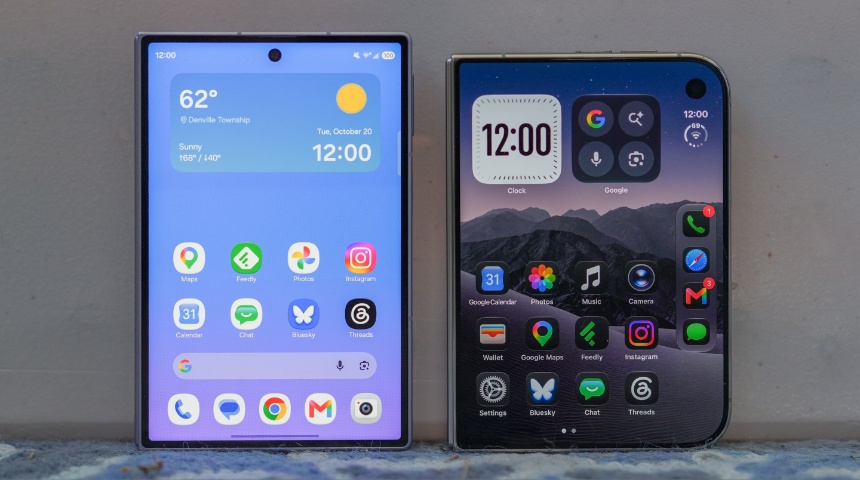
Apple has finally joined the foldable race, and the first thing buyers want to know is how its phone measures up against the one Samsung has been selling since August. The iPhone Duo went on sale on Friday, October 23, while the Samsung Galaxy Z Fold 8 has had a head start of nearly three months. On paper the two phones are close cousins. In daily use, they pull in different directions.
Here is how the Galaxy Z Fold 8 and the iPhone Duo compare on price, design, performance, cameras and battery life, and who should buy which.
Release dates and price: Samsung is cheaper, and getting cheaper still
Samsung unveiled the Galaxy Z Fold 8 at its Unpacked event on July 22, 2026, with sales starting on August 7. It launched at $1,899 for the 256GB model. The pricier Galaxy Z Fold 8 Ultra, which keeps the older tall-and-narrow shape, starts at $2,099.
Apple announced the iPhone Duo on September 9 alongside the iPhone 18 Pro and Pro Max. Pre-orders opened on October 16, and the phone reached shelves on October 23 at a starting price of $1,999. Early reports suggest stock is tight, so getting one on launch week may take patience.
The gap at list price is only $100, but the Fold 8 has already moved. As of mid-October, both Samsung and Best Buy were selling the 256GB model for $1,699.99, which puts it $300 below the Duo.
| Samsung Galaxy Z Fold 8 | Apple iPhone Duo | |
|---|---|---|
| Announced | July 22, 2026 | September 9, 2026 |
| On sale | August 7, 2026 | October 23, 2026 |
| US starting price | $1,899 (256GB) | $1,999 (256GB) |
| Recent street price | $1,699.99 (256GB, mid-October) | No discounts yet |
| Storage options | 256GB, 512GB, 1TB | 256GB up to 2TB |
| Colours | Lavender, Cream, Graphite, Pistachio | Star White, Night Sky |
Prices outside the United States run higher. The Duo starts at about €2,299 in Europe, Rs 299,900 in India, AED 8,499 in the UAE and A$3,499 in Australia.
Design: Samsung wins on slimness, Apple on toughness
The two phones look more alike than anyone expected. Both ditched the tall, narrow cover screen of earlier foldables for a wider, passport-style body, and both open into a roughly 7.6-inch inner display. Samsung’s cover screen measures 5.5 inches, Apple’s 5.4.
The difference shows up when you pick them up. The Fold 8 weighs 201g and is about 4.5mm thin when unfolded. The iPhone Duo is 5.2mm thin open and 11.3mm folded, and at 254g it is the heaviest iPhone Apple has ever made, even though it is the thinnest iPhone when unfolded. The weight comes from the titanium frame, while Samsung uses aluminium.
Apple’s extra heft buys durability. The Duo carries an IP68 rating, meaning protection against both dust and water, and Apple gave the inner screen a nano-texture surface that cuts glare and makes the crease harder to spot. Samsung has smoothed out its crease to the most subtle yet on a Galaxy Fold, but reviewers who have tested both say Apple’s version is less visible.
Two Apple choices will divide buyers. The Duo has no Face ID and relies on Touch ID in the side button, though it can also be unlocked with a paired Apple Watch. It is also eSIM-only, while the Fold 8 still has a physical SIM tray.
Specs side by side
| Spec | Galaxy Z Fold 8 | iPhone Duo |
|---|---|---|
| Inner display | 7.6-inch, 4:3, 1848 x 2448 | 7.6-inch, 1878 x 2670, nano-texture |
| Cover display | 5.5-inch | 5.4-inch |
| Chipset | Snapdragon 8 Elite Gen 5 for Galaxy (3nm) | Apple A20 Pro (2nm) |
| RAM | 12GB or 16GB | 12GB |
| Operating system | Android 17, One UI 9 | iOS 27.1 |
| Software support | 7 years of OS updates | Apple has not stated a figure |
| Weight | 201g | 254g |
| Thickness (unfolded) | About 4.5mm | 5.2mm |
| Frame | Aluminium | Titanium |
| Dust and water rating | Less complete dust sealing | IP68 |
| Biometrics | Fingerprint sensor | Touch ID, Apple Watch unlock |
| SIM | Nano-SIM and eSIM | eSIM only |
| Stylus | S Pen not supported | Apple Pencil support arriving this month |
Performance: the A20 Pro pulls ahead
Both phones are fast enough that most people will never feel the difference in everyday use. Benchmarks tell a different story. In 3DMark’s Solar Bay Unlimited stress test, Tom’s Guide recorded an average of 62.3 frames per second on the Duo against 47.35 on the Fold 8, a lead of about 32% for Apple. The Duo also has a custom vapor chamber to manage heat across its folding body, something Samsung’s phone has been criticised for lacking, with one reviewer noting it tends to run warm.
Where Samsung fights back is multitasking. The Fold 8 can run up to four apps at once and lets you float app windows anywhere on screen. It also supports Samsung DeX for desktop-style use on an external monitor. The Duo limits you to two apps side by side in Split View and offers no desktop mode.
Cameras: Apple wins most rounds, Samsung wins zoom
Neither phone has a telephoto lens. Samsung kept that feature for the Fold 8 Ultra, which has a 200MP main sensor and a 10MP 3x telephoto. The standard Fold 8 makes do with a 50MP main camera and a 50MP ultra-wide. The iPhone Duo pairs a 48MP main camera with a 48MP ultra-wide, using the main sensor for a 2x optical-quality zoom. It records 4K video at up to 120fps.
In a 10-round comparison by Tom’s Guide, the Duo came out ahead on dynamic range, colours, portraits and outer-screen selfies, handling harsh highlights and deep shadows with more balance. The Fold 8 won the zoom round, producing a cleaner image at 10x where the iPhone showed noise and grain. Reviewers describe the Fold 8’s cameras as good rather than great, and several say that is a letdown at this price.
Battery life: bigger gap than the numbers suggest
The battery capacities are almost identical. The Duo has 4,883mAh split across two cells, while the Fold 8 has 4,800mAh. Samsung rates the Fold 8’s battery at 4,660mAh minimum and promises up to 26 hours of video playback. One reviewer reported around 21 hours in real use, and others praised it as a clear step up from the Fold 7. Another reviewer measured about six hours of mixed screen-on time and still had to charge nightly.
The Duo does better in head-to-head testing. On Tom’s Guide’s battery drain test, it lasted 13 hours and 20 minutes against 10 hours and 6 minutes for the Fold 8. European energy label data lists the Duo at 51 hours and 30 minutes per charge, which is below the iPhone 18 Pro Max, and heavy use of the inner screen will shorten that.
Charging is closer. Samsung supports 45W wired and 20W wireless charging. Apple says the Duo reaches 50% in 30 minutes and supports 25W wireless charging with MagSafe.
What about Nigeria?
For Nigerian buyers, the picture is complicated. Apple has not announced an official iPhone Duo price for Nigeria, and the country is not on the first two launch waves. Reports from the local tech press estimate a grey-market unit would cost between ₦4.4 million and ₦5.6 million, with the naira trading at around ₦1,329 to the dollar. The eSIM-only design is another hurdle, since not every network supports it yet.
The Galaxy Z Fold 8 is easier to find through importers and carries the physical SIM slot, but it is still a premium purchase. Whichever phone you pick, buy from a seller who offers a warranty that will actually be honoured locally. Foldables are costly to repair, and the hinge and inner screen are the first things to check on a used unit.
So which foldable should you buy?
Buy the iPhone Duo if you already live in Apple’s world, want the best cameras for people shots, care about dust and water protection, and plan to use Apple Pencil. It is the faster phone with the longer battery life in early tests, and its screen is the more polished of the two.
Buy the Galaxy Z Fold 8 if you want a lighter, thinner phone, stronger multitasking, a physical SIM, and a lower price. With $300 off at several US retailers, it is the better value, and it has months of real-world reviews behind it while the Duo is only days old.
One caution applies to Apple’s side of the ledger. The Duo is a first-generation product, and its long-term durability will only become clear once ordinary owners start using it. Samsung is on its eighth try. For many buyers, that experience and the lower price will matter more than the benchmark lead.