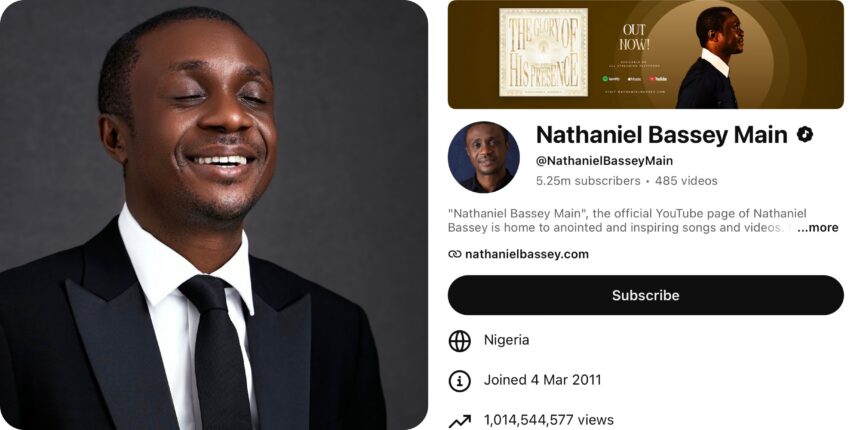
For some people, midnight is the end of a long day. For others, it is the beginning of another. But for thousands of Christians who have followed Nathaniel Bassey’s online ministry over the years, the hour has become an opportunity to pause, pray and worship.
What began as a simple online gathering has grown beyond what many might have imagined. And as the gospel minister reaches another major milestone, attention has turned to the journey behind the numbers.
The 1bn Milestone: How Nathaniel Bassey Made History On YouTube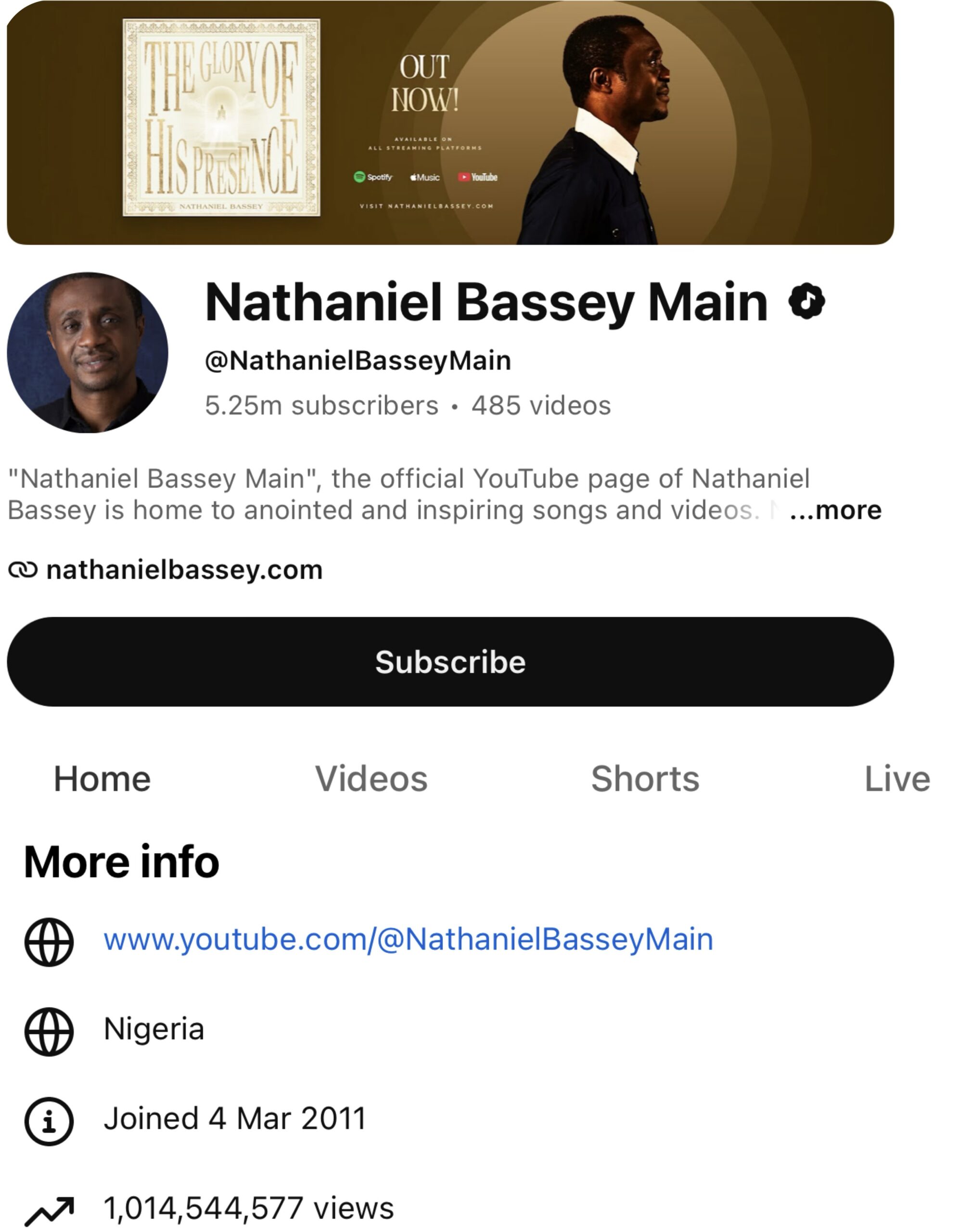

Nigerian gospel singer and pastor Nathaniel Bassey has crossed one billion views on YouTube, marking a significant achievement in his music and ministry career.
A check by WITHINNIGERIA shows his official YouTube channel, Nathaniel Bassey Main, recorded approximately 1.014 billion cumulative views and 5.25 million subscribers as of November 3, 2026. The milestone came more than 15 years after the channel was created on March 4, 2011.
Bassey’s achievement has also been reported as a first for an African gospel artiste on the platform. However, the figures relate to the total views accumulated by his channel, rather than a single song or worship programme.
The timing is particularly interesting because the milestone coincided with the October 2026 edition of the Hallelujah Challenge, the online praise and prayer programme that has become an important part of his ministry.
According to reports, the October edition attracted millions of views. Its opening session recorded more than four million views, while the grand finale, known as the Hallelujah Festival, attracted over 4.3 million views.
These figures offer a glimpse into the audience Bassey has built over the years. His channel brings together music videos, live performances, worship sessions and recordings of online prayer meetings.
The billion-view achievement is therefore not the result of one viral moment. It reflects years of music releases, worship gatherings and a growing online community.
From Music To Ministry: Who Is Nathaniel Bassey?

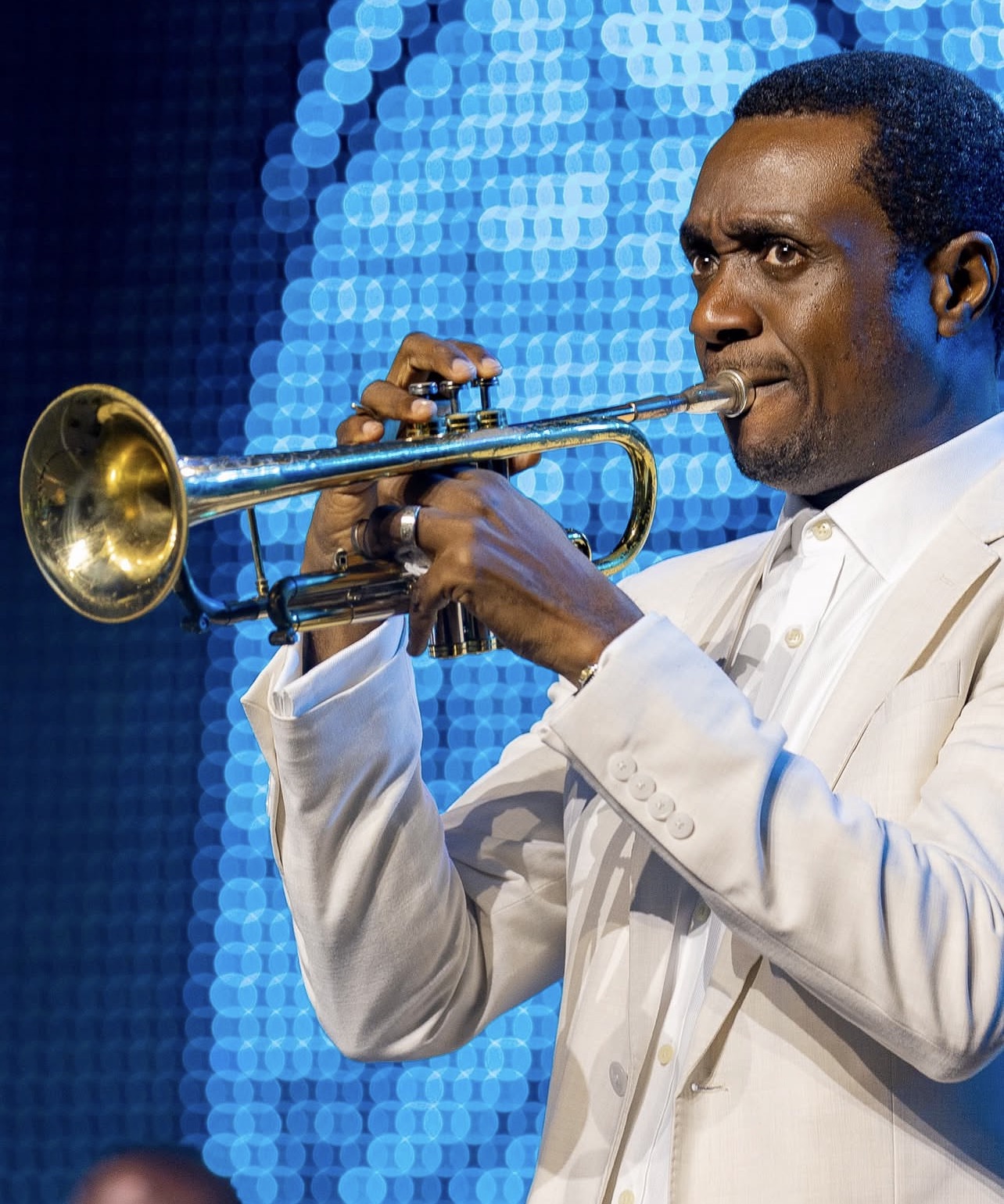
Nathaniel Bassey is a Nigerian gospel singer, songwriter, trumpeter, music producer and pastor from Akwa Ibom State. Although many people recognise him through his worship songs and online prayer meetings, music has been an important part of his life long before the Hallelujah Challenge became popular.
According to his official biography, Bassey was previously the bandleader of the Steve Rhodes Jazz Orchestra. He was also a member of the Spectrum 4 jazz quintet and worked with other musical groups before committing to full-time music ministry.
His background in jazz and instrumental music has influenced his sound, particularly his use of the trumpet during worship sessions and live performances. Bassey recorded his debut album, Elohim, in Cape Town, South Africa, in 2008. He followed it with other projects, including The Son of God in 2014, This God Is Too Good in 2016 and Revival Flames in 2017.
He later released Jesus: The Resurrection and the Life in 2018, The King Is Coming in 2019 and Hallelujah Again in 2021. Another major project was The Names of God, a 15-track album recorded live in November 2021 and released in 2022.
Beyond recording music, Bassey serves as a pastor at The Oasis, the youth church of the Redeemed Christian Church of God’s The King’s Court in Lagos. His official biography describes his approach to music as one centred on praise and worship, with an emphasis on spiritual growth, skill and character among music ministers. Over time, he has built a following through his recordings, live ministrations, church programmes and collaborations with other gospel artistes.
The Songs Behind The Numbers
While the Hallelujah Challenge has introduced Bassey to a wider online audience, his music remains a major part of his popularity. Over the years, he has released songs that have become familiar in Nigerian churches and among gospel music lovers in different parts of the world.
One of his well-known songs is Imela, a worship song featuring Enitan Adaba. The song was released in 2012 and later featured on his album The Son of God (& Imela).
Another popular release is Onise Iyanu, featuring Glorious Fountain Choir and Micah Stampley. Released in August 2016, the song celebrates God’s miraculous works and became a familiar choice during church worship sessions.
In 2017, Bassey released Olowogbogboro, featuring Wale Adenuga. The song became particularly popular among Christians who embraced its message of God’s power and ability to change situations.
Other notable songs in his catalogue include You Are God, Yahweh Sabaoth and Tobechukwu, his collaboration with fellow gospel singer Mercy Chinwo Blessed. Tobechukwu, which means “Praise God” in Igbo, was released in February 2023 as part of his Hallelujah Live project. It brought together two recognised voices in Nigerian gospel music and became another popular worship song.
His music catalogue also includes songs such as Olorun Agbaye (You Are Mighty), See What the Lord Has Done, Jesus Iye and This God Is Too Good.
These releases reflect different parts of Bassey’s musical approach, from contemporary gospel and high praise to traditional worship, hymns and instrumental ministrations.
His trumpet performances have also become a recognisable part of his ministry. Rather than relying only on vocals, he often incorporates the instrument into his worship sessions, giving his performances a distinctive sound.
The variety in his music has helped him connect with different audiences, while his songs continue to feature in church services, personal devotion and online worship gatherings.
Hallelujah Challenge: How A Midnight Instagram Session Became A Global Movement

Perhaps the most recognisable part of Nathaniel Bassey’s online ministry is the Hallelujah Challenge. The programme began on June 1, 2017, when the gospel minister started a 30-day midnight praise and worship session on Instagram Live.
The idea followed an earlier online initiative known as the Tongues Challenge, which involved participants praying for an hour every month.
In an interview with Channels Television in June 2017, Bassey explained that the idea for the Hallelujah Challenge came after he felt led to dedicate the month of June to praising God at midnight. He said:
“It started as an inspiration from God.”
He also explained that the decision to hold the sessions at midnight was connected to the biblical account of Paul and Silas praying and singing hymns while in prison, as recorded in Acts 16:25-26.
The first edition ran from June 1 to June 30, 2017. Participants joined through Instagram and Facebook, with thousands logging in to sing, pray and worship together.
The response was almost immediate. By June 16, 2017, it was reported that more than 70,000 people had joined one of the sessions on Instagram, while over 90,000 others participated through Facebook, according to figures Bassey shared at the time.
The initiative also attracted celebrities, including Tiwa Savage, D’banj, Rita Dominic, Funke Akindele and Don Jazzy.
What started as a 30-day online gathering gradually developed into a recurring worship programme with participants from different countries.
The sessions have featured other gospel singers, worship leaders and ministers, while the use of YouTube has made it possible for people to watch live broadcasts and revisit recordings.
The programme has also expanded beyond its original social media format, with some editions featuring physical gatherings and special worship events. One of its major attractions remains its simplicity. Participants do not need to attend a particular church or be in the same country to take part. They can join from their homes, workplaces or wherever they have internet access.
By the October 2026 edition, the programme had become a major source of traffic for Bassey’s YouTube channel, with individual sessions recording millions of views.
Its growth is one of the clearest examples of how social media can be used to build an international religious community around a shared activity.
Why Nathaniel Bassey Refuses To Monetise The Hallelujah Challenge


One of the most interesting aspects of Bassey’s billion-view achievement is his position on monetisation. With millions of people watching the Hallelujah Challenge online, questions have been raised about the revenue that could be generated from such a large audience.
However, Bassey has made it clear that he does not intend to monetise the Hallelujah Challenge simply because of its popularity.
In October 2025, during the Day 23 session of that year’s edition, the gospel minister addressed discussions surrounding his decision not to monetise the programme. He said:
“People are dragging me because I didn’t monetise my YouTube channel for the Hallelujah Challenge. I won’t monetise it; God didn’t tell me to.”
He further explained that he was not acting on financial considerations but following what he believed was the instruction he had received. Bassey also spoke about people creating fake YouTube pages and restreaming the programme to generate money from viewers. He warned participants that NathanielBasseymain was his official YouTube channel and urged them to avoid cloned pages.
His position attracted attention because the programme had already built a substantial audience, with millions of views recorded during its sessions. Reports have it that in October 2025, the Hallelujah Challenge had attracted more than one million views across social media platforms on October 22 alone.
What The Billion Views Mean For Nigerian Gospel Music
Nathaniel Bassey’s achievement is also significant for Nigerian gospel music, particularly at a time when digital platforms have become important tools for reaching audiences beyond traditional church settings.
For many years, gospel artistes depended heavily on church programmes, concerts, radio, television and physical music sales to share their work. Platforms such as YouTube have created another opportunity. Artistes can now release music, stream live worship sessions and build communities that extend beyond their immediate locations.
Bassey’s journey demonstrates how these opportunities can be used to grow a music ministry. His channel has brought together different aspects of his work. Listeners can find his recorded songs, live performances, instrumental worship and prayer sessions in one place.
The Hallelujah Challenge has also shown how a programme that began on Instagram can grow into an international gathering through the consistent use of digital platforms. His one-billion-view achievement comes amid the growing online presence of other Nigerian gospel ministers, showing that gospel music continues to find audiences through the internet.
However, the milestone is not simply about competition or the number of views. It also reflects the changing ways people discover, listen to and participate in gospel music. For Bassey, the achievement brings together more than 15 years of music releases, worship sessions and ministry work.
Conclusion
From his early days as a jazz trumpeter to becoming one of Nigeria’s recognised gospel ministers, Nathaniel Bassey’s journey has taken different turns. His songs have found audiences in churches and homes, while the Hallelujah Challenge has created an online space where thousands of people can gather for worship, regardless of their location.
Crossing one billion YouTube views is another major milestone in that journey. Yet, perhaps one of the most interesting parts of the story is that the programme responsible for drawing millions of people to his online ministry is one he has repeatedly said he does not want to monetise.
For Bassey, the Hallelujah Challenge remains a platform for worship rather than a revenue-generating project. And as his YouTube numbers continue to grow, his journey offers an interesting example of how music, faith and digital platforms can come together to reach an audience far beyond geographical boundaries.