

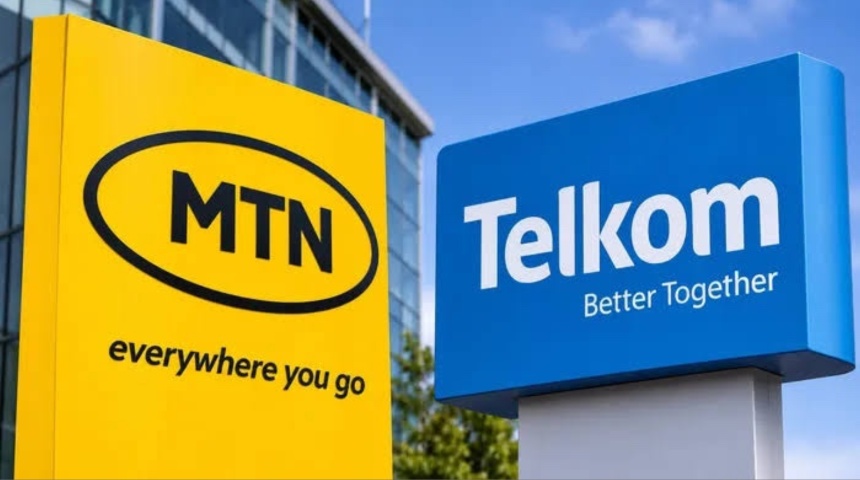
MTN Group and Telkom have confirmed that they are talking again about a takeover, four years after the last attempt fell apart. In separate cautionary announcements to the Johannesburg Stock Exchange on Monday, 16 November 2026, both companies said MTN had approached Telkom and that, if the talks succeed, MTN will make an offer for every share in the company.
The MTN Telkom acquisition talks are at an early stage, and both sides were careful to say there is no certainty of a deal. Still, the market did not wait for certainty. Telkom’s shares jumped by more than 15% within hours, and the question of what happens to South Africa’s mobile and fibre market if the two groups join forces is suddenly a live one.
What MTN and Telkom actually announced
The announcements were short and cautious. MTN said it expects any offer to be settled in cash, with an alternative for Telkom shareholders who would rather take MTN shares. The form of payment, like the price, is still open to negotiation. Telkom’s statement came from its independent board, which has appointed BofA Securities as financial adviser and Bowmans as legal adviser.
No price has been named. What we do have is a reference point. Telkom closed at R62 on Friday, 13 November, which valued the company at about R31.7 billion. One estimate puts its enterprise value, which adds debt to the equity value, at roughly R38 billion, or about $2.2 billion.
| Detail | What has been confirmed |
|---|---|
| Date announced | Monday, 16 November 2026 |
| Who approached whom | MTN approached Telkom |
| Scope | An offer for all of Telkom’s issued shares |
| Payment | Cash expected, with a share alternative for Telkom shareholders |
| Price | Not disclosed, still under negotiation |
| Telkom’s advisers | BofA Securities (financial), Bowmans (legal) |
| Status | Early-stage discussions, no certainty of a deal |
How the market reacted
Investors read the news as a sign that an offer is coming, and that it will come at a premium. Telkom opened at R70.25 on Monday, already 13% above Friday’s close, and touched R73.30 at its best. That was an 18% gain and a new 52-week high. By mid-afternoon it was trading around R71, which put its market value near R36.5 billion.
MTN’s shares moved the other way. They slipped about 2.3% to roughly R229, taking close to R10 billion off MTN’s market value as investors weighed what a cash purchase might cost. MTN was valued at about R427.7 billion on the JSE when the news broke.
The state is the biggest winner on paper. Government owns 40.5% of Telkom, and that stake gained around R1.9 billion on the day, to about R14.8 billion. The Government Employees Pension Fund, which holds another 11.1%, gained roughly R530 million.
Why the 2022 talks collapsed
Anyone watching this story will remember how it went last time. MTN confirmed formal talks in July 2022, when Telkom was worth just R17.1 billion. The proposed payment then was a mix of cash and shares. By October that year MTN had walked away.
Telkom said MTN ended the talks because it could not give assurances on exclusivity. Its board had been listening to a rival proposal from the wireless operator Rain, which wanted Telkom to buy it. Those Rain talks also came to nothing, and Telkom’s share price fell almost 25% on the day MTN’s exit was announced.
MTN never really went away, though. In June 2023 it said its 2022 offer would have been good for the shareholders of both companies. In September 2025, after Bloomberg reported that MTN was thinking about reviving the idea, chief executive Ralph Mupita said no discussions were under way, but added that “you cannot rule out anything in the future.” Two months later he argued that South Africa’s mobile market needs to consolidate into two, or at most three, large operators.
Mupita also said a deal would need three things to line up: openness from regulators, political support, and a commercial agreement between the companies. The first two are the real test this time.
Telkom is a different company now
The Telkom MTN is chasing today is not the one it walked away from. Four years ago, revenue was under pressure and the share price showed it. Since then the company has cut costs, taken mobile market share and, under chief executive Serame Taukobong, a former MTN executive, pushed hard on its data-led strategy.
The numbers from its interim results, published on Tuesday, 17 November, for the six months to 30 September, show a business that is more profitable but growing more slowly than it hoped.
| Telkom, six months to 30 Sept 2026 | Result |
|---|---|
| Group revenue | R22.5 billion (+2%) |
| EBITDA | R6.4 billion (+5.8%), margin 28.3% |
| Headline earnings per share | 334.1c (+9.3%) |
| Free cash flow | R998 million (+37.8%) |
| Mobile service revenue | R11.5 billion (+4%) |
| Mobile data revenue | R9.4 billion (+8.7%), 82% of mobile service revenue |
| Mobile voice revenue | Down 13.1% |
| Mobile subscribers | 26.3 million (+7.2%), of which 23.2 million prepaid |
| Capital expenditure | R2.2 billion (-22.5%), fibre spend down 35.1% |
| Openserve homes connected | 870,856 of 1.59 million passed (54.8%) |
| BCX revenue | R5.4 billion (-8.2%), EBITDA down 22.7% |
Two things stand out. First, mobile growth faded in the second quarter. Telkom blamed civil demonstrations that disrupted prepaid recharges in informal sales channels, and its own guidance admits that some of the assumptions behind its medium-term plan have changed materially because of higher fuel prices, inflation and geopolitical tension. Revenue growth of 2% is well short of the mid-single-digit target. Second, the enterprise unit BCX remains the weak spot.
That slowdown may explain why Telkom’s board is willing to listen. A growth story that has lost some of its speed is easier to sell at a premium than one still at full pace.
What MTN would be buying
The attraction is easy to see. Telkom brings a mobile business with 26.3 million subscribers and an infrastructure arm, Openserve, which is South Africa’s second-largest home fibre provider after Vumatel, the network Vodacom now co-controls through Maziv. It also carries a large enterprise and IT services operation through BCX.
MTN South Africa, by comparison, has been shrinking its customer base on purpose. It shed about two million prepaid customers in the year to September, leaving it with 39 million subscribers, as it chased what it called a healthier base. Its service revenue was flat in the third quarter. Adding the two subscriber figures together gives roughly 65 million, which is why local reports say the combined group would pass Vodacom by mobile customers.
There is also the question of Openserve. Taukobong has said repeatedly that the fibre business is not for sale. Whether that stance survives an offer for the whole company is one of the more interesting details to watch.
Government holds 40.5% of Telkom, and the Government Employees Pension Fund, run by the Public Investment Corporation, holds 11.1%. Together that is more than half the company. No deal gets done without them, and selling the state’s stake would need political backing, not just a good price.
The mood in Pretoria will matter. South Africa’s government has been trying to improve connectivity and draw more investment into rural areas, and it will want to know what a sale does for both. Whether the state sees a strategic asset or a profitable exit will shape everything that follows.
Regulators will want a say
Even with the shareholders on board, the Competition Commission and the communications regulator, Icasa, would both have to approve a deal. A merger would remove one of the country’s big mobile operators and leave an enlarged MTN and Vodacom dominating the market. Expect demanding conditions on spectrum and wholesale access if it goes ahead.
The regulators have been here before. In 2015, the Competition Commission blocked a network-sharing and roaming arrangement between MTN and Telkom, saying it would hurt competition, and the two companies dropped the plan. The Commission pointed out that smaller players such as Telkom and Cell C are the ones that tend to push prices down. It also noted that South Africans pay relatively high prices for mobile services.
More recently, Vodacom’s purchase of a stake in Maziv took four years to close after the Competition Tribunal initially blocked it. That is a fair guide to how long a contested telecoms deal can take.
This is where opinions split. Supporters of consolidation argue that a bigger, financially stronger MTN could invest more in network quality and fibre. Critics will say that fewer operators means less pressure on prices, and Telkom has been the aggressive low-price player.
Telkom itself says South Africa’s mobile operators are already locked in a price war. If one of the main discounters is absorbed by a larger rival, it is reasonable to ask how long that pressure lasts. Regulators will ask the same question, and any approval is likely to come with commitments aimed at keeping the market competitive.
| Question | The case for a deal | The case against |
|---|---|---|
| Prices | Scale could cut costs and allow lower tariffs | One fewer low-price challenger |
| Network | More money for coverage and capacity | Fibre investment could be redirected |
| Fibre | Openserve and mobile could be combined into one offer | Concentration in wholesale access |
| Jobs | Stronger group with more resilience | Overlapping roles and restructuring risk |
| Competition | Two strong players could invest harder | Vodacom and MTN dominate |
Nobody should treat this as a done deal. MTN has not named a price, Telkom’s board has not agreed to anything, and the state has not said what it will do with its stake. If the talks do produce a firm offer, expect a long road through due diligence, shareholder votes and two regulators.