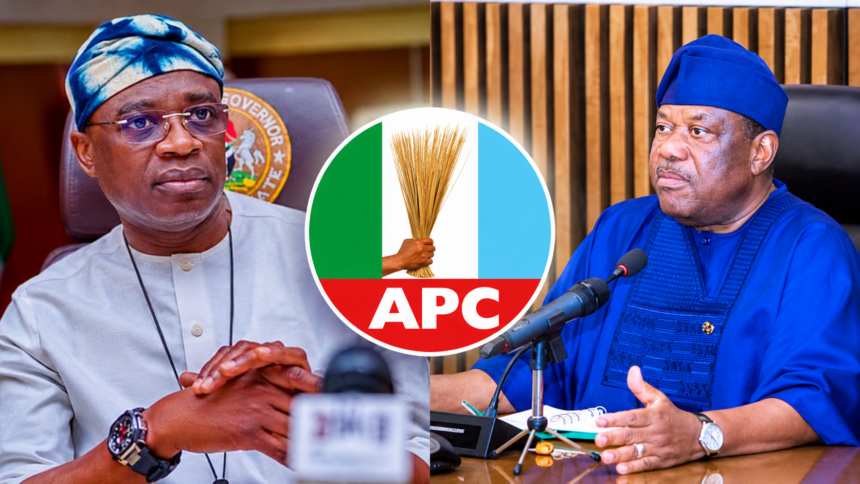
As the 2027 governorship election approaches, Benue State Governor, Hyacinth Alia, is facing mounting political challenges, with divisions within the All Progressives Congress, strained alliances and an increasingly active opposition threatening his bid for a second term.
Alia, a Catholic priest-turned-politician, secured an historic victory for the APC in May 2023, ending the Peoples Democratic Party’s longstanding hold on the state.
However, the political circumstances surrounding his emergence have changed, leaving the governor with the task of managing competing interests within his party while preparing for a potentially difficult re-election contest.
At the centre of the crisis is his deteriorating relationship with the Secretary to the Government of the Federation, Senator George Akume, whose political influence and grassroots network were considered important to the APC’s victory in 2023.
The alliance brought together Akume’s years of political experience and established structures with Alia’s popularity among voters, creating a formidable political force that helped the party dislodge the PDP.
Their relationship, however, reportedly began to deteriorate over disagreements concerning appointments, political influence, party leadership and control of the APC structure in the state.
What started as a disagreement between political allies has since developed into a struggle for control of the ruling party, with reconciliation efforts yet to produce a lasting resolution.
The emergence of parallel party structures and continuing disagreements over leadership have also raised concerns about the APC’s ability to present a united front ahead of the election.
For Alia, the challenge is to maintain his political independence without completely alienating influential party figures whose support could prove important during the campaign.
The divisions were further highlighted during the inauguration of the governor’s 2027 re-election campaign council on November 6, 2026.
According to a source, several prominent APC stakeholders, including Akume, serving senators and members of the House of Representatives from Benue, were absent from the event.
The absence of such influential figures has fuelled questions about the level of unity within the ruling party and the extent of support for the governor’s second-term ambition.
Their political relevance lies partly in their established connections with party members and grassroots mobilisers across the state’s 23 local government areas.
Consequently, Alia’s personal popularity may not be enough to guarantee electoral success if divisions within the party weaken its campaign structure.
Beyond the APC crisis, the governor must also contend with political developments within the opposition, where former governor Samuel Ortom remains an influential figure.
The political relevance of former Senate President, Senator David Mark, and the emerging African Democratic Congress platform also adds another dimension to the contest, while the PDP continues to weigh its own governorship ambitions.
Discussions involving politicians from different camps have raised the possibility of new alliances and realignments, potentially bringing together interests that previously competed against one another.
Such cooperation could create a more formidable challenge for the incumbent, particularly if opposition figures find common ground ahead of the poll.
Another major source of tension for Alia is his disagreement with the APC state chairman, Austin Agada.
For about three years, the governor has reportedly refused to recognise Agada as the party’s chairman, despite a Court of Appeal judgment recognising him as the state chairman.
Instead, Alia backed Benjamin Omale, who was appointed caretaker chairman by the APC national leadership under the then national chairman, Abdullahi Ganduje.
Agada has since secured the enforcement of the court judgment, a development that could further complicate the governor’s relationship with the party structure.
With the re-election campaign approaching, Alia faces the difficult task of managing the lingering disputes, rebuilding relationships with influential stakeholders and preventing the opposition from capitalising on the divisions.
Whether he can overcome these challenges and secure another term will depend, in part, on how effectively he navigates the political contest within the APC and the broader battle for support across Benue State.