


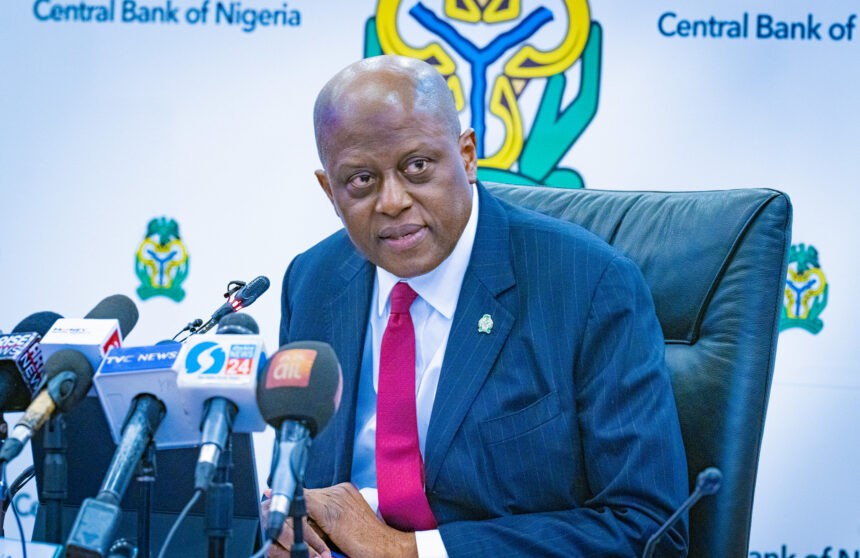
The Central Bank of Nigeria (CBN) says it will retain the interest rate at 23 per cent following a cut in September. CBN Governor Olayemi Cardoso announced the decision at a news conference in Abuja on Tuesday. It followed the 308th meeting of the Monetary Policy Committee (MPC).
The apex bank had, in September, cut rates after it lowered the Monetary Policy Rate (MPR) from 26.5 per cent to 23 per cent.
The latest CBN MPR announcement came just a week after the data from the Consumer Price Index released by the National Bureau of Statistics (NBS) showed that inflation dropped to 14.06 per cent in October. Following the drop in inflation in October, many had hoped that the CBN would cut rates again, but that did not happen. All other banking and monetary instruments also remained unchanged from the last MPC meeting.
For households and businesses, the decision shows that it is not yet uhuru, and the fight against rising prices will continue for the foreseeable future.
Why The CBN Retains Rate
The pace at which prices rise has slowed in recent months. Headline inflation has eased for five straight months. Cardoso attributed this to two reasons. First, the relative exchange rate stability. Second, past central bank policies are now working better across the economy.
However, the slowdown in inflation has started to lose momentum. Economic pressures are still making it hard for prices to fall quickly to match stagnant household incomes. Because of this, committee members found it prudent to retain rates, as holding the rate steady helps keep price expectations under control.
The CBN is also looking ahead at two major spending triggers. The end-of-year festive season is fast approaching. At the same time, election-related activities are starting to intensify. Both events usually release a lot of cash into the economy.
When more people spend massively at once, demand rises, and prices often soar. Cardoso said keeping the current monetary position is the best way to protect the gains made so far.
CBN holds the line on other banking and monetary instruments
The interest rate was not the only tool retained. The MPC also kept the asymmetric corridor around the MPR at +50/-300 basis points. In simple terms, this corridor sets two limits. It guides what banks pay to borrow from the CBN and what they earn on deposits there.
In addition, the committee retained the Cash Reserve Ratio (CRR) at 45 per cent for deposit money banks and 16 per cent for merchant banks. The CRR on non-Treasury Single Account (TSA) public sector deposits also remained at 75 per cent.
These numbers matter because the CRR caps how much cash banks can lend out. A 45 per cent ratio means commercial banks must lock nearly half of their customer deposits with the CBN. A 75 per cent ratio on non-TSA government funds locks away even more cash.
By keeping these rules tight, the central bank prevents too much money from circulating. Less excess cash makes it harder for inflation to rise again.
What this means for the micro and larger economy
For businesses and borrowers, things are not looking good, as they will continue to grapple with a credit squeeze and high interest rates that stifle growth and hamper innovation. Individuals and companies hoping for cheaper credit after September’s rate cut will have to wait longer.
Banks still face tight cash rules, so lending will likely remain expensive. Small business owners seeking holiday stock loans may feel this pinch. On the flip side, savers and those who have invested in bonds, treasury bills and other securities can keep enjoying stronger returns as rates stay at a high double digit.
For ordinary households and families, however, the policy aims to bring stability and relief to the market. If the naira remains steady and cash flow stays controlled, price jumps should slow down further. The MPC also expressed confidence in the ongoing harvest season. A stronger harvest brings more local food to markets, which should help ease food inflation, but this is only a temporary fix and does not guarantee long-term and permanent socio-economic succour to struggling families whose household consumption has plummeted disastrously.
Still, the apex bank is not giving any assurance. Cardoso noted that the committee will remain data-dependent and cautious. That means future decisions will depend strictly on what the numbers show. If festive and election spending triggers fresh price hikes, the bank could tighten monetary instruments. If inflation keeps falling steadily, another rate cut could be afoot.