


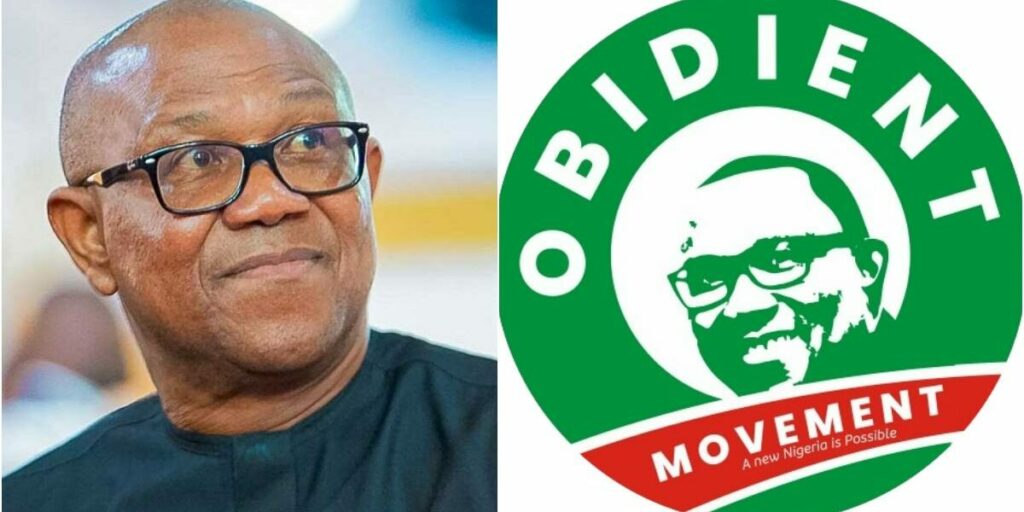
- The uncertainty and misgivings surrounding Obi’s political move, coupled with the perennial and unresolved political crisis in the Labour Party, have forced many Obidients to withdraw from electioneering and elections where Obi is not on the ballot.
- The general erratic and cutthroat political atmosphere in the country has compelled Obi to keep his cards close to his chest regarding his moves and decisions ahead of the 2027 election.
On Saturday, the former governor of Ebonyi State and Minister of Works, Dave Umahi, stated that the state and the entire South East will vote for President Bola Tinubu in 2027. The Obidient, a movement led by the Labour Party presidential candidate, Peter Obi, will not influence the way the residents of Ebonyi and the people of the south east vote in 2027, Umahi declared in a mocking tone of finality while speaking at the Ohanivo 2025 New Yam Festival in Onicha LGA of the state on Saturday.
The Obidient movement changed Nigeria’s political landscape in 2023. A tsunami swept through the country, rewriting and changing the rules of electioneering and political campaigns in the country. Created out of necessity after the supporters of Obi, whose name is the etymology of the movement, realised they would need to pull out all stops and do everything they could if their candidate was going to stand any chance at the polls. Obi, who was contesting the presidency on the platform of the Labour Party after leaving the Peoples Democratic Party (PDP), did not have the luxury of depending on the party for anything more than words of support.
When he became its presidential candidate, the Labour Party did not even have a single councillor in the entire country. Unlike the ruling All Progressives Congress (APC) and PDP, who had national appeal, moneybags and powerful backers both in public and private sectors, many elected public office holders across the three tiers of government and a massive warchest for a general election, Obi had none of these trappings. This is where his enviable and exemplary traits and disposition came in handy. His goodwill attracted millions to him while his humility and frugality made him the toast of the electorate. Whatever he lacked in party support and financial resources, he gained in public and the electorate’s dedication and investment in his ambition.
The prospect of his presidency, what he stands for and the readiness of those who believe in him, as the man to turn Nigeria around, to do any for him gave birth to the Obidient. A label that would later become a sobriquet with which his supporters would be described. Before the Obidients stepped into politics, politicians literally doled out huge sums of money to get the support of the people. But with the Obidients and Obi, it was the other way round. People contributed money and pooled resources towards the actualisation of the goal of a politician they believed in. Though Obi did not win the election, the Obidients made their presence felt on election day.
On election day the Obidient movement swept across the country like a tsunami, dislodging many powerful political dynasties hitherto thought to be formidable and invincible. Many people who did not think they could win elections in the country benefited from Obi’s goodwill and the Obidient volcano. A relatively unknown Labour Party was tossed into the mainstream of Nigerian politics as it became one of the major opposition parties in the country. The Obidient wind of change saw the Labour Party win six senatorial seats and 34 in the House of Representatives, making it the third most popular party in the 10th National Assembly. It also made the gubernatorial aspiration of Alex Otti a reality having contested four times before and losing on all occasions
However, for all the seismic political change it engendered in 2023, the Obidient movement has been found wanting in subsequent off-season and staggered elections, especially gubernatorial polls, as it has not replicated the wondrous feat of 2023 again. This has prompted many people, especially the traducers and political adversaries of Peter Obi, to conclude that the wind has been taken out of the sails of the Obidient movement. But has the influence of Obidients truly diminished? This question can be answered in different ways depending on who is posing or answering it. Nevertheless, one thing we can agree on is that the movement is not as active as it was in the build-up to the 2023 elections. This inactivity or dormancy is largely due to other factors.
The movement has not been able to make its presence felt in elections after the 2023 general elections for a variety of reasons. Since 2015, elections in Nigeria have largely become an exercise in subversion of people’s will but the situation has become progressively worse since 2023. The brazenness and impunity with which elections are rigged have left many disillusioned as whatever little hope they have about democracy being the only form of government that can engender the kind of development and economic growth the country needs has been dashed. This troubling situation has prompted many people, including Obidients, to boycott many of the staggered elections in 2024 and 2025.
Another reason the movement has not been able to shape the outcome of subsequent elections after the 2023 general polls is that Obi himself is not on the ballot for these elections. Many Obidients’ enthusiasm and zeal to bring about change in 2023 were largely because Obi was running for the presidency and the promise of a free, fair and credible election by the Independent National Electoral Commission (INEC). That was why it was easy for many to ride on Obi’s coattails to win federal legislative seats because Senate and House of Representatives elections were held on the same day as the presidential election and voters in many areas in the southern parts and Middle Belt areas of the country voted for Labour Party across board as they felt if Obi was going to be the kind of president they wanted him to be if he won then he needed to have a foothold and considerable influence in the national assembly.
This gave birth to the “LP from top to bottom” slogan. After the election, the enthusiasm and zeal petered out not only because Obi is not on the ballots of subsequent elections but because many of those who leveraged his goodwill and clout to win elections turned out to be nothing more than unscrupulous opportunists. Many of them have either outright defected from the Labour Party or are now secretly aligned with people who are known political foes of Obi. This has made many Obidients less trusting and wary of people who now try to hitch their political wagon to the potent horse of the Obidient movement. Many have not vowed to restrict their participation in any elections that Obi is involved in and on the ballot. This has effectively neutered their buoyancy and ability to stamp their authority on elections where Obi is not among the candidates.
Furthermore, the uncertainty and misgivings surrounding Obi’s political move, coupled with the perennial and unresolved political crisis in the Labour Party, have forced many Obidients to withdraw from electioneering and elections where Obi is not on the ballot. The general erratic and cutthroat political atmosphere in the country has compelled Obi to keep his cards close to his chest regarding his moves and decisions ahead of the 2027 election. This is not necessarily to keep the Obidients in the dark but to beat his political adversaries at their own game and keep them at bay.
The aforementioned reasons can be adduced as why the Obidients have not brought the vigour, the passion and the zeal of the 2023 general election to the off-cycle polls conducted since then. This cannot automatically mean that the movement has lost its potency and virility and will not dictate the play in 2027. As a leading figure in the ruling party, expecting Minister Umahi to sing the praise and extol the Obidient movement is like expecting a jew to eulogise the Nazis. It is impossible.
The minister’s remarks are either fueled by the need to amplify the chances of the APC in 2027 and prop it up as indomitable or spurred by a poor reading of the nation’s political climate. The 2027 election is still some eighteen months away, and, like they say, 24 hours is a long time in politics. It will be a bit immature for anyone to make a definite and conclusive statement on the existential status of the Obidient movement before the 2027 general elections, assuming they will be free, fair and credible.