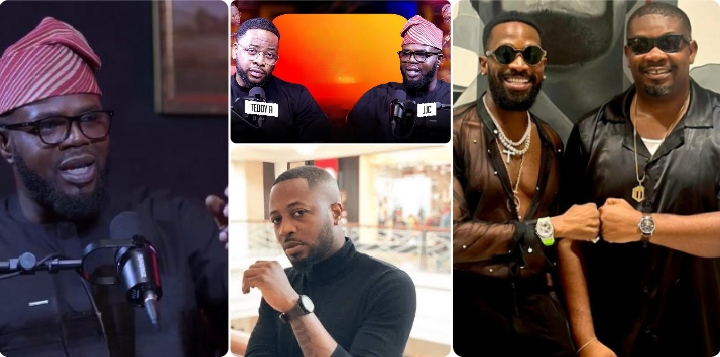
The room felt heavy with unsaid words. Cameras rolling, lights soft, BBNaija star Teddy A leaned forward. Silence hovered as if the air itself awaited confession. Across him, Music veteran and Filmmaker, Abdulrasheed Bello aka JJC Skillz shifted in his seat, the weight of years etched in the lines of his face. This was not just another music interview. The tension was tangible. Behind casual smiles lay a history of ambition, broken trust, and battles fought in studios and clubs long forgotten. Every word promised to reveal pieces of Nigeria’s music history that had never been fully told.
He began with the earliest days, before fame and glittering stages. He spoke of the grind, the moments when doors slammed without reason and when recognition felt like a distant star. Afrobeat and hip hop were still finding their voice in Nigeria, and he was in the thick of it, struggling, crafting, hustling. He carried a vision, yet found himself overlooked, sometimes undermined, sometimes invisible despite being foundational. The struggle was lonely and exhausting, a test of endurance few would understand.
Each recollection seemed to weigh heavier than the last. His voice carried not anger but sorrow, tinged with a stubborn pride. It was a story of someone who had shaped pathways for others yet was left on the margins of the narrative. From the earliest collaborations to impromptu shows in small clubs, he had invested time, energy, and belief in people who would later walk paths diverging from his own. Behind each anecdote was a lesson about ambition, loyalty, and the thin line between mentorship and betrayal.
As the conversation deepened, Teddy A remained still, letting Skillz navigate the terrain. The audience online felt every pause and hesitation, every glance that betrayed memories of triumphs and slights. There was a rhythm to the telling, a cadence that mirrored the beats Skillz had once mastered. This was history in motion, a personal chronicle woven into the collective story of Nigeria’s music industry, and no filter could contain the rawness of it.
The Early Struggle: Breaking into Nigeria’s Music Scene
JJC Skillz recalled a time when breaking into the Nigerian music industry felt impossible. Opportunities were scarce, connections were guarded, and recognition often depended on who you knew rather than what you created. He painted pictures of nights spent in studios, learning the nuances of production, and navigating the egos that loomed over every stage. These were the formative years, where talent was tested against patience and resilience, where every rejection became a lesson in survival.
There were moments of fleeting triumph, small gigs that felt like victories. Yet, each win seemed tempered by the reality that others often claimed the spotlight more easily. Despite this, Skillz continued, forging relationships and refining his craft. He described the emotional toll of giving his all, sometimes receiving gratitude, other times only indifference. The industry was a proving ground, and he had to fight for every inch of respect, every note of recognition.
Reflecting on these experiences, Skillz admitted that the early struggle left scars. Ambitions clashed with industry politics, and loyalty was frequently tested. He described encounters with peers where trust was extended and broken, opportunities offered and later withdrawn. These early challenges shaped his understanding of the music business as much as they honed his creative instincts. Every song, every collaboration carried the imprint of lessons learned in hardship.
Despite the challenges, Skillz’s narrative highlighted resilience. The early years were as much about survival as they were about artistry. He had built foundations that others later stood on, even if credit was not always forthcoming. The story was not just about personal pain but also about contribution, about laying tracks in the Nigerian music landscape that helped shape what it would eventually become.
Mo’Hits and the Shadows of Alleged Betrayal
One of the most discussed revelations from the interview centered on Don Jazzy, D’Banj, and the early Mo’Hits circle. JJC Skillz claimed that he had been instrumental in their rise, providing mentorship, resources, and guidance at a time when their paths were uncertain. He recalled housing them, feeding them, and securing performance opportunities that allowed them to be noticed. According to him, these acts of support were never forgotten, yet gratitude was fleeting.
Skillz alleged that behind closed doors, negative words were being circulated about him. The very individuals he helped were, in his view, working to diminish his presence and credibility. Social media erupted at the allegations, fans and critics debating their plausibility, reflecting the enduring fascination with Mo’Hits history. The claims touched on the tension between collaboration and competition, illustrating how success in the Nigerian music scene often comes with hidden costs.
He described the emotional weight of feeling undermined by peers once trusted. It was not merely about missed opportunities but a deeper sense of erasure, of contributions that were minimized or rewritten. For Skillz, these experiences were lessons in vigilance, teaching that support offered to others can be complicated by ambition and self-interest. The betrayal he described was as personal as it was professional, shaping how he approached relationships within the industry thereafter.
The narrative unfolded like a cautionary tale, a lens into the complexities of mentorship in a competitive space. Skillz’s reflections highlighted how ambition can intersect with loyalty, and how early contributions, no matter how significant, do not guarantee lasting acknowledgment. The Mo’Hits story, as recounted by Skillz, became a microcosm of broader patterns in Nigerian music, where histories are contested and legacies debated.
Don Jazzy and D’Banj as His Signees
JJC Skillz reflected on a period when Don Jazzy and D’Banj were not yet household names, describing them as young talents full of energy and ambition but lacking the networks and guidance to navigate the Nigerian music scene. He claimed that he signed both artistes under a fifty-fifty contractual agreement, believing the partnership to be fair and mutually beneficial.
The arrangement, according to Skillz, was meant to balance creative freedom with shared responsibility, a structure he thought would foster collaboration rather than competition.
Yet, the partnership soon became a source of tension. Skillz recounted that Don Jazzy and D’Banj began questioning the fairness of the arrangement, suggesting that he was taking a larger share than what was agreed. These conversations, he said, were not just professional disagreements but deeply personal, shaking the trust that had underpinned their early relationship. The friction was subtle at first but eventually escalated into an irreconcilable divide, leaving Skillz feeling isolated from the very people he had nurtured.
Alleged Refusal to Collaborate With Tunde Ednut as Witness
Skillz described a later chapter where he attempted to reconnect musically with Don Jazzy and D’Banj. He reached out with the intention of collaboration, believing that their shared history could pave the way for creative synergy. According to Skillz, both artistes allegedly ignored or declined his requests, leaving him perplexed and hurt. The refusal was not framed as a minor oversight but as a symbolic rejection of past connections and shared endeavors.
Adding another layer to the narrative, Skillz revealed that Tunde Ednut had allegedly confirmed a conversation in which Don Jazzy and D’Banj purportedly agreed not to collaborate with him. He claimed that the discussion included the notion that he sought to ride on their shine, a sentiment that cut deep because Skillz felt that he had been foundational in their early growth. This, in his account, was not simply a professional slight but a personal rebuff, underscoring the tension between gratitude and ambition in the music scene.
The refusal, Skillz emphasized, had broader implications for his artistic trajectory.
Plans for musical projects were stalled, and opportunities that could have amplified his influence in the industry were hindered. He described the emotional toll of seeing peers succeed while he remained sidelined, reinforcing a pattern of frustration and invisibility that had marked his career. The experience, though painful, became a lens through which he examined the intersection of loyalty, recognition, and ambition.
Skillz’s reflections on this period also highlighted a philosophical approach to setbacks. He framed the rejection not as an endpoint but as a turning point, a moment to recalibrate and pursue alternative collaborations. It was an assertion of agency in an industry often dictated by alliances, a reminder that resilience can transform exclusion into innovation. The refusal, while stinging, catalyzed a redirection that would eventually contribute to his legacy in unexpected ways.
‘We Are Africans’ Collaboration Shift
One of the most illustrative examples of Skillz’s resilience was his recounting of the “We Are Africans” project. Initially, he intended the song to feature Don Jazzy and D’Banj, leveraging their fame to create a unifying anthem. The plan, however, was disrupted when they allegedly declined involvement, leaving Skillz to reconsider his approach. The pivot was both strategic and creative, as he sought collaborators who could bring depth and cultural resonance to the project.
Skillz turned to Femi Kuti, Dagrin, and other artistes, redirecting the project toward a broader African representation. In his account, this decision imbued the song with a cultural weight that transcended commercial considerations. By incorporating voices that carried history and artistry, the collaboration evolved into a musical statement that resonated with audiences across Nigeria and beyond. The absence of Don Jazzy and D’Banj, he suggested, inadvertently allowed the song to achieve a richer, more authentic identity.
The shift also symbolized a turning point in Skillz’s career narrative. It demonstrated his ability to adapt to setbacks and convert potential losses into opportunities for innovation. He described the experience as a lesson in creative autonomy, emphasizing that artistic vision should not be compromised by personal grievances. The success of “We Are Africans” became a testament to the power of perseverance, of transforming rejection into a defining moment.
Beyond its commercial or critical reception, Skillz framed the project as a personal affirmation. It was proof that his contributions to the music industry extended beyond any single alliance or collaboration. By reimagining the project with artists who shared his vision, he asserted his relevance, agency, and commitment to the craft. In essence, the song became a reflection of resilience in the face of perceived betrayal, a milestone that underscored his ongoing impact on Nigeria’s musical landscape.
Dr Sid and the Rejected Remix
Following the release and success of “We Are Africans,” Skillz recounted an encounter with Dr Sid, a Mo’Hits Records artiste. According to him, Dr Sid proposed a remix that would have incorporated D’Banj and other Mo’Hits members, potentially reopening old wounds. Skillz said he declined, choosing not to revisit relationships that had caused emotional and professional strain. The decision, he framed, was both protective and principled, prioritizing his creative integrity over opportunistic collaborations.
This refusal reflected Skillz’s evolving approach to the industry. He emphasized that decisions were not made out of spite but as a deliberate strategy to maintain control over his artistic narrative. By declining the remix, he avoided re-entering dynamics that had previously undermined his confidence and recognition. The encounter, in his telling, reinforced the importance of setting boundaries and asserting agency in an environment where loyalties can be fluid and reputations precarious.
Skillz also suggested that this moment was emblematic of his broader philosophy regarding collaboration. Creative partnerships, he noted, should be grounded in mutual respect, trust, and recognition of contribution. When these elements are absent, even potentially lucrative or high-profile projects may not be worth pursuing. The encounter with Dr Sid became a lens through which he examined the ethics of artistic relationships, the responsibilities of mentorship, and the consequences of unresolved tensions.
In hindsight, the rejected remix symbolized both closure and clarity. Skillz framed it as a conscious decision to move forward without reopening chapters that had caused pain. It was a reaffirmation of autonomy, a deliberate step to define his legacy on his terms. By prioritizing integrity and emotional well-being over opportunism, he illustrated the often-overlooked emotional calculus behind decisions in the music industry.
Perfect. I’ll continue the article with the next sequence while keeping the same narrative nonfiction style, four-paragraph subheadings, metaphorical flow, fact-based storytelling, SEO-friendly subheadings, and reader-friendly readability.
The Deepest Pain — D’Banj and 2Kriss
JJC Skillz described what he called the most personal and painful episode in his career, involving D’Banj and an emerging artiste named 2Kriss. According to Skillz, he had invested significant time nurturing 2Kriss, helping him navigate studio work, performance preparation, and networking within the music industry. The relationship was emblematic of Skillz’s mentorship style, grounded in dedication and a desire to build careers rather than merely seek fame.
The incident occurred at a club, a public setting that made the confrontation even more jarring. Skillz claimed that D’Banj approached him with a threat, stating that he intended to take 2Kriss from him, mirroring what Skillz alleged had happened with Don Jazzy years prior. The words, Skillz suggested, cut deeper than any professional disagreement, striking at trust, loyalty, and the sense of personal investment he had placed in his protégés.
For Skillz, this moment crystallized the emotional burden of working in an industry where relationships could turn transactional. He described feelings of betrayal, frustration, and powerlessness, emotions that had accompanied earlier conflicts but were amplified by the personal nature of the threat. The incident reinforced a recurring theme in his narrative: that contributions and mentorship could be overshadowed by ambition and self-interest, leaving foundational work unacknowledged.
Yet, even in recounting this painful memory, Skillz framed the experience as instructive. It became a lesson in protecting one’s intellectual and creative property, understanding the boundaries of collaboration, and navigating the delicate balance between trust and caution. The episode shaped his perspective on mentorship, emphasizing the need to safeguard not just artistic work but also the emotional and relational investment that underpins it.
Reflections on Career and Legacy
Throughout the interview, Skillz reflected deeply on his career trajectory and the legacy he hoped to leave behind. He highlighted his international work, particularly his time in the United Kingdom, where he expanded his creative scope and built networks that enriched his understanding of music on a global scale. He suggested that these experiences positioned him uniquely as an artist capable of bridging African and international music spaces.
Skillz expressed frustration over what he perceives as underappreciation in Nigeria’s mainstream music narrative. Despite his foundational contributions to the early stages of Afrobeat and hip hop in the country, he felt sidelined in historical accounts that prioritize more visible names. The sense of being overlooked, he said, contrasted sharply with the level of effort and mentorship he had provided, creating a lingering tension between recognition and reality.
In exploring his legacy, Skillz emphasized artistic integrity over commercial success. He framed his career as a mosaic of collaborations, mentorships, and projects that shaped musical directions rather than mere chart performance. The narrative, he suggested, should celebrate the architects of change and innovation, including those whose contributions are less visible but no less impactful. His reflections were both personal and philosophical, a reckoning with time, effort, and the elusive nature of lasting recognition.
These reflections also extended to the broader music community. Skillz suggested that acknowledging pioneers and behind-the-scenes contributors is crucial to sustaining an industry that values both innovation and fairness. He positioned his story as a cautionary tale for future generations, illustrating the importance of documenting contributions, maintaining respect, and navigating ambition while honoring those who paved the way.
Industry Relationships and Personal Insights
Skillz shared nuanced insights about navigating relationships within the music industry. He observed that collaborations, while often celebrated publicly, can be fraught with complexity behind the scenes. Expectations, personal ambitions, and competition frequently influence interactions in ways that outsiders may not perceive. Skillz framed these dynamics as central to understanding both his personal experiences and the broader ecosystem of Nigerian music.
He discussed the emotional impact of feeling overlooked by peers, emphasizing that professional neglect often carries personal consequences. The experience of being undervalued, according to Skillz, creates a dual challenge: maintaining creative output while managing the internal toll of diminished recognition. His reflections highlighted the psychological landscape of an industry that demands both resilience and adaptability in the face of shifting alliances.
Skillz also offered perspectives on the power of mentorship and the responsibilities that come with nurturing emerging talent. He suggested that investing in others is not only an act of generosity but also a strategic contribution to the sustainability of the music community. At the same time, he emphasized the importance of protecting oneself from exploitation and navigating relationships with discernment. These insights underscored the tension between collaboration and self-preservation that defines the careers of many industry veterans.
Ultimately, Skillz framed his experiences as lessons in agency, foresight, and emotional intelligence. He suggested that understanding the motives and ambitions of peers is as critical as mastering artistic craft. The narrative painted a portrait of an artist deeply aware of both the creative and relational dimensions of his profession, navigating challenges with reflection and strategy while maintaining an enduring commitment to his craft.
Tone and Public Reaction
The interview’s tone was widely described as explosive and candid, with Skillz speaking openly about grievances that had lingered for years. He did not shy away from naming individuals, recounting specific events, and expressing the emotional consequences of professional betrayals. The atmosphere, as conveyed through social media reactions, was charged with a mixture of shock, empathy, and debate, reflecting the enduring fascination with Mo’Hits history and the personalities involved.
Public reaction ranged from supportive to skeptical, illustrating the polarizing nature of the revelations. Fans debated the validity of Skillz’s claims, contextualizing them within the broader trajectory of Nigerian music. Social media commentary emphasized the complexity of industry relationships, the interplay of fame and loyalty, and the often-unseen contributions of artists whose work shapes cultural movements without necessarily capturing widespread recognition.
Media outlets highlighted the interview as a rare instance of candid reflection from a veteran artist who had largely remained in the background. Analysts noted that Skillz’s narrative, whether fully corroborated or not, offers insight into the structural and relational challenges within the music industry. His account served as both documentation and commentary, bridging personal memoir with cultural history.
The tone of the interview, Skillz emphasized, was intended not to inflame but to illuminate. He positioned his narrative as a reflection on past experiences, the lessons learned, and the importance of acknowledgment. The public response, while varied, reinforced the significance of such disclosures in shaping collective understanding of Nigerian music history and the nuanced dynamics that define it.