An affidavit filed at the federal high court in Abuja on September 12, 2025, by an official of the Independent National Electoral Commission (INEC) outlined the commission’s position on the leadership dispute within the African Democratic Congress (ADC).
The affidavit was deposed by an assistant executive officer at the commission, Jacob Ayuba, in response to an application brought before the court by Nafiu Bala.
Bala, who identified himself as the factional chairman of the party, had approached the court seeking orders to restrain members of a rival leadership group from acting as party executives.
The suit, marked FHC/ABJ/CS/1819/2025, was filed on September 2, 2025, and named several parties, including the ADC, David Mark, Rauf Aregbesola, the electoral commission, and Ralph Nwosu.
The dispute followed developments within the party in July 2025 when its founder, Ralph Nwosu, announced the resignation of members of the national working committee.
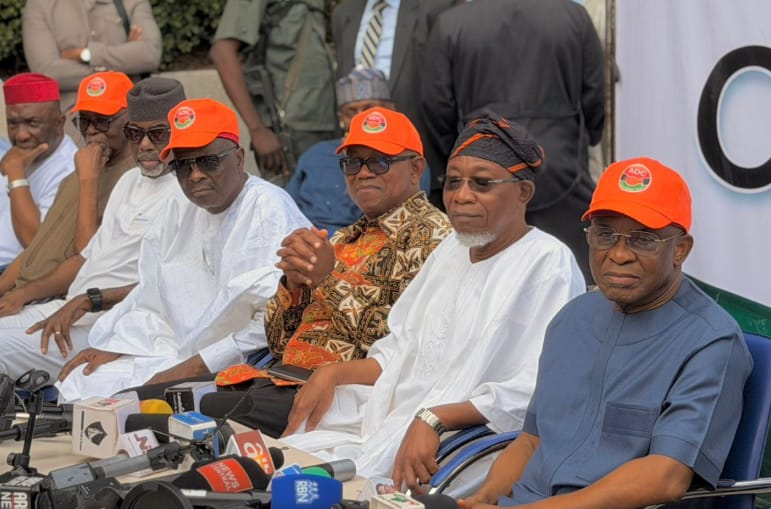
At the time, Nwosu endorsed an interim leadership arrangement led by the former senate president, David Mark.
The arrangement, however, was contested by a faction within the party led by Bala, who maintained that he did not step down from his position.
Bala argued that, based on the party’s constitution, he was next in line to assume leadership following Nwosu’s exit.
He asked the court to stop the rival group from presenting itself as the leadership of the party and to direct the commission to recognise him as acting national chairman.
He also sought orders to halt party activities such as meetings, congresses, and conventions pending the determination of the case.
The motion ex parte was heard on September 4, 2025, before the presiding judge, Emeka Nwite.
The court directed that all respondents be notified and required to show cause why the application should not be granted.
In response, the electoral commission filed an affidavit explaining its actions and position regarding the dispute.
Ayuba stated in the affidavit that the commission received a letter from the party on July 4, 2025, inviting it to observe a national executive council meeting scheduled for July 29, 2025.
He explained that the venue for the meeting was later changed, after which officials of the commission were deployed to monitor the proceedings.
According to him, a report was prepared by the monitoring team and submitted to the commission’s headquarters.
He stated that the report confirmed that the party’s NEC carried out changes to its leadership structure during the meeting.
He added that the outcome of the meeting included the appointment of David Mark as national chairman and Rauf Aregbesola as national secretary.
He further stated that the commission subsequently updated its records to reflect the changes in the party’s leadership.
“The 4th Defendant in furtherance of the change of leadership in the 1st Defendant’s National Working Committee, also uploaded the names of all the National Officers of the Party on its website,” the affidavit read.
“A Copy of the list of the National Officers of the 1st Defendant uploaded on the 4th Defendant is herein attached and marked as Exhibit ‘INEC 3’.”
The affidavit also addressed the reliefs sought by the applicant, stating that the actions he aimed to restrain had already been completed.
“The acts the Plaintiff/Applicant seeks to restrain by the ex parte application have already been completed,” the document stated.
“That I know as a fact that an injunction cannot lie to stop a completed act.”
The commission further argued that the matter before the court related to internal party affairs.
“That the Plaintiff’s application is in substance an invitation to this Honourable Court to delve into issues of internal/domestic affairs of 1st Defendant as a political party,” the affidavit stated.
“That I know as a fact that a Court of record should not dabble into a political question which remains the exclusive preserve of political parties which should be allowed to do their things.”
It added that the grievances raised by the applicant concerned internal processes rather than issues relating to candidate nomination or primary elections.
“That the Plaintiff’s grievances as contained in his Originating Summons relate solely to the 1st Defendant’s internal processes of changing National Officers of the Party,” the affidavit read.
“That I know as a fact that the jurisdiction of the Court in party affairs is limited to where its complaint is about the conduct of its primaries for the selection/ nomination of a candidate.”
Subsequently, the dispute extended to the appellate level after the rival leadership challenged the proceedings at the lower court.
In March 2026, the court of appeal dismissed the challenge, stating that it lacked merit.
The appellate panel, led by Uchechukwu Onyemenam, held that no substantive ruling had been issued by the lower court at the time of the appeal.
The court noted that the directive given by the trial judge was limited to notifying the parties involved.
It also stated that there was no valid decision upon which the appeal could be based.
The court directed all parties to maintain the existing situation and avoid actions that could affect the ongoing proceedings.
Following the judgement, the electoral commission announced on April 1 that it would suspend engagement with both factions of the party.
The commission stated that it would not monitor meetings or activities of either group pending the resolution of the dispute.
The development reflected the continuing legal and administrative processes surrounding the leadership contest within the party.