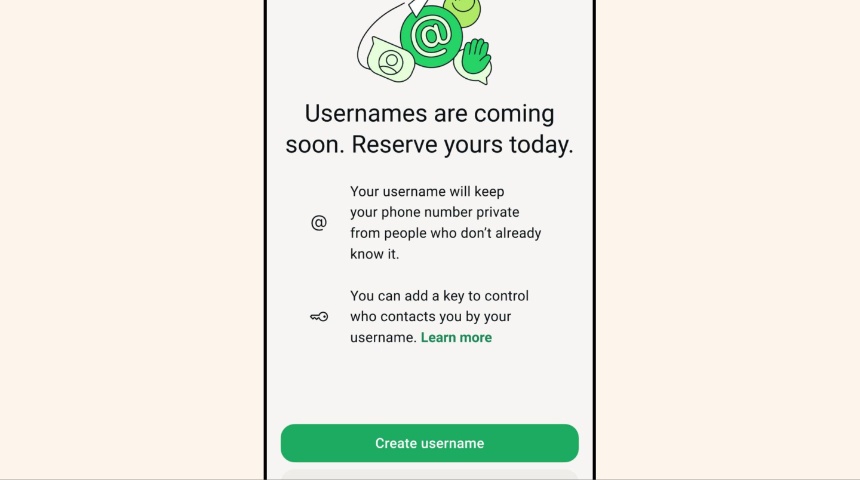
WhatsApp just confirmed what beta testers have suspected for months: phone numbers are no longer the only way to find someone on the app. Starting this week, the Meta-owned platform is letting its more than three billion users reserve a username, a handle they can hand out instead of a personal number once the feature fully launches later in 2026.
- What’s Actually Changing
- Why WhatsApp Is Doing This Now
- How to Reserve Your Username Right Now
- The Naming Rules You Need to Know
- The Username Key: An Extra Layer of Privacy
- When Is It Actually Launching?
- What This Means for Businesses
- How This Compares to Other Messaging Apps
- Should You Reserve a Username Today?
It’s a quiet but significant shift for an app that has tied identity to phone numbers since it launched in 2009. For the first time, you’ll be able to meet someone new, a classmate, a neighbour, a contact from a work event, and give them a way to reach you on WhatsApp without handing over the one piece of information that’s nearly impossible to change once it leaks.
What’s Actually Changing
‘s vice president of product, Alice Newton-Rex, told reporters the company built usernames as a privacy-first feature from the ground up. There’s no public directory to browse, no autocomplete, and no algorithm suggesting accounts you might know. Anyone wanting to message you for the first time will need to type your exact username. Get one character wrong, and the conversation simply doesn’t start.
That design choice separates WhatsApp’s approach from Instagram or X, where usernames double as a discovery tool. Here, the handle exists purely to replace the phone number in the moment of first contact. Once a conversation begins, everything continues exactly as before, end-to-end encrypted, with no change to how messages are protected.
Your phone number doesn’t disappear entirely. It still powers account verification, login, and recovery in the background. What changes is what you’re required to disclose to a stranger before you’re willing to talk to them.
Why WhatsApp Is Doing This Now
The company has been quietly preparing the groundwork since 2023, with references to usernames spotted in early beta builds long before public testing began. A limited rollout reached select users, including a batch of Indian beta testers, in April 2026. By March, business-scoped user IDs were already live in webhook responses for companies using WhatsApp’s API, and by May, the API supported sending messages directly to those identifiers.
WhatsApp’s own explanation, posted in its announcement, captures the reasoning in plain terms: a phone number is personal, it’s tied to so many parts of a person’s life, and sharing it with someone new can feel like a far bigger step than it should be. Usernames are meant to lower that barrier without lowering the platform’s security standards.
There’s also a numbers problem the company had to solve before launch. With three billion-plus accounts already on the platform, short, memorable handles were always going to run out fast. That’s exactly why reservations opened well ahead of the actual feature, giving people first dibs on the username they want before global demand kicks in.
How to Reserve Your Username Right Now
If you want to lock in a handle before someone else takes it, the process takes seconds:
- Update WhatsApp to the latest version on your phone or desktop.
- Open Settings, then tap Account, then Username.
- Type in the handle you want, or use WhatsApp’s built-in username generator if you’re drawing a blank.
- Confirm your reservation.
Reservations don’t activate the feature itself, that’s still rolling out gradually by country, but they guarantee the name is yours when it does go live. WhatsApp said users will get an in-app notification once usernames are switched on for their region.
The Naming Rules You Need to Know
WhatsApp isn’t leaving the format open-ended. According to reporting from WABetaInfo, which has tracked the feature through multiple beta releases, every username must follow these rules:
- Between 3 and 35 characters long
- At least one letter required
- Lowercase letters, numbers, periods, and underscores only
- Cannot start with “www.” or end in a domain extension like “.com” or “.net”
That last rule is a deliberate anti-phishing measure, designed to stop bad actors from creating handles that mimic real websites. Notable individuals, brands, and organisations will also have certain usernames reserved on their behalf to prevent impersonation, and WhatsApp said it plans to verify accounts that carry recognisable names.
One detail worth flagging for anyone active across Meta’s apps: your WhatsApp username needs to be unclaimed across Instagram and Facebook simultaneously. If you already run a consistent handle on those platforms, you can claim the matching one on WhatsApp directly, useful for creators and small businesses that want one identity everywhere. If you’d rather keep your profiles separate, this cross-platform rule is worth thinking through before you reserve anything, since the same handle could make it easier for strangers to connect your accounts.
The Username Key: An Extra Layer of Privacy
Beyond the handle itself, WhatsApp is introducing an optional four-digit code called the username key. Think of it as a second lock. Even if a stranger somehow learns your exact username, they won’t be able to message you unless they also have this key.
Anyone who tries to reach you without it gets diverted to a separate Requests folder instead of landing in your main inbox, keeping unsolicited contact out of sight until you decide whether to engage. It’s an optional setting, but for anyone who wants tighter control over who reaches them first, it’s worth switching on.
When Is It Actually Launching?
This is where the timeline gets specific. According to recent reporting, WhatsApp’s rollout is happening in clearly defined waves:
- April 8, 2026 — Limited beta testing began for a small group of users.
- June 29, 2026 — Username reservations opened globally.
- July 7, 2026 — Wave one goes live in Algeria, Azerbaijan, Ghana, Libya, and Nepal.
- July 20, 2026 — Wave two expands the feature further.
- September 2026 onward — The rest of the world begins receiving access.
Most users elsewhere should expect the feature to reach them gradually “over the coming months,” in WhatsApp’s own words, rather than all at once. Keep your app updated and check Settings periodically; WhatsApp says it will notify users directly once the option appears on their account.
What This Means for Businesses
For companies running customer service or marketing through WhatsApp’s Business API, this update isn’t optional homework, it’s a deadline. WhatsApp has told business partners that systems built around phone-number identification need to support the new Business-Scoped User ID (BSUID) by mid-2026.
In practice, that means CRM platforms, chatbots, and support dashboards built to recognise customers by phone number alone will need updating to also handle username-based contacts. Businesses won’t lose access to phone numbers they already have on file, existing customer relationships carry over unaffected, but any new contact who signs up with a username instead of sharing their number will need to be tracked differently.
Meta has said it will continue updating its developer documentation as the rollout expands, and businesses are being encouraged to start auditing how deeply their systems depend on phone numbers as the primary customer identifier.
How This Compares to Other Messaging Apps
WhatsApp is, notably, late to this particular party. Telegram has supported usernames since 2013. Signal added them in 2022. Both platforms have used handles for years as a way to message people without exchanging numbers first. What sets WhatsApp’s version apart is the deliberate decision to avoid turning it into a discovery feature, there’s no search bar to type a name into and browse results, and no suggested contacts based on mutual connections. It’s a handle exchanged directly between two people, nothing more.
It’s also a response, in part, to the rise of RCS messaging, which uses sender IDs rather than raw numbers for identification. As messaging platforms compete on privacy as much as features, WhatsApp’s move closes a gap that’s existed since the app first launched.
Should You Reserve a Username Today?
If you’ve got a name, brand, or handle you’d be upset to lose, the answer is yes, do it now rather than waiting. Reservations are already open, the process takes under a minute, and the company has been clear that demand is expected to be high once the wider rollout begins. Catchy, short handles will go quickly.
For everyone else, there’s no rush. WhatsApp has repeatedly stressed that usernames are entirely optional. The app will continue working exactly as it does today for anyone who doesn’t want to set one up, phone numbers aren’t going away, and existing contacts who already have your number will keep seeing it as normal.
What’s changing is the choice. For the first time on WhatsApp, you’ll get to decide what a stranger needs to know about you before they can say hello.