


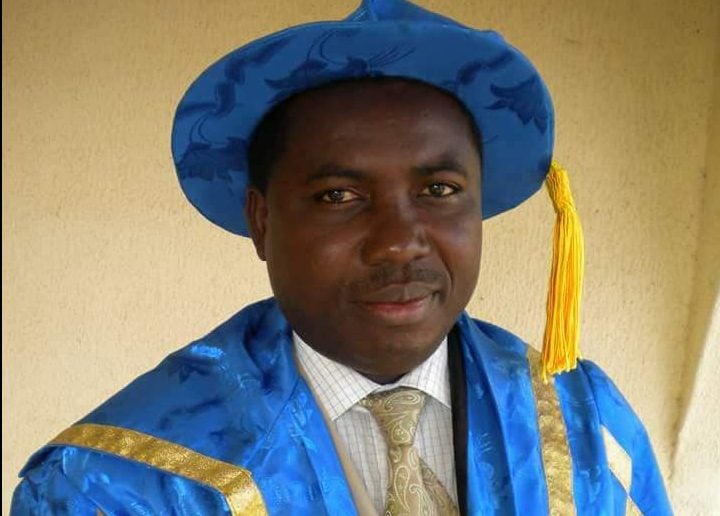
Last week Professor Mahmood Yakubu resigned as the chairman of the Independent National Electoral Commission (INEC) after over a decade overseeing the affairs of the electoral body. The jury is still out on what the general consensus is about his stewardship and how posterity will judge him.
On Thursday, President Bola Tinubu appointed Joash Ojo Amupitan as the chairman of INEC, marking the beginning of a new era for the commission. The appointment was confirmed by the National Council of State.
Amupitan was born on April 25, 1967, in Aiyetoro-Gbede, Ijumu LGA of Kogi state. He is married to Yemisi, and they have four children.
He was born into a deeply religious Christian family that cherishes education. His late mother, Alice Ajigba Amupitan, was an educator and church leader in Kogi state.
He had his first degree at the University of Jos, where he obtained a Bachelor of Laws (LL.B) degree in 1987. He was called to the bar in 1988. Amupitan joined UNIJOS in 1989 as an assistant lecturer. He had his master of Laws (LL.M) in 1993, and bagged a Doctor of Philosophy (PhD) in law in 2007. His academic journey was defined and shaped by tenacity and an unflinching dedication to legal scholarship.
Over the years, he has contributed significantly to papers and books on public law, corporate governance, privatisation law, and the law of evidence through his academic works, which include journal articles, book chapters, monographs, and case reviews. He has been a supervisor to over 30 master of Laws candidates and more than a dozen doctoral students. His academic record is a catalogue of accomplishments that shows a career dedicated to improving legal education and advancing Nigeria’s jurisprudence.
Amupitan was conferred with the rank of senior advocate of Nigeria (SAN) in 2014. Nigeria’s highest and most coveted legal profession’s recognition.
The rank conferment underscored his excellence in practice, research, and general contributions to strengthening the country’s jurisprudence. It positioned him as both an academic of repute and a sterling practitioner who combines theory with legal practicality.
At UNIJOS, Amupitan headed the department of public law before serving as dean of the faculty of law. He was subsequently appointed chairman of the committee of deans and directors and a member of the university’s governing council. The senate of the university elected him deputy vice-chancellor (administration) in 2022, a role that deepened his experience in management and governance.
These positions have earned him a seat at the table where important discussions about legal education and practice in Nigeria are taking place.
In December 2023, he was appointed pro-chancellor and chairman of the governing council of Joseph Ayo Babalola University, Ilesa, Osun state. Outside the university system, Amupitan has served on the governing council of the Nigerian Institute of Advanced Legal Studies and on the Council of Legal Education.
AMUPITAN AND INEC’S NEW ERA
Amupitan’s appointment as INEC’s chairman is coming at a time when the trust of the electorate in the commission is at an all-time low, and there is more scrutiny on it than ever. The commission grapples with mounting pressure from Nigerians to conduct free, fair and credible elections.
Many are hoping that he will use his combined background and wealth of experience in academia, legal practice and institutional governance to bring the much-needed discipline, far-reaching reforms and impactful leadership to the commission.
The professor’s knowledge of electoral law reform would come in handy and be critical to fixing the lacuna in the system and strengthening enforcement.
As INEC chairman, Amupitan faces an immediate and herculean task of restoring voter trust and confidence, strengthening the credibility of the voter register, and ensuring that technology enhances rather than hinders elections.
How he handles political pressures in relation to the commission’s autonomy, a recurring challenge in Nigeria’s democracy, will set the tone for how his time will be remembered.
His record and accomplishments reflect the disposition of a character that places a premium on law, stability, and reform, but how he will bring these to bear at INEC will no doubt shape his legacy.