
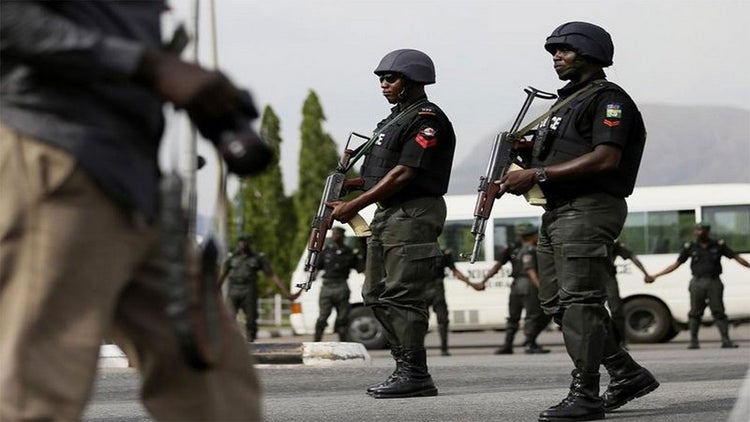
The order to strip very important persons of police escorts has resurfaced again, adding to a long list of similar directives that have shaped Nigeria’s security landscape over the past two decades.
The latest instruction came from the President, Bola Tinubu, who directed the withdrawal of all police personnel assigned to VIPs after a security briefing at the State House.
The meeting was attended by the inspector-general of police, the chief of army staff, the chief of air staff, and the director-general of the Department of State Services.
The president said any individual who still requires an armed escort must obtain protection from the Nigeria Security and Civil Defence Corps rather than the Nigeria Police Force.
The presidency explained that the move aims to return officers to understaffed formations, especially in remote places where attacks and abductions continue to rise.
The practice of pulling officers off VIP duty is, however, not new.
Successive police chiefs have issued similar directives, each time promising to restore manpower to operational units.
Implementation has often been patchy, short-lived or reversed due to political pushback.
Below is a summary of ten key moments when authorities attempted to take police personnel off VIP assignments.
The former inspector-general, Tafa Balogun, made one of the earliest attempts in 2003 when he ordered the removal of police orderlies from politicians and judicial officers.
He said the measure was necessary to reduce misuse of police manpower.
The move attracted mixed reactions, and the then governor of Lagos, Bola Tinubu, urged the police to reconsider the policy.
The police later restored escorts to judges, but Balogun again directed officers attached to private citizens to return to their bases in 2004.
A similar approach resurfaced in 2009 when the former inspector-general, Ogbonnaya Onovo, instructed all officers serving as private orderlies to report back to their commands.
He stated that the federal executive council had earlier approved a limited list of officials entitled to police security, such as the president, vice-president, ministers and certain judicial officers.
He excluded former public office holders, spouses of serving officials and private individuals.
He said over 100,000 officers were carrying out escort duties, many without approval, and that this weakened policing nationwide.
He gave a seven-day deadline for officers to comply, warning that the police profession was being degraded by VIP assignments that included domestic chores.
When Hafiz Ringim took over in 2010, he cautioned officers attached to unauthorised persons to leave such posts immediately or face disciplinary action.
He also set up a team to track compliance with the directive.
His successor, Mohammed Abubakar, continued the withdrawal campaign in 2012.
He announced the cancellation of all approved police guards assigned to private persons and corporate entities.
He said the aim was to improve service delivery to the public and redirect manpower to vital security needs.
The former inspector-general, Solomon Arase, ordered another round of withdrawals in early 2016.
He said the escort system placed heavy pressure on the police and that personnel should be reassigned to sensitive operations.
Despite the announcement, many VIPs reportedly regained their police details shortly afterwards.
In 2018, Ibrahim Idris issued one of the widest directives, instructing state commissioners of police to remove officers attached to politicians, private citizens and businesses.
He said escorts should only be granted based on credible threat assessments.
The order began to unravel within days as officers were seen returning to VIP duty.
The #EndSARS protests in 2020 prompted another move by the then inspector-general, Mohammed Adamu, who directed police escorts to be withdrawn from dozens of public figures and organisations.
The list included political actors, religious bodies and prominent individuals.
The order received attention but faded during implementation.
Usman Alkali Baba, who assumed office in 2021, also announced the withdrawal of mobile police officers guarding private individuals.
He said the constitution did not provide for private orderlies.
The directive experienced the same irregular enforcement seen under previous police chiefs.
When Kayode Egbetokun became the acting inspector-general in 2023, he revealed plans to remove mobile police officers from VIP protection and replace them with a special intervention unit.
He later clarified that the directive applied only to persons not officially entitled to police security.
In 2025, he again instructed commanders to compile lists of officers attached to VIPs and return them to the barracks for retraining.
While some deployments were recalled, many VIPs in major cities soon had new police escorts.
The latest shift, introduced by the president, aims to push the responsibility of VIP protection to the civil defence corps.
Officials say the approach could solve the cycle of resistance that has stalled similar efforts for years.
It remains to be seen whether the transfer will signal a lasting change in how security personnel are distributed between high-profile individuals and the wider public.