
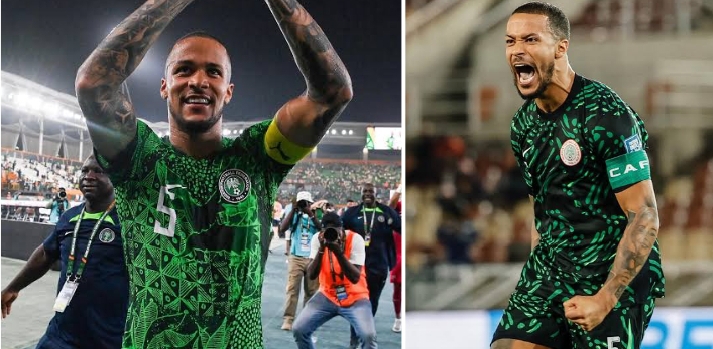
December 4, 2025, started like any other Wednesday in Lagos, but by evening, Nigerian football fans were shaken. William Troost-Ekong, the Super Eagles captain, officially announced his retirement from international football.
He took to social media and wrote words that felt heavy yet heartfelt: “Honoured. Grateful. Forever a Super Eagle. Playing for Nigeria has been the greatest privilege of my life.” He added that while his “journey may end here,” his support for the national team “never will.” For millions who had watched him lead the team through highs and lows, it was a quiet kind of heartbreak.
Ekong’s retirement came just weeks before the start of the 2025 Africa Cup of Nations, the tournament that has always been a stage where legends are made. The timing was startling for some fans, puzzling for others, but for Ekong, it was a decision marked by peace and reflection.
Nigeria’s failure to qualify for the 2026 FIFA World Cup after a playoff defeat to the Democratic Republic of Congo, a match that saw hopes dashed for millions, was the final push toward his decision.
From Amsterdam Streets to Nigerian Dreams
Troost-Ekong’s story is not typical. Born in Amsterdam to a Dutch mother and Nigerian father, he began playing football in the youth academies of the Netherlands. He represented Dutch youth sides, but his heart always tugged him toward Nigeria, the country of his father. In 2015, under the guidance of the late coach Stephen Keshi, he made his senior debut for Nigeria. A young defender stepping onto the African stage, unsure yet determined, carrying the weight of expectation and the hope of an entire nation.
The journey from debutant to captain was not linear. Early on, Ekong had to prove himself, adapting to a different style of football, a different climate, and different pressures. He learned fast. The physicality of African football, the fervent stadiums, the high stakes of qualifiers, and the media scrutiny shaped him into a player ready for leadership.
Injuries, Comebacks, and Moments That Defined Him
Over the decade that followed, Ekong battled injuries that would have broken lesser players. Muscle tears, minor surgeries, and match suspensions were part of his story. Yet every setback was met with determination. By 2018, he had cemented himself as a defensive anchor, playing in Nigeria’s squad at the 2018 FIFA World Cup. He was not just a defender; he was a presence, a voice on the pitch, a calming force that made everyone around him better.
The AFCON tournaments were where Ekong truly shone. His record as the highest-scoring defender in AFCON history, with five goals, is testament not just to skill, but to timing, positioning, and sheer bravery. In the 2023 edition, he captained the team to the final, scoring a decisive goal and earning the Player of the Tournament award. These moments were not just about stats; they were about leadership, about carrying the hopes of millions across stadiums and living rooms in Nigeria.
The Burden of Leadership
Being captain of the Super Eagles is not easy. It is not just about organizing the defense or scoring in crucial moments. It is about being the face of a nation’s dreams, the voice in the locker room, the person who has to calm tempers, motivate the young, and sometimes absorb the criticism meant for the team. Ekong did this quietly, without theatrics. His leadership was measured, calm, and effective. Teammates often speak of his ability to balance firmness with empathy, to guide without domineering, to lead by example rather than words.
In the end, perhaps the weight of responsibility, coupled with the physical toll of years of top-level football, made him step away. He left with dignity, with gratitude, and with a clear message that his love for Nigerian football remains unwavering.
A Legacy Etched in Numbers
Ekong’s numbers tell a story of consistency and excellence. Over 83 caps, he scored eight goals for the national team. Some sources report seven, but either way, these are remarkable for a defender. He was a regular fixture in the squad, often playing full matches under extreme conditions, in hostile stadiums, and under immense pressure. Beyond goals and appearances, he carried the intangible traits of leadership, resilience, and national pride.
His achievements include a bronze medal at the 2016 Olympic Games with the Nigeria U-23 squad and participating in the 2018 FIFA World Cup. He played pivotal roles in multiple AFCON tournaments, culminating in the 2023 edition, where his influence on the field and off it was undeniable.
Why the Timing Felt Right
Ekong’s retirement was not sudden. Observers noted that the missed 2026 World Cup qualification was emotionally heavy for him. After years of striving to lead Nigeria to the world stage, the playoff defeat to DR Congo in late 2025 was a moment of reflection. Ekong expressed that he had given everything to Nigerian football, and stepping away now allowed him to do so with peace and dignity.
His farewell letter spoke of gratitude, pride, and a deep connection to the national team, signaling that this was a decision made with a clear mind and full heart.
Passing the Torch to a New Generation
Nigeria now faces the challenge of replacing not just a defender, but a captain, a leader, and a mentor. Ekong’s departure opens opportunities for younger players to step up, but it also leaves a gap in experience and leadership.
His words, urging the current Super Eagles to carry on the legacy, show that he believes in the next generation. Coaches and players alike will have to find a new rhythm, and the lessons Ekong imparted will guide them.
Fan Reactions and Emotional Farewells
The reaction from Nigerian fans was immediate and intense. Social media feeds flooded with gratitude, nostalgia, and admiration. Old match clips resurfaced, highlighting his best tackles, his goals, and moments of leadership.
Across Lagos, Abuja, and Port Harcourt, conversations in football circles turned to his contributions, the moments they cheered, and the times they feared he might leave due to injury. Ekong’s legacy is not just statistics; it is the memory of a captain who bore the national jersey with pride, resilience, and humility.
Looking Back at the Journey
When we trace Ekong’s journey from 2015 to 2025, it is a story of ambition, sacrifice, and achievement. From his debut under Stephen Keshi to leading Nigeria in multiple tournaments, his trajectory is emblematic of dedication. Each goal, each defensive intervention, each calm word in the dressing room contributed to a narrative bigger than any single match.
Ekong became more than a player; he became a symbol of commitment to Nigeria, someone whose life on and off the pitch inspired younger players and reassured fans.
The AFCON 2025 Question
With AFCON 2025 looming, Ekong’s retirement raises immediate tactical and leadership questions. Who will marshal the defense? Who will provide the calm voice on the field? Analysts are already speculating, but one thing is clear: replacing Ekong’s experience will not be simple.
His ability to read the game, anticipate danger, and organize the backline will be sorely missed. Coaches will have to adapt quickly, and younger defenders will be under pressure to rise to the occasion.
Beyond the Field
Ekong’s contribution to Nigerian football extends beyond his on-field performance. He represents a bridge between home-based and diaspora players, someone who understood global football but remained committed to local success. His presence fostered cohesion, professionalism, and mentorship.
Off the pitch, he has inspired countless young Nigerians to believe that wearing the national jersey is an honor worth fighting for.
The Last Goodbye
On that December evening, as he posted his farewell message, millions felt the weight of a chapter ending. “Honoured. Grateful. Forever a Super Eagle.” Those words are simple yet profound. They encapsulate a decade-long journey filled with triumph, struggle, leadership, and national pride.
Ekong’s retirement is not just the end of a career; it is the closing of a story that has inspired, challenged, and uplifted Nigerian football for ten years.
Final Thoughts: The Captain Who Left a Mark
William Troost-Ekong retires with a legacy few defenders achieve. He leaves the Super Eagles as a player who led by example, who carried injuries and pressure without complaint, who scored goals in critical moments, and who remained loyal to Nigeria through every challenge. His retirement is a reminder that leadership is about commitment, resilience, and humility. For the young generation stepping into his boots, the challenge is clear: honor the jersey, lead with integrity, and carry on the legacy.
Ekong’s journey reminds us that football is more than a game. It is identity, it is pride, it is history. And while the Super Eagles will fly on without him, the shadow of his leadership, the lessons of his career, and the example he set will linger for years to come.



Discussion about this post