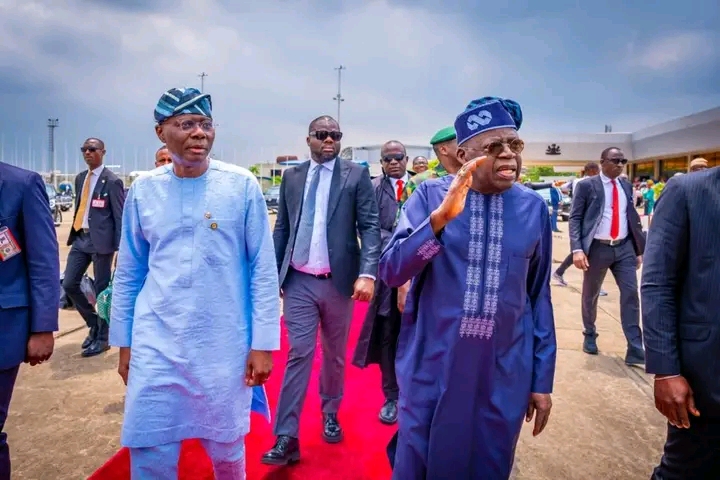
Every December, as the political temperature in Abuja cools and the year exhales its final breath, attention quietly shifts southward. Lagos begins to hum in a different register. The air thickens with memory, movement, and anticipation. It is not announced with fanfare. There are no elaborate countdowns or choreographed public ceremonies. Yet observers notice the signs. Security details adjust. Familiar routes are cleared. Longstanding allies arrive earlier than usual. The city senses a return.
For Bola Ahmed Tinubu, Lagos is not merely a destination. It is a living archive. Streets carry the residue of past battles, victories, betrayals, and reinventions. December magnifies this connection. While other leaders retreat into private holiday sanctuaries, Tinubu’s year end rhythm has consistently pulled him back into the public geography that shaped him. The return is neither accidental nor sentimental. It follows a pattern refined over decades.
To understand Tinubu’s Lagos December is to understand how power behaves when it feels at home. This is not the Lagos of campaign rallies or emergency negotiations. This is Lagos as memory space, cultural ground, and political sanctuary. The kind of place where presence itself communicates continuity. Where absence would speak louder than words.
What unfolds during these weeks is not a celebration in the conventional sense. It is a sequence of gestures, appearances, silences, and symbolic choices. Together they form a ritual that sits quietly outside the campaign trail yet remains deeply political. A ritual that blends culture, legacy, and authority in ways that only Lagos allows.
Spending the Holidays in Lagos
President Tinubu’s decision to spend the Christmas and New Year period in Lagos during the 2025 holiday season follows a pattern that predates his presidency. Before assuming national office, he routinely marked the end of the year in Lagos after completing political or official obligations elsewhere. As president, this habit has not been discarded. Instead, it has been absorbed into the architecture of state power, quietly normalized.
The journey itself is usually preceded by official visits to other parts of the country. In 2025, these included stops in Borno and Bauchi, where project commissions and formal engagements were concluded before the holiday window opened. The sequencing matters. Lagos is not treated as an extension of those duties. It is the closing chapter. The place where the year is allowed to settle.
Unlike Abuja, Lagos offers Tinubu a different kind of visibility. It is less about podiums and protocols, more about recognition without announcement. The city knows him. The relationship does not require explanation. That familiarity allows the president to move through December engagements with a blend of formality and ease that is rarely possible in the federal capital.
This choice also reflects an older political logic. In Nigerian politics, where leaders return during moments of rest often reveals where they draw reassurance. Tinubu’s repeated selection of Lagos over Abuja during the holidays reinforces the idea of Lagos as his political home base. Not a retreat from power, but a return to its roots.
Attendance at Cultural Events
Among the most visible elements of Tinubu’s Lagos December is his presence at cultural gatherings, most notably the Eyo Festival. Scheduled for December 27 during the 2025 holiday period, the festival stands as one of Lagos’s most enduring traditional ceremonies. Held at Tafawa Balewa Square, it draws together history, symbolism, and public memory in a single procession.
Tinubu’s role as Guest of Honour places him within the ceremonial framework rather than above it. This distinction matters. The Eyo Festival is not a casual celebration. It is a ritual of passage, remembrance, and communal identity. His attendance signals alignment with the custodians of Lagos history rather than an attempt to dominate the stage.
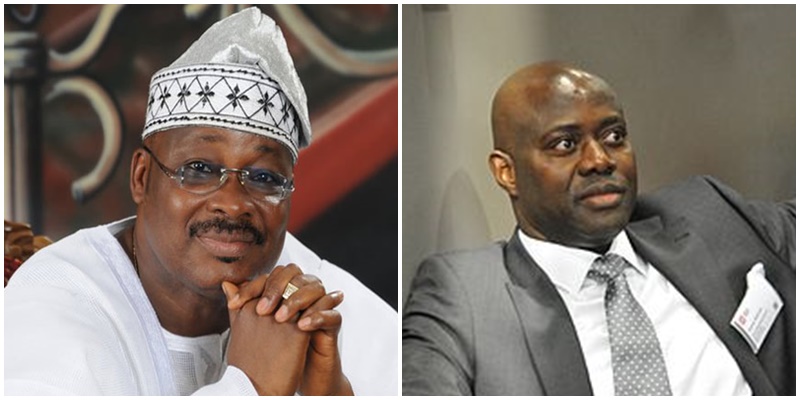
The 2025 edition carries additional weight. It is planned to honour the late Alhaja Abibatu Mogaji, Tinubu’s mother, alongside former Lagos governors Lateef Jakande and Michael Otedola. These names form a lineage. Family, mentorship, and political inheritance intersect. By standing present, Tinubu is not merely observing culture. He is situating himself within a continuum.
Cultural participation during the holiday season allows Tinubu to communicate stability without speeches. In a country where political messaging is often loud and confrontational, these moments operate differently. They rely on symbolism, shared memory, and visual presence. Lagos understands this language well, and December is when it speaks most clearly.
Engagements Beyond Personal Festive Time
Although the holiday period suggests rest, Tinubu’s Lagos presence consistently blurs the line between private celebration and public responsibility. His schedule during these weeks rarely resembles a vacation in the conventional sense. Instead, it becomes a softer extension of governance, one conducted through appearances rather than announcements.
Meetings continue, though often out of public view. Consultations take place without press statements. Political allies, traditional leaders, and long standing associates use the season to reconnect. Lagos becomes a quiet convergence point where conversations unfold without the rigid structure of Abuja’s bureaucracy.
The Eyo Festival itself exemplifies this blending of roles. While culturally framed, it also functions as a space of elite interaction. Attendance is both symbolic and strategic. It allows for visibility without confrontation, unity without policy debate. For a sitting president, this balance is invaluable.
What emerges is a pattern of leadership that does not switch off during the holidays but recalibrates. Tinubu’s December engagements suggest that power, for him, is not paused. It is repositioned. Lagos provides the setting where authority can exist in a less formal register while remaining firmly intact.
The Symbolism of Lagos Over Abuja
Choosing Lagos over Abuja during the holidays carries symbolic weight. Abuja represents the mechanics of governance. Lagos represents its origin story. December is when that distinction becomes visible. Tinubu’s preference signals that leadership, for him, remains anchored in lived political experience rather than administrative abstraction.
Abuja empties out during the holidays. Lagos fills up. The contrast matters. By aligning himself with the city that swells rather than shrinks, Tinubu places his presence where energy accumulates. This choice aligns with his broader political philosophy, one that privileges movement, networks, and adaptability.
The symbolism extends beyond geography. Lagos embodies complexity. It is chaotic, layered, demanding. Remaining present within that complexity during moments of rest suggests endurance rather than escape. It reinforces the image of a leader comfortable within density and contradiction.
Over time, this symbolism has become part of his political language. Lagos in December is not framed as nostalgia. It is framed as relevance. The city continues to matter. By returning consistently, Tinubu affirms that relevance through presence alone.
Public Visibility Without Campaigning
One of the most distinctive aspects of Tinubu’s year end Lagos routine is how visible it is without resembling a campaign. His appearances are framed around culture, commemoration, and social presence rather than political messaging. This distinction preserves the neutrality of the holiday period while maintaining influence.
The absence of campaign language is deliberate. Lagos in December is saturated with activity. Attempting to dominate that space with overt politics would disrupt the balance. Instead, Tinubu’s presence blends into the city’s rhythm. He becomes part of the scene rather than the focus of it.
This form of visibility operates on recognition rather than persuasion. Supporters feel acknowledged without being mobilised. Critics observe without feeling challenged. The approach reduces friction while keeping authority intact. It is visibility calibrated to avoid escalation.
Such positioning also allows the president to remain accessible without being exposed. Cultural events provide structured spaces. Appearances are finite. The boundaries are clear. In this way, public visibility is maintained without surrendering control of the narrative.
Memory, Legacy, and the End of the Year
December invites reflection. In Lagos, this reflection is collective. Tinubu’s year end presence places him within that collective memory. He is seen not only as a sitting president but as a figure whose story is intertwined with the city’s evolution.
Legacy is reinforced through repetition. Returning each year transforms presence into ritual. The ritual does not demand celebration. It demands recognition. Over time, this recognition accumulates into historical placement rather than temporary attention.
The honouring of past figures during cultural events aligns with this logic. By standing alongside memory, Tinubu positions himself as both inheritor and custodian. The message is subtle but persistent. Leadership is framed as continuity rather than interruption.
As the year closes, Lagos absorbs this presence without ceremony. The city has seen leaders come and go. Those who return consistently are remembered differently. December becomes the point where that difference is quietly confirmed.