
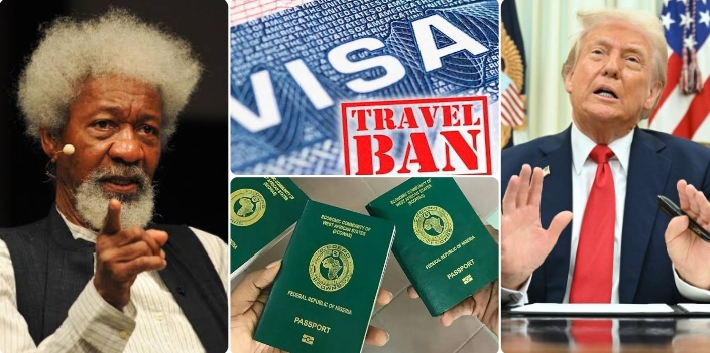
The streets of Lagos hum with a restless energy that never seems to sleep. Cars inch forward through the traffic, motorbikes weave between commuters, street vendors call out to buyers, and neon signs flicker against the night sky. Yet beneath the familiar rhythm of the city, there is a tension that settles quietly in conversations and in the worried eyes of travelers. News travels faster than the light, whispers of changes across the Atlantic, hints of decisions that could alter the lives of Nigerians in ways both immediate and unforeseeable. There is a weight in this anticipation, a sense that what has always been certain might now shift without warning, leaving ordinary people suspended in a space between expectation and reality.
Information comes in fragments. Official notifications, social media speculation, and discussions among families and legal consultants paint a picture that is neither clear nor reassuring. The U.S. government has issued new proclamations affecting immigration, and Nigeria is reportedly among the countries facing heightened restrictions. Legal pathways that many had relied upon for years suddenly seem uncertain, creating a quiet anxiety that threads through classrooms, offices, and family homes. People talk carefully, aware that the consequences of misunderstanding could ripple through plans, education, careers, and personal aspirations.
Amid this uncertainty, some figures acquire symbolic weight, their past actions casting long shadows over current events. Wole Soyinka, the Nobel Laureate whose life has been intertwined with activism, moral advocacy, and public dissent, stands as one such figure. His choices, including destroying a green card in protest years earlier, echo in conversations about agency, sovereignty, and resistance. To many, he embodies the tension between individuals and the bureaucracies that govern movement, opportunity, and legal recognition.
There is a universality to the unease, yet it is deeply personal. Each household, each student, each entrepreneur navigates the invisible consequences of policy shifts that they cannot control. The suspense is not in dramatic headlines but in the quiet uncertainty that colors everyday decisions. People wait, watch, and question, trying to discern what is procedural and what is symbolic, what is temporary and what might define the new normal for Nigerians seeking legal immigration or citizenship in the United States.
The Pause That Resonates Across Continents
On December 16, 2025, the U.S. government issued a proclamation that added Nigeria to an expanded list of countries facing immigration restrictions. The announcement instructed the U.S. Citizenship and Immigration Services to pause processing green card applications and citizenship petitions from Nigerian nationals. This suspension includes both those seeking new status and those already in the United States adjusting their status or waiting for naturalization. It is not a total entry ban, yet its effects are profound, touching families, students, and professionals who had long relied on established legal pathways.
For Nigerians planning futures in the United States, the announcement feels like a sudden wall that rises between intent and opportunity. Plans that had seemed concrete now waver under administrative authority. Students anticipating the next academic term, families arranging reunification, and entrepreneurs planning investments confront delays whose length and outcome remain unclear. The suspension is not merely bureaucratic; it carries emotional and practical consequences, leaving people in a liminal space where hope and uncertainty coexist uneasily.
The proclamation is part of a broader expansion of Trump-era travel and immigration restrictions. Dozens of countries in Africa and elsewhere have been added to similar lists, with policy justifications framed in terms of security and enhanced screening. Observers note that while the focus is often on administrative efficiency, the human impact is immediate and tangible. Citizens navigating these systems find themselves negotiating not just laws but interpretations, discretion, and timing, all of which can dramatically alter life trajectories.
This pause also invites reflection on the asymmetry of bureaucratic power. Decisions made thousands of miles away carry consequences felt at the level of households, classrooms, and offices. The abstract language of proclamations translates into real-life uncertainty, reshaping expectations and influencing choices. Nigerians across the globe watch closely, aware that policies meant to address broad concerns intersect with individual lives in ways that are often opaque and unpredictable.
Soyinka’s Visa Revocation: Individual Action Meets Policy Trends
In late October 2025, Wole Soyinka faced a revocation of his U.S. visa. The U.S. Consulate in Lagos requested that he surrender his non-immigrant visa for physical cancellation. While officials have not publicly linked this revocation to any specific new law, Soyinka interprets it as connected to his outspoken criticisms of President Trump and his broader stance on immigration and governance. He approached the cancellation with characteristic humor at a Lagos press conference but made clear he would not reapply.
Soyinka’s personal history with U.S. immigration policy lends context to the revocation. In 2016, he destroyed his green card in protest of policies and rhetoric that he believed undermined fairness, justice, and the rights of migrants. His current visa situation is understood as an administrative exercise of discretionary powers that consular authorities possess, yet for many Nigerians, it resonates as emblematic of broader systemic issues. The line between individual and structural experience blurs, and Soyinka becomes a symbolic figure for those navigating uncertain legal pathways.
Observers note that while Soyinka’s case is singular, it mirrors the anxieties of thousands of Nigerians facing administrative pauses and restrictive policies. His actions highlight the interplay between personal agency and institutional authority, illustrating that even highly influential individuals are subject to the contingencies of immigration systems. His protest is both literal and metaphorical, a reminder of the human dimension within complex bureaucracies.
The symbolism extends beyond the individual. In a nation grappling with shifting U.S. policies, Soyinka’s stance offers a framework to interpret events. His protest frames questions about rights, justice, and agency, encouraging reflection on how policies affect not just those with resources and influence, but ordinary citizens whose lives are entwined with global migration trends.
Historical Context: Nigerian Migration and U.S. Policy
Nigeria’s history with U.S. immigration is long and layered. Students, professionals, and families have engaged with pathways to education, work, and settlement across decades. Policies have oscillated between periods of openness and restriction, reflecting changes in governance, security priorities, and international relations. Generations of Nigerians have internalized the rhythm of these shifts, understanding that migration is as much about timing, procedure, and interpretation as it is about opportunity and ambition.
In recent years, immigration scrutiny has intensified globally, with an emphasis on security, verification, and procedural oversight. U.S. policy adjustments now intersect with technological systems, social networks, and real-time communications, magnifying both the visibility and impact of administrative decisions. Citizens interpret announcements through a lens informed by history, anticipating consequences that might extend far beyond the text of official communications.
Soyinka’s life and work intersect with this historical narrative. His critiques of authority, his public interventions, and his symbolic protests have long highlighted tensions between governance and individual rights. In the context of restrictive policies, his actions resonate as historical continuity, linking past advocacy to contemporary concerns. Observers see in him both a participant and a lens through which broader social and legal dynamics are interpreted.
The historical perspective illuminates the stakes of policy decisions. Nigerians do not view administrative pauses in isolation; they situate them within decades of migration experience, policy evolution, and cultural understanding of opportunity. This historical framing adds depth to the discourse, connecting the individual, the administrative, and the national in a continuum of cause, effect, and interpretation.
The Human Dimension: Families and Aspirations in Limbo
Across Nigeria, ordinary citizens confront the tangible weight of administrative pauses. Families planning reunions, children preparing for U.S. universities, and professionals seeking career opportunities face uncertainty that can ripple through daily life. A student who meticulously prepared for admission abroad now wonders if her future semester will be deferred indefinitely. Parents consider whether investments in education or relocation will be wasted. Entrepreneurs pause expansion plans, mindful that the window for opportunity may narrow without notice. The suspension of green card and citizenship processing is no longer abstract; it manifests in anxiety, delayed decisions, and recalibration of dreams.
The effect extends beyond individual families to communities and professional networks. When a single member of a family or company is affected by visa or green card delays, the consequences cascade. Collaborative projects stall, long-term financial planning is disrupted, and social connections that rely on transnational mobility are strained. Each application paused or delayed resonates through social, economic, and cultural networks, highlighting how administrative decisions reverberate far beyond their immediate scope.
For many Nigerians, the pause underscores the fragile intersection of legal process and personal aspiration. The bureaucratic authority exercised from distant offices becomes a powerful determinant of life choices. Citizens learn to navigate ambiguity, seeking counsel, interpreting guidelines, and preparing contingency plans. The pause is not merely procedural; it is experiential, a state of waiting that can redefine ambition and strategy in profound ways.
Soyinka’s symbolic protest informs this human dimension. His earlier decision to destroy his green card and his refusal to reapply for a U.S. visa serve as a public narrative through which citizens interpret administrative authority. His acts remind Nigerians that personal choices and moral stances can intersect meaningfully with systemic structures. Observers draw lessons from his actions, understanding that agency exists even within seemingly rigid bureaucracies.
Policy Patterns: The Expansion of Restrictive Measures
The suspension of Nigerian applications aligns with broader trends in U.S. immigration policy under Trump’s second presidency. Over recent months, travel restrictions and visa limitations have expanded to include more countries, with particular emphasis on Africa and the Middle East. These measures often cite security and screening concerns, though their implementation and communication have created significant uncertainty for affected populations. Administrative discretion, procedural complexity, and inconsistent messaging contribute to an environment in which citizens experience both technical and psychological strain.
The expansion of restrictions reflects a continuation of earlier policy approaches. During Trump’s first term, immigration and travel bans were enacted with emphasis on vetting, security risk assessment, and protection of borders. The second term has extended these policies, introducing additional layers of scrutiny, broader inclusion of countries, and tighter oversight of visa categories. The cumulative effect is a legal landscape that is simultaneously more structured and more opaque, leaving affected individuals and communities to navigate shifting criteria with limited guidance.
Social media and news coverage amplify these changes. Public discourse, commentary, and speculation inform citizen perceptions, creating a feedback loop in which policy decisions and social understanding reinforce one another. Nigerians engage with this information actively, interpreting implications for travel, residency, education, and business. Policy is no longer merely an administrative act; it becomes a lived reality, evaluated and debated by a global audience attuned to both local and international developments.
These patterns underscore the intersection of policy and human experience. Decisions about visa processing, green card applications, and citizenship petitions are not purely legal or procedural; they are also cultural and symbolic. Citizens interpret restrictions as indicators of global positioning, relative trust, and systemic priorities. Understanding these patterns allows observers to situate current developments within broader historical and geopolitical contexts, revealing both the causes and consequences of administrative action.
Symbolic Resistance: Soyinka’s Role in Public Consciousness
Wole Soyinka’s protest is emblematic of how individual action can illuminate systemic structures. By destroying his green card in 2016 and refusing to reapply for a U.S. visa in 2025, he has articulated a narrative of moral agency that transcends personal circumstance. For Nigerians navigating immigration uncertainty, his acts provide both guidance and a framework for interpreting policy. They signal that while administrative authority is powerful, citizens retain the capacity for conscious choice, ethical reflection, and symbolic engagement.
The resonance of Soyinka’s actions lies in their visibility and consistency. His protest is neither fleeting nor performative; it reflects decades of engagement with governance, rights, and civic responsibility. In a context where policies can feel impersonal or arbitrary, his stance humanizes the implications of administrative decisions. Citizens see in him a figure who bridges public discourse and private consequence, whose choices illuminate the moral and practical dimensions of legal systems.
Soyinka’s symbolism also highlights intergenerational awareness. Young Nigerians, who often engage with migration and global mobility differently than previous generations, interpret his actions as guidance for negotiating complex bureaucracies. His protest contextualizes abstract policies in lived experience, framing questions of access, justice, and opportunity in terms that resonate across educational, professional, and social spheres.
The interplay of individual agency and systemic authority underscores a central lesson: protest, whether symbolic or procedural, offers perspective. Soyinka’s narrative demonstrates that public engagement can clarify the human dimension of policy, providing insight and reflection for communities facing uncertainty. His role as both participant and interpreter of policy developments continues to shape collective understanding and response.
The Legal Landscape: Navigating Rules and Exceptions
Understanding the implications of the pause in green card and citizenship processing requires careful attention to U.S. legal frameworks. While the policy suspension affects Nigerian nationals, it does not constitute a total ban. Legal pathways still exist, including temporary visas, exceptions under family reunification provisions, and discretionary waivers. However, these pathways are complex, often requiring specialized knowledge and strategic navigation to be effective.
Lawyers and immigration consultants emphasize that administrative discretion plays a decisive role in outcomes. Even when statutory frameworks provide a path, the implementation of policy can vary depending on interpretation, procedural adherence, and discretionary judgment. For affected individuals, this adds layers of uncertainty, requiring constant vigilance and adaptive planning. Each decision, from timing of submission to completeness of documentation, carries heightened significance in shaping potential outcomes.
Historical precedents illustrate the fragility of legal expectations. Previous pauses, revisions, or expansions of U.S. immigration policy have often created cascading effects, delaying applications for months or even years. Nigerian applicants, aware of these patterns, approach the current pause with cautious pragmatism, balancing hope, preparation, and contingency planning in a landscape that is simultaneously formal and opaque.
Soyinka’s stance again provides perspective. His refusal to engage with policies he viewed as unjust underscores the distinction between legal compliance and moral judgment. Citizens interpret his actions as guidance in navigating legal systems with agency, understanding that adherence to law does not preclude reflection on fairness, justice, or dignity. His protest serves as both caution and inspiration in a complex legal landscape where rules, exceptions, and discretion intertwine.
Closing Thoughts: Living with the Pause
The Trump administration’s halt on green card and citizenship processing for Nigerians is more than an administrative footnote. It is a pause that disrupts lives, delays ambitions, and casts uncertainty over plans long in motion. For families separated by borders, students awaiting enrollment, and professionals eyeing opportunities abroad, the suspension transforms expectation into suspense.
Every application becomes a waiting game, every decision tinged with ambiguity.
The ban highlights the power of policy to shape personal futures. Citizens must now navigate new realities where legal pathways are suspended, timelines are uncertain, and administrative discretion dominates outcomes. The impact is immediate and practical, influencing migration plans, career trajectories, and family strategies, while also signaling how global mobility is contingent on external judgments.
Symbolic acts, like Wole Soyinka’s protest, gain added resonance in this context. His stance reminds Nigerians that even when formal pathways are closed or constrained, agency and principle remain. While the pause limits immediate options, reflection, strategy, and ethical clarity offer ways to assert dignity and maintain perspective.
Ultimately, the ban is a test of adaptation and resilience. Nigerians face the pause not only as a bureaucratic barrier but as a moment to recalibrate, plan around uncertainty, and consider what avenues remain open. In a world where access can be suspended by decree, the human response—measured, deliberate, and principled—becomes as significant as any application or visa form.



Discussion about this post