
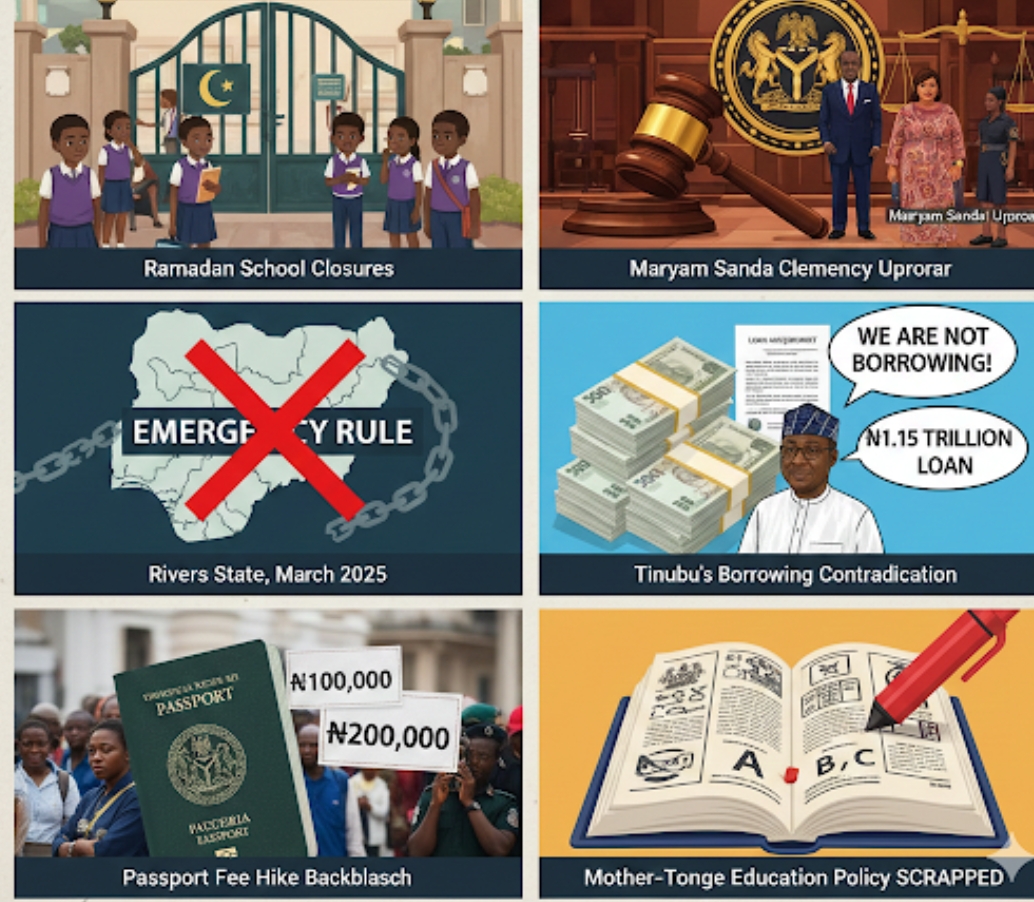
Nigeria’s 2025 was defined not only by economic reforms and security tensions but also by a string of heated government actions and political controversies.
From school shutdowns during Ramadan to presidential clemency battles, and from borrowing contradictions to education policy reversals, several decisions sparked nationwide debate.
This report highlights the most contentious policies, official actions, and public statements that dominated Nigeria’s national conversation in 2025.
Ramadan school closure sparks outrage
Four northern states — Bauchi, Katsina, Kano, and Kebbi — closed schools for about five weeks during Ramadan, triggering nationwide criticism.
Christian groups including the Christian Association of Nigeria and the Catholic Bishops Conference condemned the move as discriminatory and harmful to education.
The Muslim Rights Concern defended the policy, arguing it served the “greatest happiness for the greatest number” and accusing CAN of “double standards”.
Islamic scholars and education experts also disagreed, with some insisting the closures undermined learning while others described it as a fair accommodation for fasting students and teachers.
Emergency rule divides nation
On March 18, President Bola Tinubu declared a state of emergency in Rivers State, suspending governor Siminalayi Fubara, his deputy and lawmakers for six months.
Critics including the Nigerian Bar Association and governors of the Peoples Democratic Party argued the President lacked constitutional power to suspend elected officials.
They accused Tinubu of ignoring the alleged role of the minister of the Federal Capital Territory, Nyesom Wike, in the crisis.
Former president Goodluck Jonathan condemned the suspension of elected officials as damaging to democracy.
Opposition leaders Atiku Abubakar and Peter Obi urged the National Assembly to reject the proclamation, branding it unconstitutional and dangerous.
The Federal Government defended the decision as lawful, citing collapse of governance, pipeline vandalism and what was described as “total paralysis of governance”.
The attorney-general of the federation, Lateef Fagbemi, defended it as a “bold decision” necessary to prevent the state from “complete collapse”.
The six-month emergency ended on September 17, with Tinubu ordering the reinstatement of the governor, deputy and lawmakers.
Governor Fubara later defected to the All Progressives Congress on December 9, saying alignment with the President would stabilise the state.
Tinubu’s borrowing contradiction
A major fiscal storm erupted after President Tinubu declared Nigeria debt-independent and later sent new loan requests to the Senate.
In September, Tinubu announced that Nigeria had met its 2025 revenue target ahead of schedule and said, “Today, I can stand here before you to brag: Nigeria is not borrowing.”
Weeks later, he sought approval to borrow ₦1.15 trillion domestically to fund the 2025 budget deficit.
This came days after the Senate approved a $2.347 billion external loan and plans for a $500 million sovereign Sukuk.
The African Democratic Congress slammed the development as “reckless debt accumulation wrapped in propaganda” and “policy inconsistency”.
The party accused the government of contradicting its own revenue success claims despite announcing ₦20.59 trillion non-oil revenue in eight months.
Maryam Sanda clemency uproar
President Tinubu’s decision to grant clemency to Maryam Sanda in October generated national outrage.
Sanda had been sentenced to death in 2020 for the murder of her husband, Bilyaminu Bello.
The Bello family condemned the pardon as “the worst possible injustice any family could be made to go through”.
Rights activists and political figures branded the clemency “an affront to justice” and “a grave error of judgement”.
Tinubu later revoked the pardon and converted the sentence to 12 years.
The supreme court eventually ruled that the executive intervention was improper while an appeal was pending and restored the death sentence.
KWAM 1 aviation ambassador controversy
The Federal Government’s decision to name Fuji musician Wasiu Ayinde, popularly known as KWAM 1, as aviation security ambassador sparked uproar.
He had earlier been accused of obstructing aircraft movement and assaulting aviation staff.
The government reduced his six-month ban after he apologised.
Human rights lawyer Femi Falana criticised the government for shielding him from prosecution.
Many Nigerians described the move as “double standards”.
The minister of aviation and aerospace development, Festus Keyamo, defended his appointment as community service reform.
Passport fee hike backlash
The Federal Government doubled passport fees to ₦100,000 and ₦200,000, insisting the hike would end corruption and delays.
The minister of interior, Olubunmi Tunji-Ojo, said the policy would ensure passports are delivered within one week.
Nigerians criticised the increase as insensitive amid hardship.
Peter Obi condemned it, warning that ₦100,000 exceeded the national minimum wage.
SERAP described the increment as discriminatory and unlawful.
Mother-tongue education policy scrapped
The Federal Government reversed the policy mandating indigenous languages as the primary medium of instruction.
The minister of education, Tunji Alausa, said failures in WAEC, NECO and JAMB justified reverting to English.
Educationists condemned the policy shift as backward and harmful to learning.
The Nigerian Academy of Education warned it would endanger indigenous languages and deepen inequality.
Experts argued that failure in education was linked to poor funding, not local language teaching.


Discussion about this post