
The opening of 2026 places a quiet but unmistakable spotlight on Nigeria’s richest, a circle so narrow that each movement among its members reverberates across industries, markets, and even national perception. Forbes’ billionaire list captures these fortunes with precision, yet numbers alone cannot convey the stories of vision, perseverance, and calculated risk behind them.
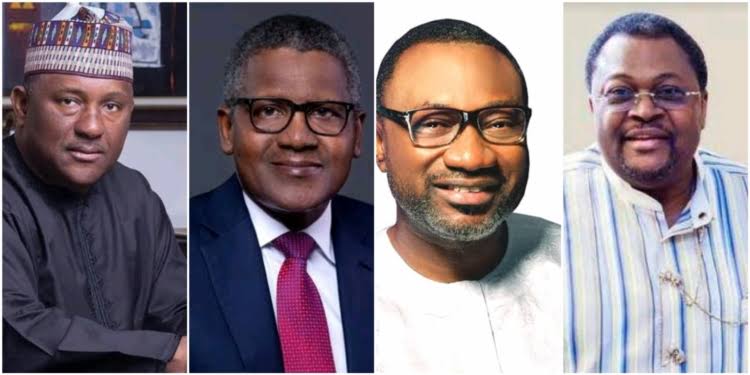
Aliko Dangote, Abdulsamad Rabiu, Mike Adenuga, and Femi Otedola dominate this landscape, representing the concentrated wealth of a nation where a few industrial empires shape the economy in ways that touch millions.
The 2026 landscape raises the same question it always does: who gained, who held steady, and who slipped? These questions are not idle speculation. They are inquiries into the machinery of wealth, the interplay of markets, and the strategy required to sustain industrial empires.
Aliko Dangote: Africa’s Industrial Pillar
Aliko Dangote enters 2026 at the pinnacle of Nigerian wealth with an estimated net worth of 25.6 billion dollars. Globally, Forbes ranks him 89, placing him among the hundred richest people in the world. His fortune is anchored in cement, sugar, and the monumental Dangote Petroleum Refinery, whose inclusion in valuation calculations has propelled his wealth to levels that far exceed previous years. Dangote’s empire is not just financial; it is industrial, infrastructural, and deeply interwoven with Nigeria’s economic landscape.
Every cement shipment, sugar production line, and barrel refined at the Dangote refinery is a testament to decades of strategic planning and expansion. The refinery alone symbolizes a new era in Nigeria’s industrial capability, transforming crude oil into both profit and national influence. Dangote’s global rank at 89 underscores not only his fortune but the reach of his industrial empire, signaling Africa’s presence in global wealth dynamics.
Industrial dominance carries subtle pressures. Fluctuations in commodity prices, currency exchange rates, and regulatory policies could shift fortunes at any moment. Maintaining top position requires strategic adaptability, industrial foresight, and a long-term vision that balances growth with resilience. Dangote’s operations, sprawling across factories and refineries, create employment, infrastructure, and economic stability, illustrating that his wealth is inseparable from his industrial contributions.
By 2026, Dangote represents the embodiment of strategic orchestration. His wealth more than doubled year-on-year due to refinery valuation, a leap that consolidates his position at the top of Africa and maintains his global influence.
Forbes’ ranking quantifies this success, but the underlying story is one of vision turned tangible through industry, labor, and strategic insight. Dangote’s journey demonstrates how ambition, precision, and patience transform opportunity into empire.
Abdulsamad Rabiu: The Industrial Challenger
Abdulsamad Rabiu rises sharply in 2026 with an estimated net worth of 9.5 billion dollars, placing him at 335 globally according to Forbes. His BUA Group holdings in cement, sugar, and food processing have expanded aggressively, demonstrating that wealth in Nigeria is both concentrated and fiercely contested. Rabiu’s ascent signals a shift in industrial momentum, a reminder that strategic expansion and operational efficiency can propel industrialists past peers in relatively short timeframes.
Rabiu’s growth strategy is marked by careful acquisition and expansion of production facilities, bolstered by an emphasis on scale and market penetration. Each factory, distribution center, and product line serves as a tangible expression of influence and operational competence. Forbes’ global ranking of 335 captures his rising fortune, but the underlying narrative is about industrial mastery, disciplined growth, and strategic foresight.
Industries like cement and sugar, often overlooked in global discussions, are central to Nigeria’s economic development. Rabiu’s factories employ thousands and stimulate regional infrastructure, illustrating that industrial investment is inseparable from societal impact. His rise on Forbes reflects not only personal wealth but the increasing weight of industrial performance, showing how strategic vision converts into financial and societal influence.
Entering 2026, Rabiu represents the emerging force in Nigeria’s billionaire landscape. He does not unseat Dangote, but his trajectory illustrates the intensity of competition and opportunity within the country’s industrial ecosystem. Forbes rankings quantify wealth, but the broader story is one of calculated ambition, market mastery, and the relentless pursuit of industrial expansion.
Mike Adenuga: Telecom and Oil Influence
Mike Adenuga, a veteran industrialist, begins 2026 with an estimated net worth of 6.3 billion dollars. Forbes ranks him 594 globally, reflecting both his enduring presence and the slight decline in valuation from 2025. Adenuga’s fortune is concentrated in telecommunications through Globacom and oil via Conoil, industries highly sensitive to market fluctuation, regulatory changes, and global commodity prices. His position in 2026 demonstrates resilience amid changing market conditions.
Adenuga’s operations extend far beyond financial metrics. Telecommunications influence commerce, education, and social connectivity, while oil production underpins industrial and energy sectors. Each corporate decision carries national and regional implications, intertwining wealth with influence. The Forbes global rank of 594 captures his financial standing but only hints at the reach and strategic impact of his enterprises.
The slight decrease in net worth reflects the volatile nature of the sectors he dominates. Oil prices fluctuate unpredictably, competition intensifies in telecommunications, and regulatory shifts create constant pressure. Adenuga’s continued position on the Forbes list demonstrates strategic navigation, operational persistence, and the ability to adapt without losing long-term relevance in Nigeria’s industrial hierarchy.
In 2026, Adenuga exemplifies endurance within Nigeria’s billionaire ecosystem. His operations show that wealth is cumulative and resilient, shaped not only by strategic investment but by the ability to withstand volatility. Forbes rankings quantify his financial standing, yet the more profound narrative is one of sustained industrial relevance, influence, and strategic foresight.
Femi Otedola: Steady Fortunes in Energy
Femi Otedola begins 2026 with a net worth of 1.6 billion dollars, placing him at 2,320 globally according to Forbes. While his fortune may appear modest compared with Dangote or Rabiu, Otedola represents stability in a sector prone to volatility. His investments in Geregu Power and other energy-related ventures have ensured that his wealth remains resilient, reflecting a strategy focused on sustainable growth rather than rapid escalation.
Energy is the lifeblood of Nigeria’s economy, and Otedola’s role in it is quietly significant. Geregu Power supplies electricity to thousands of homes and industries, creating both social impact and financial return. Each megawatt generated is not only a unit of energy but a tangible contribution to national infrastructure. Forbes captures Otedola’s financial status, but the deeper narrative is in the societal and industrial influence his operations maintain.
Unlike Dangote’s monumental industrial projects or Rabiu’s aggressive expansion, Otedola’s wealth trajectory emphasizes careful positioning and long-term foresight. Energy investments, while slower to appreciate than industrial assets, provide resilience against market shocks. Otedola’s consistent presence on the Forbes list underscores his ability to navigate an unpredictable sector while maintaining influence and financial stability.
Entering 2026, Otedola embodies the value of steadiness within Nigeria’s billionaire sphere. His fortune may not fluctuate dramatically, but its consistency represents strategic prudence and industrial impact. Forbes rankings quantify his wealth, but the story is about sustained relevance in energy, calculated risk management, and the quiet authority that comes from enduring presence.
Key Wealth Shifts in 2026
The start of 2026 reveals notable shifts among Nigeria’s billionaire class. Dangote’s fortune more than doubled due to the inclusion of the refinery’s valuation, solidifying his position at 25.6 billion dollars. Rabiu’s rise to 9.5 billion illustrates the momentum of BUA Group’s industrial expansion, while Adenuga’s slight decline to 6.3 billion demonstrates the volatility inherent in telecoms and oil. Otedola’s consistent net worth of 1.6 billion reflects stability in energy investments.
These shifts emphasize the concentrated nature of Nigeria’s billionaire landscape. With only four individuals dominating the main Forbes list, even minor changes in industrial valuation, asset appreciation, or market performance can produce measurable effects in rankings. Each adjustment is a reflection of strategy, opportunity, and operational execution
Beyond financial metrics, wealth shifts carry symbolic significance. They indicate the competitive dynamics among industrialists and the changing contours of influence.
Dangote’s refinery illustrates the transformative power of a single asset, while Rabiu’s growth reflects industrial agility. Adenuga’s modest decline signals the fragility of certain markets, and Otedola’s stability underscores the value of strategic consistency.
For 2026, these movements suggest a broader narrative: Nigerian billionaire wealth is dynamic, concentrated, and intimately tied to industrial performance. Forbes rankings provide the numerical framework, but the story is told through factories, refineries, power plants, and strategic decisions that transform resources into both wealth and influence.
Industrial Foundations: Cement, Sugar, Oil, and Power
The fortunes of Nigeria’s top billionaires are anchored in industries that are fundamental to the nation’s growth. Cement, sugar, oil, and power are the pillars upon which their wealth rests, shaping infrastructure, commerce, and industrial capacity. These sectors are not flashy or technologically novel, but their influence is enormous. Factories, refineries, and power plants convert raw materials into both economic output and social influence, creating the conditions for billion-dollar wealth.
Cement and sugar underpin construction and food security. Dangote and Rabiu’s factories provide the materials for urban expansion, roads, and housing, while sugar production feeds both domestic consumption and regional trade. Oil and energy, controlled by Adenuga and Otedola, supply the power necessary for industry, commerce, and daily life. The wealth derived from these industries is inseparable from their societal impact, illustrating how fortune in Nigeria is grounded in tangible contributions
Industrial wealth requires strategy beyond financial investment.
Operational efficiency, supply chain management, and market positioning are essential to maintaining dominance. Factories and refineries do not only generate revenue; they produce employment, regional development, and economic stability. Forbes rankings capture these outcomes numerically, but the real story is in the transformation of resources into influence, infrastructure, and opportunity.
By 2026, the concentration of wealth in these industries highlights the limited but powerful circle of Nigeria’s billionaire class. Even small changes in production, market share, or regulatory conditions can have significant effects on net worth and global rankings. The Forbes list provides a snapshot of financial status, yet the deeper narrative reveals the interplay between industrial mastery, strategic foresight, and the enduring impact of these sectors on national development
Notable Exclusions From the Global List but Present in Other Forbes Segments
While only four Nigerians appear on the main Forbes billionaire list for 2026, several others hold significant wealth yet are excluded from the primary ranking due to residency and operational focus.
Figures such as Tope Awotona, founder of Calendly, and Adebayo Ogunlesi, a global infrastructure investor, exemplify this category. Forbes includes them in specialized segments like the Black Billionaires list, highlighting their prominence in the global economic landscape while acknowledging that their primary operations and influence extend beyond Nigeria.
Tope Awotona, whose Calendly platform has reshaped scheduling and productivity on a global scale, represents a new generation of Nigerian entrepreneurs whose fortunes are built primarily in the diaspora. His wealth is substantial, and his inclusion in Forbes Black Billionaires reflects both his financial achievements and cultural significance. Similarly, Adebayo Ogunlesi commands influence through infrastructure investments across continents, steering deals worth billions while maintaining ties to Nigeria. Their absence from the main Nigeria-resident billionaire list underscores the methodology’s focus on domestic residency and operational control.
These exclusions illustrate the dual narrative of Nigerian wealth. Domestically, industrial empires dominate Forbes rankings, rooted in cement, sugar, oil, and energy. Internationally, diaspora figures create wealth through technology, finance, and global investment. Both narratives are essential to understanding Nigeria’s economic footprint. While Dangote, Rabiu, Adenuga, and Otedola capture national industrial influence, figures like Awotona and Ogunlesi demonstrate the global reach and diversified potential of Nigerian talent in wealth creation.
2026 and Beyond: Trends and Projections
Entering 2026, Nigeria’s billionaire landscape remains focused on cement, sugar, oil, and energy, with Dangote and Rabiu leading industrial growth. Adenuga and Otedola continue to show resilience in telecom and power sectors, reflecting stable, long-term investment strategies
Technology and global opportunities may shape future wealth. Diaspora figures like Tope Awotona and Adebayo Ogunlesi demonstrate how Nigerians can build fortunes abroad, suggesting future billionaires could emerge from both domestic industry and international ventures.
Maintaining industrial assets will be key for existing billionaires, while modernization and strategic investments will determine who sustains influence. Market conditions, regulation, and global demand will continue to affect fortunes.
Overall, Nigeria’s billionaire ecosystem is likely to combine steady industrial dominance with growing global entrepreneurship. Rankings will reflect not just wealth, but the broader impact these individuals have on the economy.


Discussion about this post