
Lagos has always lived with water as both companion and threat. The lagoon glitters at dawn, carries commerce by afternoon, and swallows silence at night. Every day, boats move quietly between islands and mainland corridors, carrying workers, traders, creatives, and dreamers chasing deadlines and opportunities. The water does not announce danger. It rarely does.
On the final days of the year, when the city slows just enough to breathe, movement does not stop. People still travel to work sites, private residences, beach houses, and event venues. For many, the waterways offer speed, escape from traffic, and a sense of control over time. It feels ordinary. Too ordinary to fear.
That sense of normalcy is what makes tragedy arrive without warning. On a December evening, as Lagos prepared to cross into a new calendar year, a routine journey on the lagoon ended abruptly. What followed was not just an accident, but a moment that peeled back layers of urban survival, informal transport, and the fragile balance between ambition and safety.
This story is not about spectacle. It is about how a city moves, who it moves, and what happens when the systems meant to protect everyday lives fail quietly, without headlines at first.
The Night the Lagoon Turned Hostile
The passenger boat departed in the evening hours on December 31st 2025, moving through the Nigerdock axis of the Igbologun water channel. It was a familiar route, used regularly by private operators and passengers seeking faster passage across Lagos waterways. Night had settled in fully by the time the vessel moved forward, darkness broken only by distant lights reflecting off the water.
According to official confirmations, the boat was operated by Savvy Marine and was traveling from Ilashe Beach House. The departure time placed the journey well into the night window, a period that safety authorities have repeatedly flagged as high risk on Lagos waterways. Still, the boat moved, as many do, guided by routine and expectation rather than fear.
At approximately 8:35 pm, something went wrong. Early reports suggest the vessel may have struck a submerged object. The waterway, often unpredictable and poorly mapped in sections, has long carried hazards hidden beneath its surface. What is known is that the impact destabilized the boat, triggering a sequence of events that unfolded faster than passengers could react.
In the chaos that followed, balance was lost, control slipped away, and the water that moments earlier had seemed calm became unforgiving. By the time help arrived, lives had already been altered permanently.
Casualties Beneath the Calm Surface
Authorities later confirmed that 6 passengers lost their lives in the incident, while 4 others were rescued and taken to hospital. These figures emerged gradually, shaped by search operations, recovery efforts, and the slow process of accounting for everyone on board. In water accidents, numbers rarely settle immediately. They shift as bodies are recovered and survivors identified.
Search and rescue teams worked through the night, navigating darkness, debris, and uncertainty. The Marine Police, LASWA, and NIWA coordinated efforts to locate victims and secure the area. For families waiting onshore, time stretched painfully. Each passing hour carried hope and dread in equal measure.
What distinguishes this tragedy from many others is not only the death toll, but the profiles of those believed to be among the victims. These were not anonymous travelers passing through the city unnoticed. They were working professionals, young entrepreneurs, and women actively building businesses in Lagos demanding creative economy.
Their deaths resonated quickly within private networks, creative circles, and online communities. Long before official names were released, grief had already found faces.
Official Response and the Language of Safety
In the days following the accident, LASWA and NIWA issued statements confirming the incident and reiterating existing safety regulations. Central among these was the emphasis on the no night travel advisory, a rule designed to limit exposure to poor visibility, navigational hazards, and delayed emergency response.
Life jackets were mentioned again, as they often are after water tragedies. Authorities stressed compliance, responsibility, and the shared duty between operators and passengers. The language was familiar, almost ritualistic, echoing statements made after previous mishaps on the lagoon.
Yet beneath these reminders lies a deeper tension. Night travel continues despite warnings, not because passengers are reckless, but because Lagos rewards speed and punishes delay. Work schedules, private engagements, and economic pressure often override safety advisories that feel disconnected from daily realities.
The official response addressed the event, but it also reopened a longstanding conversation about enforcement, accountability, and whether safety rules exist only on paper or in practice.
Social Media, Memory, and the Speed of Grief
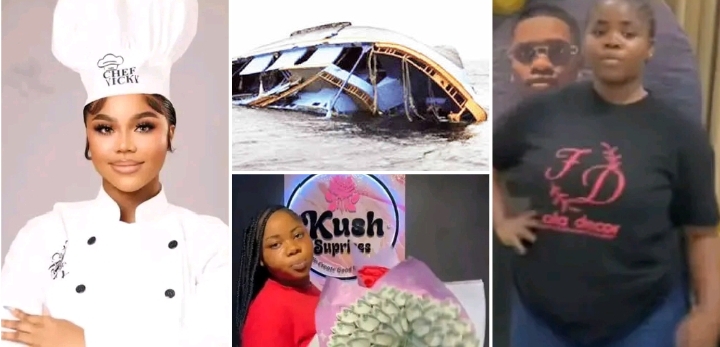
While official channels moved cautiously, social media moved at its usual speed. Posts began to circulate mourning specific individuals, sharing photographs, business pages, and personal stories. Among these were claims that 3 sisters were among the victims, all young women involved in small but visible entrepreneurial ventures.
According to these posts, one sister worked in interior decor, another in surprise packages and gifting, while the third supported their shared business ambitions. The framing was intimate and devastating. A family bound by blood and work, lost together while simply trying to earn a living.
Another name that surfaced was Victoria Agu, described as a culinary professional admired for her work in local and international cuisine. Posts claimed she had recently launched a spice line, positioning her as a rising figure within Lagos food culture. The language of mourning was unmistakable, but the verification was not yet complete.
These narratives spread quickly, carried by emotion rather than confirmation. They filled the silence left by official restraint, offering faces where authorities offered numbers.
Verified Facts Versus Emerging Claims
Mainstream media outlets confirmed the accident, its location, and the number of casualties. They verified night travel, the involvement of Savvy Marine, and the activation of emergency response teams. What they did not yet confirm were names, relationships, or public profiles of the victims.
This gap is not unusual in Nigeria. Authorities often delay releasing identities until families are notified and investigations advance. In the meantime, blogs, entertainment platforms, and private networks publish what they know, sometimes accurately, sometimes prematurely.
The claims about 3 sisters and Victoria Agu remain unconfirmed by police statements, LASWA lists, or major national newspapers. That does not render them false. It places them in a space between truth and confirmation, where grief often arrives before paperwork.
Understanding this distinction matters. It protects families, preserves journalistic integrity, and prevents the amplification of misinformation during moments of collective pain.
Public Figures Without Celebrity Armor
One reason this tragedy has drawn such attention is the nature of those reportedly involved. These were not film stars or musicians with national fame. They were lifestyle entrepreneurs, creatives, and business owners with online visibility and community recognition.
In modern Lagos, influence does not require television screens. A decorator with loyal clients, a chef with a growing following, or a gifting brand with consistent bookings can command respect and reach without traditional celebrity status.
When such figures die suddenly, the impact ripples through networks that feel personal rather than distant. Clients mourn service providers who became friends. Followers grieve creators who inspired them quietly.
This is why the language matters. These were not celebrities in the conventional sense, but they were public figures in their own ecosystems, and their loss feels deeply personal to those who knew their work.
Waterways, Work, and Invisible Risk
Lagos waterways are not leisure routes alone. They are arteries of labor. People use them to meet deadlines, attend jobs, deliver services, and sustain livelihoods. For many entrepreneurs, especially those serving affluent island communities, water travel is not optional. It is essential.
This dependence creates vulnerability. When safety advisories conflict with economic survival, risk becomes normalized. Night travel happens because clients expect punctuality, because traffic alternatives are punishing, and because enforcement is inconsistent.
The lagoon does not discriminate between tourists and workers. When accidents occur, they expose the quiet compromises people make daily to keep their lives moving forward.
The recent boat mishap is a reminder that ambition often travels alongside danger in Lagos, unseen until it surfaces violently.
Where Accountability Begins and Ends
As investigations continue, questions remain about vessel condition, operator compliance, passenger awareness, and enforcement presence. These questions are not about blame alone. They are about patterns.
How many boats move at night without consequence. How many passengers board without life jackets because no one insists. How often submerged hazards remain unmarked. How response times vary depending on location and time.
Accountability in water transport does not rest solely with operators or passengers. It extends to regulatory consistency, infrastructure investment, and public education that matches lived realities.
Until these layers align, tragedies like this will continue to feel shocking while remaining structurally familiar.
A City That Moves On Water Must Protect Its People
Lagos markets itself as a coastal megacity, defined by movement and resilience. Its waterways symbolize both opportunity and neglect. Each accident forces a brief pause, a moment of reflection, before routines resume.
But behind every pause are families adjusting to absence, businesses closing without ceremony, and futures that end mid sentence. These losses are not abstract. They are intimate and irreversible.
The recent boat mishap is not just an end of year tragedy. It is a mirror held up to how Lagos values time, labor, and safety. It asks whether speed will always outrank protection, and whether lessons learned will last beyond headlines.
For now, the water is calm again. Boats continue to move. The city breathes and pushes forward. But beneath the surface, questions remain, waiting for answers that cannot be delayed forever.


Discussion about this post