
Nigeria’s state houses of assembly in 2025 were repeatedly engulfed by internal power struggles that disrupted lawmaking and tested democratic stability.
Across Lagos, Benue, Rivers, Edo and Zamfara states, legislative chambers meant to safeguard public interest became theatres of suspensions, impeachments and political brinkmanship.
The recurring crises exposed the vulnerability of state legislatures to executive influence, party pressure and factional rivalry.
LAGOS ASSEMBLY: OBASA’S IMPEACHMENT AND RETURN
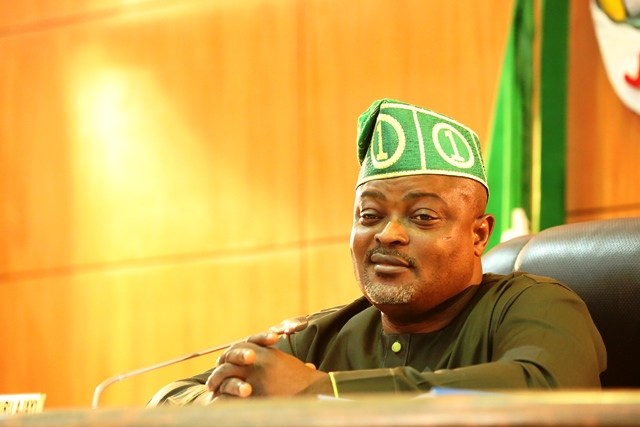
The political year opened dramatically in Lagos state when lawmakers removed Mudashiru Obasa, the speaker of the house of assembly, on January 13.
Obasa, who had presided over the chamber since 2015, was accused of financial misconduct and abuse of office, allegations his supporters described as politically driven.
Thirty-six of the 40 lawmakers endorsed the impeachment, installing the deputy speaker, Mojisola Meranda, as his replacement.
The leadership change, however, triggered weeks of instability within the assembly complex.
In late February, Obasa returned with supporters and announced his resumption as speaker amid disorder.
“I’ve resumed, and I remain the speaker of the assembly,” Obasa said.
The confrontation led to physical scuffles before the All Progressives Congress intervened to restore order.
On March 3, Meranda resigned, paving the way for Obasa’s reinstatement.
A Lagos court later ruled in April that the impeachment proceedings were “illegal, unconstitutional, null and void”.
The crisis stalled legislative business for over seven weeks, delaying budgets and oversight activities.
BENUE: SUSPENSION AND PROLONGED POLITICAL STALEMATE
In Benue state, tensions centred on Hyacinth Dajoh, the former speaker of the house of assembly.
Dajoh resigned on August 25, days after suspending four lawmakers, including the deputy whip, for alleged insubordination.
Although a replacement was immediately appointed, the assembly suspended Dajoh the following day for allegedly plotting to impeach the governor of the state, Hyacinth Alia.
The suspension was extended by six months in November as investigations continued.
“This extension is based on Dajoh’s refusal to cooperate with probes,” a lawmaker said anonymously.
Supporters of the former speaker described the action as politically motivated, while assembly leaders defended it as necessary for institutional stability.
The prolonged standoff highlighted entrenched executive-legislative tensions within the state.
RIVERS: IMPEACHMENT THREATS AND EMERGENCY RULE
The most far-reaching crisis unfolded in Rivers state, where lawmakers clashed openly with Siminalayi Fubara, governor of the state.
In March, the house initiated impeachment proceedings against Fubara and his deputy, Ngozi Odu.
The conflict was linked to a prolonged fallout between the governor and Nyesom Wike, former governor of the state and current Federal Capital Territory minister.
Escalating unrest, including pipeline vandalism and legislative paralysis, prompted federal intervention.
In September, President Bola Tinubu declared a state of emergency in Rivers state.
“The Governor of Rivers State, Mr Siminalayi Fubara, his deputy, Mrs Ngozi Odu and all elected members of the House of Assembly of Rivers State are hereby suspended for an initial period of six months,” Tinubu said.
Ibok-Ete Ibas was appointed sole administrator as protests erupted across the state.
Although the emergency rule was later lifted, the crisis left lasting political and economic scars.
EDO: DEFECTIONS SHIFT LEGISLATIVE BALANCE
In Edo state, the assembly experienced rapid realignment as the APC strengthened its majority.
In April, Blessing Agbebaku defected from the Peoples Democratic Party to the APC, accompanied by several local government chairpersons and councillors.
The APC’s control expanded further following defections by Donald Okugbe, Bright Iyamu, Richard Edosa and Sunday Ojezele.
Maria Oligbi-Edeko, the PDP deputy speaker, resigned, citing her party’s diminished standing.
Party leaders described the realignment as necessary to support governance, while critics warned of weakened opposition oversight.
ZAMFARA: SUSPENDED LAWMAKERS CHANGE SIDES
In Zamfara state, legislative divisions deepened when six suspended PDP lawmakers defected to the APC on December 25.
The lawmakers cited unresolved party disputes, governance concerns and constitutional breaches within the assembly.
They alleged that the rival faction passed laws without the required quorum, rendering such actions invalid.
The defection underscored the fragility of legislative cohesion in crisis-prone assemblies.
As 2026 approaches, analysts warn that without structural reforms, state assemblies may remain tools of political contest rather than democratic institutions.


Discussion about this post