
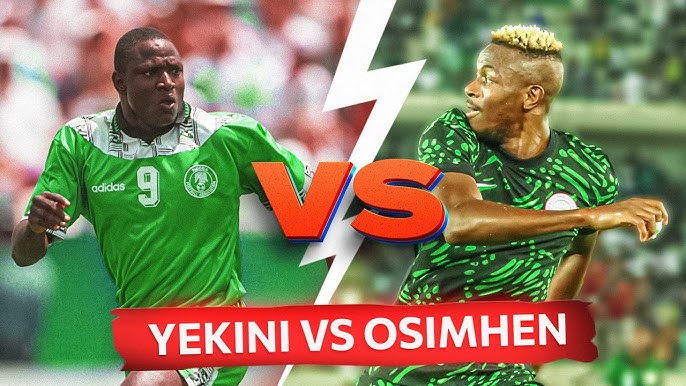
There is a peculiar weight that follows a striker once he steps onto the green of the Super Eagles’ pitch. For Victor Osimhen, it is not only the expectations of millions of Nigerian fans, nor the gaze of scouts and pundits across Europe. It is the lingering shadow of a record that has stood for decades. Rashidi Yekini, a name whispered with reverence in Lagos streets and Abuja stadiums alike, laid claim to 37 goals for Nigeria.
The number itself seems simple, yet it has become a benchmark of permanence, a myth wrapped in the pulse of every football conversation. Osimhen enters this narrative as a young predator, hungry, measured, and aware that every touch, every run, every finish brings him closer not just to victory but to history.
In the early days of his Super Eagles career, the goals came in bursts of promise and flashes of brilliance. The friendly against Ukraine was one of those defining moments. The match ended 2–2, but Osimhen’s contributions were unmistakable.
He scored both goals for Nigeria, timing his runs with the precision of a hunter and finishing with a composure that belied his age. It was the kind of performance that signals the start of something larger than a single game. Observers spoke of raw potential, but those who knew the history of Nigerian football understood that potential alone could not carry one past Yekini’s ghost.
As the qualifiers for the Africa Cup of Nations and the World Cup rolled in, Osimhen found himself not merely scoring but imposing himself upon the rhythm of Nigerian football. Every strike was a conversation with the past, a subtle assertion that the legacy of Yekini, while formidable, was not untouchable.
His goals were more than goals; they were statements. A young forward had arrived who combined speed, power, and instinct. Each goal was a question posed to history: How close can the present come to the myth of Yekini? How patient must a nation be while its future striker chisels himself into legend?
Match-by-Match Goal Records: Victor Osimhen vs Rashidi Yekini
Victor Osimhen – International Goals for Nigeria
- Ukraine 2–2 Nigeria (Friendly) – Osimhen scored 2 goals (made it 2–0)
- Nigeria 2–1 Benin (AFCON Qualifier) – 1 goal (equaliser 1–1)
- Lesotho 2–4 Nigeria (AFCON Qualifier) – 1 goal (3–1)
- Nigeria 4–4 Sierra Leone (AFCON Qualifier) – 2 goals (2–0 & 4–1)
- Nigeria 3–0 Lesotho (AFCON Qualifier) – 1 goal (1–0)
- Cape Verde 1–2 Nigeria (World Cup Qualifier) – 1 goal (1–1)
- Central African Republic 0–1 Nigeria (World Cup Qualifier) – 1 goal (2–0)
- Liberia 0–2 Nigeria (World Cup Qualifier) – 1 goal (1–0)
- Nigeria 1–1 Cape Verde (World Cup Qualifier) – 1 goal (1–0)
- Nigeria 2–1 Sierra Leone (AFCON Qualifier) – 1 goal (2–1)
- Sao Tomé and Principe 0–10 Nigeria (AFCON Qualifier) – multiple goals (1–0, 4–0, 8–0, 9–0 by halftime)
- Liberia 1–3 Nigeria (AFCON Qualifier) – 1 goal (1–0)
- Nigeria 6–0 São Tomé and Príncipe – 3 goals (1–0, 4–0, 5–0)
- Nigeria 1–1 Ivory Coast (AFCON 2023) – 1 goal (1–1)
- Nigeria 3–0 (2025 AFCON Q) – 1 goal (2–0)
- Nigeria 1–1 Benin (AFCON Q 2025) – 1 goal (equaliser 1–1)
- Rwanda 0–2 Nigeria (2026 World Cup Qualifier) – 2 goals (1–0 & 2–0)
- Nigeria 1–1 Zimbabwe (2026 WC Q) – 1 goal (1–0)
- Nigeria 4–0 Zimbabwe (2026 WC Q) – 3 goals (1–0, 2–0, 3–0)
- Nigeria 4–1 (2026 WC Q) – 2 goals (1–0 & 4–1)
- Nigeria 3-2 Tunisia (AFCON 2025 group stage) 1 goal
- Mozambique 0–4 Nigeria (AFCON 2025 Round of 16) – 2 goals (2–0 & 3–0)
Total: 34 goals in 49 appearances
Rashidi Yekini – International Goals for Nigeria
- 1985 vs Kenya (WC Qualifier) – 2 goals (1 in each match)
- 1985 vs Ivory Coast (Friendly) – 2 goals (1 in each match)
- 1988 vs Egypt (AFCON) – 1 goal
- 1990 vs Egypt (AFCON) – 1 goal
- 1990 vs Ivory Coast (AFCON) – 1 goal
- 1990 vs Zambia (AFCON) – 1 goal
- 1991 vs Burkina Faso (AFCON Qualifier) – 4 goals (spread across multiple matches)
- 1992 vs Kenya (AFCON) – 2 goals
- 1992 vs Zaire (AFCON) – 1 goal
- 1992 vs Cameroon (AFCON) – 1 goal
- 1992 vs South Africa (WC Qualifier) – 2 goals
- 1993 vs Congo (WC Qualifier) – 1 goal
- 1993 vs Sudan (AFCON Qualifier) – 1 goal
- 1993 vs Ivory Coast (WC Qualifier) – 1 goal
- 1993 vs Algeria (WC Qualifier) – 2 goals
- 1993 vs Ethiopia (AFCON Qualifier) – 3 goals
- 1993 vs Ivory Coast (WC Qualifier) – 2 goals
- 1994 vs Gabon (AFCON) – 2 goals
- 1994 vs Zaire (AFCON) – 2 goals
- 1994 vs Ivory Coast (AFCON) – 1 goal
- 1994 vs Georgia (Friendly) – 2 goals
- 1994 vs Bulgaria (World Cup) – 1 goal
- 1998 vs Jamaica (Friendly) – 1 goal
Total: 37 goals in 62 appearances
Climbing the Ranks Through the Qualifiers
The path to a record is never linear. For Osimhen, it threaded through the qualifying campaigns that defined a team, a generation, and a nation’s hopes. In 2024, he equaled Segun Odegbami’s tally of 23 goals, a milestone that brought quiet attention. Each match thereafter carried a dual weight: the immediate challenge on the field and the invisible count ticking closer to 37. Nigeria’s fixtures were many, from Cape Verde to the Central African Republic, from Liberia to Sao Tomé and Principe. Osimhen’s ability to find the net repeatedly became both a lifeline for his team and a ritual of inevitability.
In Cape Verde, Osimhen’s strike leveled the game, reminding everyone of his capacity to rise under pressure. Against the Central African Republic and Liberia, he demonstrated his versatility, scoring decisive goals that maintained Nigeria’s qualifying momentum. These were not the flamboyant moments that dominate highlight reels but the kind of efficient, reliable strikes that define careers. With each goal, the gap between him and Yekini narrowed, yet the tension remained. Would he break the record as a young hero, or would history resist, demanding patience, endurance, and courage?
Then came the routs, games that allowed Osimhen to assert himself as more than a promising talent. The 10–0 annihilation of Sao Tomé and Principe was historic in its own right. Osimhen’s multiple contributions—scoring in the early minutes, by halftime, and adding to the avalanche late—demonstrated his lethal instinct inside the box. To many, it was a spectacle; to Osimhen, it was a step in a larger dialogue with Nigeria’s footballing past. He understood the weight of each goal, that even a match against a lower-ranked side was a chance to engrave his name closer to Yekini’s.
In these qualifiers, a pattern emerged. Osimhen’s goal-scoring was not random; it followed a rhythm of preparation, anticipation, and execution. He scored first to calm, scored equalizers to motivate, scored braces to dominate, and hat-tricks to awe. By the time Nigeria faced São Tomé and Príncipe again, he had already become a figure of inevitability, the one through whom the nation’s scoring dreams flowed. It was not luck or circumstance—it was precision, timing, and a relentless hunger.
The AFCON Stage
By the time Africa’s premier tournament arrived, Victor Osimhen was no longer a hopeful talent. He was a striker with a reputation, a name chanted in stadiums, a presence felt in the psyche of defenders across the continent. The 2023 and 2025 AFCON qualifiers had prepared him for this stage, yet the tournament itself demanded a higher form of focus. Nigeria’s opening matches were tense, each strike, each movement scrutinized not just by fans but by history. Osimhen knew that beyond trophies and wins, each goal carried the weight of a record, the whisper of Rashidi Yekini’s 37 goals growing louder in the backdrop of every cheer.
His equalizer against Ivory Coast at AFCON 2023 was more than a goal. It was a statement that he could perform under pressure, that the nerves of a continental stage would not shake him. In a game that ended in a draw, Osimhen’s touch of instinct, timing, and precision reminded everyone that he was a striker molded for moments of tension. It was here that the chase for Yekini’s record began to feel inevitable, each goal an inch closer to the summit, each match a test of stamina, skill, and mental fortitude.
The tournament exposed him to varied defenses, from compact, stubborn lines to aggressive presses designed to neutralize him. Yet Osimhen adapted. Against teams like Benin and Rwanda in subsequent AFCON 2025 qualifiers, he demonstrated a combination of patience and predatory instinct. His equalizers were not simply tactical but psychological, turning moments of frustration into confidence for his team. The hat-trick against Zimbabwe in the World Cup qualifier that followed was a continuation of this form, a demonstration that his scoring ability could dominate games and shift momentum single-handedly.
It was not merely the quantity of goals that mattered. Each strike contributed to a narrative of inevitability. Fans began to sense the proximity of history, commentators spoke of Yekini in the present tense, and teammates started to defer to him in critical moments. Osimhen’s ability to navigate pressure, to combine skill with intelligence, and to maintain focus while chasing a record built a sense of suspense around every match. Nigeria’s pursuit of continental glory and World Cup qualification intertwined with his personal chase, and every goal was a heartbeat toward a future that seemed just within reach.
Braces and Hat-Tricks: The Numbers Climb
The World Cup qualifiers presented Osimhen with moments that transformed potential into legend. In Rwanda, he scored both goals in a 2–0 victory, asserting dominance while sending a clear signal to history. Observers began to map his journey with meticulous care, noting each contribution, each brace, each match that nudged him closer to Rashidi Yekini’s elusive record. It was a chase measured not only in goals but in the increasing sense that the record itself was no longer untouchable.
In Nigeria’s 4–0 victory over Mozambique at the AFCON 2025 Round of 16, Osimhen scored twice, confirming that he thrived not only in qualifiers but also on tournament stages where every goal mattered exponentially. The strikes were clinical, yet there was artistry in their timing and execution. He combined speed, spatial awareness, and decision-making in a manner that made scoring appear inevitable. The record was no longer a distant figure; it loomed close, three goals away, and the anticipation of surpassing Yekini filled every corner of discussion across Nigeria.
The 4–0 triumph over Zimbabwe in the World Cup qualifier amplified the narrative further. Osimhen netted a hat-trick, each goal a building block in the construction of legacy. Analysts began comparing his movements to past greats, fans debated his potential to overtake Yekini within months, and teammates looked to him as the axis of Nigeria’s attack. With each goal, the conversation shifted from possibility to probability, from potential to expectation. It was a rare moment where individual brilliance aligned perfectly with team ambition, producing a synergy that intensified the suspense.
Even in matches where the margin was slim, such as the 1–1 draw with Benin or the 1–1 game against Zimbabwe earlier, Osimhen’s contributions were decisive. Equalizers and opening goals carried the weight of victory and history simultaneously. These were the moments that defined his career arc, reinforcing the notion that the journey to 37 goals was as much about timing and impact as it was about tallying numbers. Every strike became a story, a snapshot of focus, discipline, and instinct harmonizing under pressure.
Chasing Shadows and Breaking Barriers
The psychological component of chasing a record is often underestimated. For Victor Osimhen, every goal, every touch, and every sprint carried the dual burden of team expectation and historical weight. Rashidi Yekini’s record was no simple number; it was a monument of Nigerian football, a benchmark that had survived decades, shifting generations, and evolving styles of play. Yet with each brace, each hat-trick, Osimhen began to reshape the narrative, transforming the shadow of the past into a catalyst for performance.
During qualifiers and AFCON tournaments, media narratives began to crystallize around this pursuit. Headlines spoke of “Osimhen closing in on Yekini,” fan chatter transformed into virtual campaigns, and social media timelines exploded with clips, analyses, and debates. The record became more than a statistic; it was a living storyline, with Osimhen at its center, turning every match into a chapter, every goal into a sentence, every brace into a paragraph of history being rewritten in real time.
His mindset remained remarkably grounded despite the swelling attention. Publicly, he emphasized team triumphs over personal accolades, yet on the pitch, his instinctive pursuit of goals showed a relentless focus. The ability to balance personal ambition with collective responsibility was a hallmark of his growth, a maturity that enabled him to chase a record without letting pressure undermine performance. Each goal, whether in a friendly, qualifier, or tournament, became a study in precision, timing, and mental resilience.
As 2026 arrives, the narrative reaches a point of tension. Osimhen sits three goals shy of Yekini’s 37, a narrow gap that feels both tantalizingly close and historically significant. Analysts, fans, and teammates speculate, measuring his form, predicting the next breakthrough, and mapping possible scenarios. Each game now carries an almost cinematic weight. Every sprint into the box, every feint past a defender, every calculated finish contributes to a story that is part legacy, part suspense, and part national obsession
AFCON 2025: Osimhen’s Goal-Scoring Surge Inches Him Closer to Yekini’s Record
The Africa Cup of Nations 2025 has become a stage where Victor Osimhen’s pursuit of history plays out in real time. Every match, every touch, every strike is measured against decades of legacy, as he inches toward Rashidi Yekini’s thirty-seven-goal milestone. The Round of 16 clash against Mozambique was emblematic of his impact. Scoring a brace in a 4–0 rout, he not only propelled Nigeria into the quarter-finals but also brought his international tally to thirty-four goals. The performance reflected the convergence of instinct, preparation, and opportunity, a moment where personal ambition and national expectation intersect seamlessly.
Osimhen’s goals extend beyond the numerical. Against Mozambique, each strike illustrated his spatial awareness and timing, turning subtle movements into decisive moments. Earlier in the tournament, his group-stage goal against Tunisia demonstrated a different facet of his skill: patience under pressure, composure in crucial situations, and the ability to shift the momentum of a match. Collectively, these performances reveal a player who is both consistent and versatile, capable of influencing outcomes while steadily closing in on one of Nigeria football’s most hallowed records.
Beyond scoring, Osimhen’s presence transforms the dynamics of Nigeria’s attack. Defenders are drawn to his physicality and movement, creating space for teammates like Ademola Lookman and Akor Adams to exploit. His contributions are multidimensional, including link-up play and three recorded assists, underscoring that his impact is not measured solely in goals. In essence, Osimhen embodies both the precision of a striker and the influence of a playmaker, a combination that accelerates his journey toward overtaking Yekini while enhancing team performance.
The AFCON stage also introduces subtle psychological tests, and Osimhen navigates them with determination. A brief moment of visible frustration during the Mozambique match highlighted his competitive intensity, yet it was quickly tempered by teammates and coaching guidance, reflecting a balance between personal drive and team unity. As Nigeria prepares for the quarter-finals, the spotlight on Osimhen intensifies. Every goal now carries additional weight, each touch potentially historic. The tournament is both a proving ground and a countdown, a dramatic intersection where personal ambition, national expectation, and historical significance collide in every sequence of play.
Closing Thoughts
AFCON 2025 has shown Victor Osimhen as more than a goal scorer; he is a symbol of Nigeria’s attacking ambition. Each match, each strike, brings him closer to Rashidi Yekini’s 37-goal record, but it is his timing, presence, and ability to perform under pressure that have captured the imagination of fans and analysts alike. The record is no longer an abstract number—it is a challenge, a story unfolding in real time.
The chase is as compelling as the record itself. With only three goals to surpass Yekini, every upcoming match carries heightened significance. Yet Osimhen’s fiery temperament and occasional on-field controversies remind everyone that talent alone may not guarantee history. Moments of conflict or lapses in discipline could stall momentum, turning what seems inevitable into a delicate balancing act between brilliance and caution.
Whether he reaches the milestone in the next AFCON 2025 match, or qualifier, a continental clash, or a friendly, the journey has already cemented his status as one of Nigeria’s all-time greats. The excitement lies not just in if he will break the record, but in witnessing a new chapter of history being written in front of millions of eager eyes, with all the drama that accompanies a striker both gifted and passionate.



Discussion about this post