
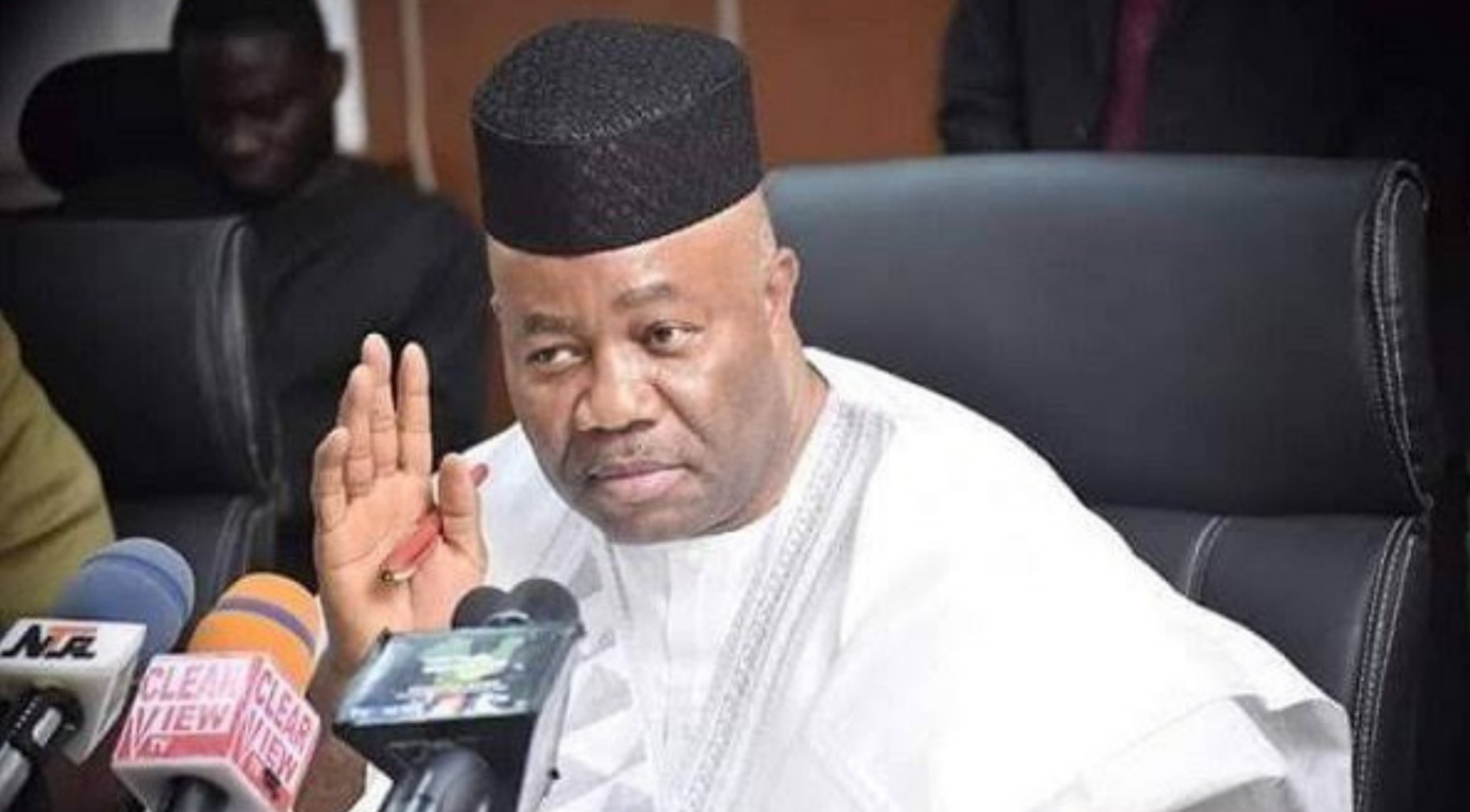
Repeated confrontations between the senate president, Godswill Akpabio, and fellow senators have drawn national attention to leadership tensions in the 10th senate.
The disputes have featured walkouts, suspensions, accusations of bias and heated exchanges on the floor of the chamber.
Together, these episodes have come to define a turbulent relationship between the senate president and some of his colleagues.
Below are key incidents that have shaped Akpabio’s tenure so far.
Ali Ndume’s walkout
Ali Ndume, senator representing Borno south, walked out of plenary in October 2023 after Akpabio ruled him out of order during debate on a motion.
Ndume accused the senate president of bias and high-handedness while presiding over senate proceedings.
Citing order 54 of the senate standing rules, the Borno lawmaker said sittings under Akpabio often violated established procedures.
“There are some things we do in this chamber that are against our rules,” Ndume said.
“Nobody is too big to learn…”
Akpabio immediately ruled him out of order using the same provision of the rule book.
In July 2024, the All Progressives Congress asked Ndume to vacate his position as chief whip over comments critical of the Bola Tinubu administration.
“You have been making uncouth and rabid outbursts against the government before the international community which is not only harmful to the government’s image, but its effort to bring in foreign direct investments (FDIs),” the party said in a letter to the senate leadership.
Tony Nwoye’s minority leadership protest
Tony Nwoye, senator representing Anambra north, clashed with Akpabio in November 2023 over changes announced in the minority leadership.
Nwoye accused the senate president of imposing leaders on the minority caucus.
“Are we your slaves? Why will the senate president be picking leaders for us?” Nwoye shouted.
“You have done your worst. You have pushed us to the wall. Meaning what? It is unfair. It is not about me, it is about the institution of the state.”
The confrontation turned plenary rowdy, forcing Akpabio to restore order.
Abdul Ningi’s budget allegation
Abdul Ningi, senator representing Bauchi central, alleged in March 2024 that trillions of naira were “smuggled” into the 2024 budget.
The senator claimed that “apart from what the national assembly did on the floor, there was another budget that was done underground which we didn’t know”.
The allegation followed the passage of a N28.7tn budget, N1.2tn higher than the N27.5tn proposed by President Bola Tinubu.
Akpabio suspended Ningi, accusing him of spreading falsehood capable of destabilising the country.
“Nigerians are bashing the senate. Many Nigerians will never in future come back to respect this chamber,” Akpabio said.
“The integrity of this chamber has been damaged and we wanted you to repair it with your speech.”
Ningi was later recalled, with Akpabio citing “unity and reconciliation” as justification.
Ireti Kingibe’s chamber protest
Ireti Kingibe, senator representing the federal capital territory, walked out of the chamber in December 2024 after her motion was not entertained.
Kingibe had intended to move a motion on demolitions in the FCT, but it was absent from the order paper.
Akpabio said senate rules permit only one motion of urgent public importance daily.
Kingibe later returned to apologise for her action.
Before the incident, Akpabio advised Nyesom Wike, minister of the federal capital territory, to ignore complaints by the senator.
“I saw one of the legislators on television talking about you (Wike) and mentioning the fact that she was not carried along,” Akpabio said.
“Well, she is a member of the senate. Once a decision is taken, she is bound by the decision.”
Natasha Akpoti-Uduaghan’s suspension
Natasha Akpoti-Uduaghan, senator representing Kogi central, clashed with Akpabio on February 20 over the reassignment of her seat.
The disagreement escalated when she refused to comply with the relocation directive.
“I don’t care if I am silenced. I am not afraid of you. You have denied me my privilege,” she said.
Akpoti-Uduaghan later accused Akpabio of sexual harassment, which he denied.
The senate ethics committee subsequently recommended her suspension for six months.
The suspension removed her remuneration, security and access to the chamber.
On July 4, a federal high court in Abuja described the suspension as excessive and urged her reinstatement.
Upon her return, Akpoti-Uduaghan accused Akpabio of treating her like domestic staff.
Seriake Dickson’s Rivers emergency rule clash
Seriake Dickson, senator representing Bayelsa west, confronted Akpabio in March 2025 over emergency rule declared in Rivers state.
The dispute followed a motion to reorder the order paper for debate on the proclamation.
Akpabio resisted Dickson’s attempt to raise a point of order.
“Senator Seriake Dickson, let’s not argue. If we do, it won’t be good for any of us,” Akpabio said.
“You were a former governor, and I was a former governor. Please turn off your mic and sit down.”
Dickson insisted on his right to speak.
“Mr Senate President, I have respect for you, and I believe that should be mutual,” he said.
After a closed session, Dickson criticised Akpabio’s conduct.
“The senate president was very unfair to me by trying to censor my freedom of expression,” he said.
Defence and criticism of Akpabio
Akpabio’s supporters insist the senate president has merely enforced discipline.
Jackson Udom, special assistant on media to Akpabio, dismissed claims of authoritarian leadership.
“The senate president operates an open administration which involves everybody,” Udom said.
“He is just the first among equals.”
Critics argue the repeated clashes reflect deeper governance challenges.
“When you see the legislative arm having constant battles, not based on governance, that tells you there is a fundamental problem,” Abdulrazaq Hamzat, executive director of the Foundation for Peace Professionals, said.
“So, those constant battles are not good for our democracy and we need to rethink them.”
As political activities intensify ahead of the general election, observers say tensions in the red chamber may deepen.
Ultimately, Akpabio’s approach to leadership is expected to shape how the 10th senate is remembered.


Discussion about this post