
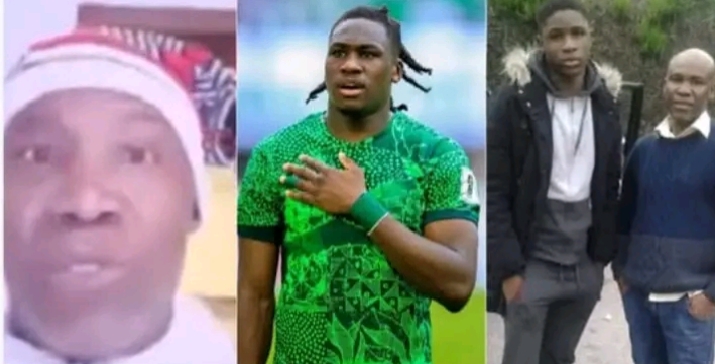
The stadium lights cast a glow on thousands of cheering fans, yet in the midst of celebration, a silent story lingered in the shadows, a story untouched by trophies and headlines. Calvin Bassey, a formidable defender for Fulham FC and the Super Eagles, stood at the pinnacle of his career, yet beneath the strength of his tackles and the precision of his passes, a deeper tension tugged at him.
A father who had not touched his life in nearly eighteen years, a voice calling for reconciliation, a past that refused to remain buried, all converging quietly as the world watched a footballer at the height of his powers, unaware that a different kind of challenge loomed beyond the pitch, one measured not in goals or tackles, but in forgiveness and human connection.
In Nigeria and across the diaspora, whispers of family and estrangement began to circulate, questions forming in the minds of fans and journalists alike. What had led to such a separation, could the bond be restored, and how does fame alter the course of a father-son relationship that had long been seemingly interrupted.
The Early Years: A Childhood Shaped by Absence
Calvin Bassey’s early life was a study in contrasts, between the promise of youth and the quiet void left by an absent father. Born to Nigerian parents, he spent his formative years in Italy where the rhythms of everyday life combined with early exposure to football. Streets and playgrounds became arenas where talent and discipline intersected, yet behind every joyful kick of a ball there was a lingering absence.
The emotional void was subtle at first, hidden beneath parental care and guidance from his mother, yet it persisted, shaping choices and perspectives that would echo into adulthood. Observers might see a rising football star, but the story of separation and longing was never far from the surface.
The family’s relocation to England marked a transition that highlighted both opportunity and distance. Football academies offered structure, mentorship, and professional pathways, yet a father’s presence was absent in the moments that count, the small decisions, the moral guidance, and the daily encouragement that often shapes confidence. For Calvin, resilience became both armor and companion, the skills honed on the pitch blending with lessons learned from solitude.
The mother’s role was magnified, her sacrifices underscored in every training session, every match, every decision that allowed her son to thrive in environments far from home. Her influence became the anchor of stability, the quiet counterbalance to the absence of paternal guidance.
The absence of Kingsley Ikenna Ughelumba, however, left gaps that could not be filled by structure alone. As Calvin navigated early adolescence, the reality of an estranged father crystallized in subtle ways, in unasked questions, in imagined scenarios, in quiet moments where companionship might have been.
These early experiences influenced his perception of family, loyalty, and trust, reinforcing bonds with his mother while complicating any potential connection to the father. In the public imagination, athletes are defined by skill, discipline, and performance, yet the private narrative of separation illuminates the human complexity behind the professional persona.
The Reunion Plea: Kingsley Bassey Speaks Out
In January 2026, Kingsley Ikenna Ughelumba, the biological father of Calvin Bassey, chose the public stage to express a deeply personal longing. After nearly eighteen years of separation, he reached out not only to his son but to the broader public, urging Nigerians to intercede and facilitate a reunion. His plea was neither a political statement nor a demand for attention, rather a profound declaration of paternal longing that drew empathy, curiosity, and debate across social platforms.
The father’s voice carried decades of regret, persistence, and hope, revealing the complexity of human relationships when fractured by separation and time. Many wondered why it had taken so long for such a statement, and whether public exposure would help or hinder the delicate process of reconnection.
Kingsley’s appeal also shed light on the challenges he faced after his marriage ended. He described being cut off from contact, having phone numbers changed, and even legal efforts in London that failed to provide him access to his children. Each failed attempt deepened the rift, yet he persisted, motivated by the desire to see his son and rebuild what was lost. The father’s approach was measured, emphasizing that his interest was rooted in emotional connection rather than financial gain or public recognition. His statement resonated with many who understood estrangement as a silent torment, an invisible ache that success and distance cannot resolve.
The father’s narrative underscored that attempts to reconnect were not limited to legal channels. He reportedly tried to meet Calvin at Leicester City, where the player once competed, but encounters were thwarted after interventions from the mother. Similarly, efforts during international competitions, including AFCON, did not materialize, leaving Kingsley’s desire unfulfilled.
These failed attempts highlighted the emotional and logistical barriers that long-term separation imposes, complicating even well-intentioned overtures, and reflecting the layered challenges of reconciling a family fractured by time, geography, and circumstance.
The Name Change and Identity: Choosing Mother’s Surname
Calvin Bassey’s decision to bear his mother’s surname was more than a legal formality; it was a declaration of identity and loyalty, a choice shaped by circumstances that began decades earlier. In the absence of his father since age 6, the mother became the central figure in his upbringing, providing stability, guidance, and the emotional support that would define his formative years.
Adopting her surname was both a gesture of gratitude and a reflection of the reality that family is constructed through presence, care, and sacrifice rather than mere biology. For fans and observers, the name Bassey signifies talent and achievement, yet behind it lies a story of complex familial allegiance.
This choice also carried cultural resonance within Nigerian society, where surnames are tied to lineage, heritage, and recognition. By choosing his mother’s name, Calvin communicated loyalty and honor to the parent who consistently nurtured his development, implicitly acknowledging the absence of his father without hostility. It was a decision that reconciled personal identity with societal expectations, a balancing act that few public figures must navigate so consciously. The name became a symbol of gratitude and survival, reflecting the intersection of personal history and public persona.
From a professional perspective, bearing his mother’s surname allowed Calvin to define his narrative on his terms. It created a distinct personal brand that is recognized in football circles and by fans worldwide, yet it also preserved the privacy of the family dynamics he lived with daily.
This decision illustrates how personal experiences shape public representation, emphasizing that identity is often sculpted by circumstances and conscious choices rather than inherited legacy alone. The surname thus carries multiple layers of meaning, encapsulating history, gratitude, and deliberate self-definition.
Public Reaction and Media Coverage: Spotlight on Estrangement
The announcement of Kingsley Ikenna Ughelumba’s public reunion plea triggered widespread discussion in Nigerian media and across social platforms. Journalists dissected the story with a combination of curiosity, empathy, and scrutiny, while fans debated the complexities of family, forgiveness, and celebrity influence.
Headlines quickly highlighted the emotional gravity, framing the situation not as mere gossip but as a reflection of human experiences that resonate broadly. Social media became a space for reflection, commentary, and even advocacy, with many users expressing support for reconciliation while others questioned the timing and public nature of the appeal.
Fans of the Super Eagles and Fulham FC weighed in, expressing empathy for both father and son. Many pointed to the importance of forgiveness and emotional healing, emphasizing that family relationships extend beyond biological connection and public persona.
Others reflected on Calvin’s career, noting that personal struggles often coexist with professional triumphs, and that the resilience demonstrated on the pitch may be mirrored in navigating complex family dynamics. Public reaction demonstrated the emotional investment of audiences, bridging the gap between sports fandom and human empathy.
Analysis of Reconciliation Possibilities: Can Bonds Be Restored?
The possibility of a reunion between Calvin Bassey and his father depends on multiple factors, both logistical and emotional. Time, absence, and prior interventions have created barriers that cannot be easily removed, yet the human capacity for forgiveness and adaptation provides a foundation for hope. Successful reconciliation requires acknowledgment of past mistakes, willingness to engage across emotional distance, and careful negotiation of boundaries that respect both parties’ lived experiences. Kingsley’s public plea demonstrates his readiness to initiate this process, signaling intent to bridge decades of separation.
Emotional preparedness is as critical as practical opportunity. Calvin, raised primarily by his mother, has developed a strong sense of autonomy and identity. Reconnection with a father who was absent for nearly eighteen years involves reconciling the past with present realities, assessing trust, and redefining familial roles. Both parties must navigate residual feelings of hurt, loyalty, and resentment, creating a delicate interplay of emotions that will shape the trajectory of reconciliation. Support from family intermediaries and empathetic guidance may be essential in creating a safe environment for dialogue.
Practical considerations also influence the likelihood of reunion. Geographic distance, professional commitments, and the high-profile nature of Calvin’s career create constraints that complicate efforts at in-person contact. Scheduling meetings, ensuring privacy, and managing public attention are logistical challenges that must be addressed thoughtfully to prevent misunderstandings or setbacks. Reconciliation is not solely an emotional process; it requires strategic coordination, planning, and respect for each individual’s circumstances.
Final Reflections: Hope, Forgiveness, and Human Connection
The story of Calvin Bassey and his father is, at its core, a reminder of the complexities of human relationships and the consequences of absence. It is a narrative that moves beyond football, beyond headlines, and into the universal experience of longing for connection. For nearly eighteen years, distance and circumstance defined their relationship, yet the recent public plea demonstrates that time does not erase desire for reconciliation. It is a quiet affirmation that bonds, even when strained or broken, remain capable of renewal.
Forgiveness emerges as a central theme, one that does not demand forgetting but encourages understanding. Calvin’s father has acknowledged past mistakes, seeking not material compensation but the chance to rebuild a relationship. The plea illustrates the delicate balance of accountability and humility, showing that reconciliation is as much about admitting faults as it is about offering trust. In doing so, it also invites observers to consider the ways in which family, choice, and circumstance interact in shaping lives.


Discussion about this post