
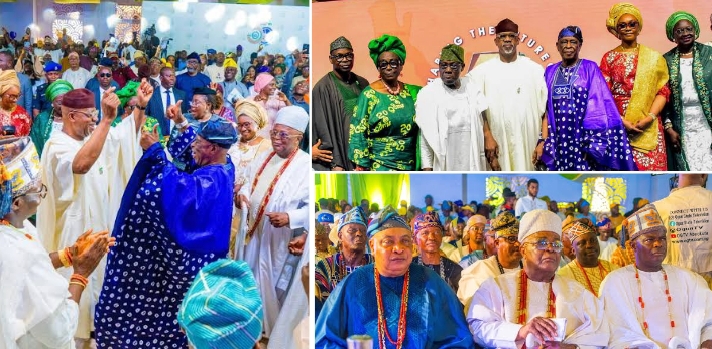
Ogun State awoke on February 3, 2026, with a quiet intensity that seemed to whisper history. Fifty years had passed since its creation, a half-century of governance, growth, challenge, and ambition. Streets in Abeokuta were alive with banners and people, but beneath the festivity lay a question that many quietly asked: who truly holds sway in a state where tradition, politics, and social influence overlap?
The golden jubilee was not just a celebration, it was a stage, a moment to observe power, allegiance, and the subtle markers of authority. Former presidents, ex-governors, monarchs, and influential citizens filled the halls, their presence alone sending signals about continuity, legacy, and the dynamics that shape Ogun.
History of Ogun State, Nigeria
Origins Before the State System
The land that is now Ogun State has deep roots long before modern political boundaries existed. In pre‑colonial times, much of this region was part of the Oyo Empire, one of the most powerful Yoruba kingdoms in West Africa. The empire began to collapse in the early 1800s, triggering migrations and the rise of new communities. One of these was Abeokuta, founded around 1830 by Egba refugees. These settlers built the town under the protection of Olumo Rock, a massive natural fortress that defended them from rival groups during inter‑tribal conflicts. Today Olumo Rock stands as a symbol of resilience and history in the heart of Abeokuta.
European contact and expanding British colonial ambitions in the late 19th century brought new political realities. After the 1885 Berlin Congo Conference, Britain expanded its influence in the region, incorporating what is now Ogun into the Protectorate of Lagos by 1893 and later into the broader Protectorate of Southern Nigeria. By 1914 this area became part of the unified colonial entity called Nigeria. Rail links between Abeokuta and Lagos developed by the turn of the century connected the region more closely to global trade routes.
During the colonial period, Ogun’s towns and cities became important centres of early nationalist and social movements. The 1930s saw parts of the area become centres of political activism, including significant contributions to early women’s movements led by figures such as Funmilayo Ransome‑Kuti, who was instrumental in advancing rights and challenging colonial economic policies.
Formation of Ogun State
Ogun State was officially created on 3 February 1976 during Nigeria’s second major state‑creation exercise under the military regime of General Murtala Mohammed, with General Olusegun Obasanjo as his deputy and successor. The new state was carved out of the old Western State, itself an administrative region of post‑colonial Nigeria. The name “Ogun” comes from the Ogun River, which flows through the state from the north to the south, and Abeokuta (“under the rock” in Yoruba) was designated its capital.
Its establishment was part of a nationwide effort to bring government closer to the people and to acknowledge ethnic and cultural identities in governance. Ogun initially included the former Abeokuta and Ijebu provinces, areas that had long been distinct in culture, economy, and political history. Notably, of the 19 states created in 1976, Ogun and Lagos are two that have remained unchanged in territorial boundaries since that time.
The first governor of the newly created Ogun State was Major‑General Saidu Ayodele Balogun, appointed in March 1976. He faced early challenges such as setting up administrative structures, finding accommodations for civil servants, and establishing foundational institutions for the new state government.
People, Culture, and Early Development
Ogun State is predominantly populated by the Yoruba ethnic group, with several major subgroups including the Egba, Ijebu, Remo, Awori, and Yewa (formerly Egbado) peoples. These groups contributed to the multi‑layered cultural identity that defines the state today.
Historically, the Ijebu were early traders who engaged with Europeans as far back as the 14th century. They developed extensive indigenous trade networks and are credited with early forms of currency in the region known as Owo Eyo (cowrie money). These networks helped position the region as a commercial hub long before modern borders and currencies.
Abeokuta quickly grew into a key urban centre because of its strategic location and cultural significance. Olumo Rock not only offered protection in times of war but became a focal point of community identity and economic activity. Agriculture around Abeokuta and beyond thrived, with crops such as rice, cassava, yams, and palm produce forming the backbone of local trade.
Modern Growth and Identity
Over the decades, Ogun State has evolved significantly. Its location next to Lagos State, Nigeria’s largest commercial centre, shaped its economic trajectory. Known today as the “Gateway State”, Ogun serves as an important corridor for trade, transport, and logistics between Lagos and the rest of the southwest and beyond.
The state diversified from agriculture into industry and manufacturing. Cities such as Ota, Agbara, Sagamu, and Ifo developed as industrial hubs with factories producing everything from cement and plastics to processed foods and textiles. Ogun’s competitive advantage has been its proximity to major markets and ports, combined with improving infrastructure, which continues to attract investment.
Ogun also became a centre of education in Nigeria. It hosts a large number of tertiary institutions, including federal, state, and private universities, teacher training colleges, and specialised research centres. Many Nigerians trace their educational and professional roots to institutions in Ogun State.
Culturally, the state is known for festivals like the Ojude Oba Festival in Ijebu‑Ode, one of Africa’s most vibrant cultural celebrations, highlighting age‑grade parades, music, and traditional pageantry. This festival reflects the rich cultural heritage that continues to draw visitors and foster community pride.
Governor Dapo Abiodun’s Address at Ogun State’s Golden Jubilee: Key Messages and Context
1. Reflecting on Five Decades of Growth and Progress
At the Inter‑Faith Thanksgiving and Prayer session held to mark Ogun State’s 50th anniversary, Governor Dapo Abiodun opened his remarks by looking back over the state’s evolution since its creation in 1976. He highlighted that the state had made remarkable progress in key sectors over the past half‑century, including education, housing, healthcare, agriculture, and industrial development.
He explained that this progress was not accidental but built on the collective efforts of successive administrations and citizens, affirming that Ogun is now one of the fastest‑growing economies in Nigeria. In fact, recent economic estimates place the state’s value at around ₦17 trillion, a marker of substantial economic growth over time.
The governor’s speech wasn’t just about numbers. It was a narrative meant to anchor pride, reminding residents that steady growth and development have defined Ogun’s trajectory, even against national economic headwinds. By foregrounding these achievements, Abiodun framed the anniversary as a moment of both gratitude and affirmation for what the state has become.
Importantly, Abiodun tied these achievements to the state’s identity and role within Nigeria, positioning Ogun not merely as a region of historical significance but as a driving force in national development. His emphasis on growth underscores how the anniversary was used to reinforce Ogun’s narrative of progress.
2. “Gateway to Prosperity”: Infrastructure, Economy, and Strategic Positioning
In his remarks, Governor Abiodun described Ogun State as the gateway to Nigeria’s prosperity, a metaphor for its strategic economic role in the southwest and the nation. He underscored how multimodal transportation infrastructure, an international‑standard airport, and an expanding road network have opened up the state’s economy to trade, investment, and mobility.
The governor emphasized that this connectivity, especially Ogun’s proximity to Lagos has helped draw industry, commerce, and talent into the state. He pointed to the state’s industrial base as a key contributor to its economic rating and attractiveness to investors, reinforcing the idea that Ogun is not static but dynamic and forward‑looking.
By highlighting infrastructure and economic capacity, Abiodun’s speech placed control and influence in the hands of state actors who have invested in long‑term planning. His messaging suggested that development direction and impact are central to understanding who shapes the state.
This focus on infrastructure also spoke to a broader narrative of competitiveness that Ogun aims not just to grow but to lead among Nigerian states, particularly in attracting investment and delivering public goods that improve livelihoods.
3. Social Services, Human Capital, and Citizen Well‑Being
Another major theme in Abiodun’s speech was the state’s performance in social services. He noted that Ogun “leads in education across all levels,” pointing to the expansion of learning opportunities and institutional capacity. Likewise, he spoke about the delivery of affordable housing, a strengthened healthcare infrastructure, and support for productive farmers as evidence of a government investing in the well‑being of its people.
By linking these services to the Golden Jubilee, the governor communicated that sustained governance focus on citizens’ lives is essential to the state’s success. Education and healthcare outcomes are not just statistics; they are seen as foundational pillars of long‑term development in Ogun.
This part of the speech also reflects a broader political message: governance should not be seen only in terms of infrastructure but in how it enhances human capital and opportunity. When the governor frames these achievements as shared, he strengthens the perception that the state’s people and its leadership have agency in shaping progress.
In doing so, Abiodun positioned his government’s agenda as inclusive and citizen‑focused, emphasizing that human development is a core part of state strategy, not merely an afterthought.
4. Honouring Legacy and Calling for Continued Commitment
A key portion of Abiodun’s address was devoted to paying tribute to Ogun’s notable sons and daughters whose accomplishments have shaped the state’s identity and contributions to national life. He specifically referenced figures such as:
- Chief Obafemi Awolowo
- Prof. Wole Soyinka
- Chief Olusegun Obasanjo
- Chief MKO Abiola
By highlighting these legacies, he reminded the audience that collective contributions across generations have built Ogun’s reputation and capacity.
This homage was not merely historical but normative, suggesting that leadership and influence are defined by dedication, excellence, and service. The governor used this moment to link the state’s past to its present and to establish a continuity of vision that residents are encouraged to uphold.
Finally, Abiodun’s remarks included a call for unity and further engagement in the state’s development agenda. By stressing unity and peace, he underscored that inclusive progress depends on shared commitment rather than division. This appeal connects directly to the celebration: the Golden Jubilee is not just a milestone but a rallying point for collective effort going forward.
Obasanjo’s Presence and the Weight of Historical Influence
Obasanjo’s attendance at the jubilee was both symbolic and strategic. Beyond honoring Ogun State’s history, it demonstrated that the former President remains a central figure in its power dynamics. His influence is cumulative, anchored in national stature and deep local roots. In a room filled with former leaders, monarchs, and civic figures, his gestures, nods, and engagement were read as endorsements, critiques, and subtle guidance.
The former President’s role revealed a form of authority that extends into perception and social capital. Attendance alone communicated control, legitimacy, and the ability to shape narrative. Observers noted that Obasanjo’s interactions with younger political figures and traditional rulers were measured, deliberate, and rich with implied counsel. Influence in Ogun State, it became clear, is exercised both in action and in presence.
During the thanksgiving and cultural sessions, Obasanjo’s remarks carried layers of significance. Praise for past leaders was interpreted as signaling alignment, while calls for continued progress were read as subtle expectations for ongoing governance. In a state where formal power is intertwined with tradition and social perception, every word and gesture becomes an instrument of authority.
Osoba and the Continuity of Local Authority
Olusegun Osoba represented a complementary layer of power at the jubilee. Unlike the national influence of Obasanjo, Osoba’s authority is anchored in state governance and historical experience. As a former Governor, his attendance reminded observers that control in Ogun State is cumulative, built on decades of decision-making and policy execution. Presence at the jubilee reaffirmed relevance, highlighting the persistent weight of local political knowledge.
Osoba’s interactions were subtle yet telling. Engagement with traditional rulers, former administrators, and professionals reflected ongoing influence in shaping Ogun’s governance. His presence demonstrated that authority is not measured solely by title but by recognition within networks that sustain governance and social stability. Every handshake and conversation carried significance beyond the ceremony.
Observing Osoba offered insight into the layered nature of leadership. Influence in Ogun State is distributed, with formal positions complemented by historical experience, advisory capacity, and social recognition. The jubilee created a visible representation of these dynamics, showing that those who know the state intimately continue to exercise influence long after leaving office.
Monarchs and the Enduring Force of Tradition
The presence of monarchs during the Golden Jubilee underscored a fundamental reality: culture mediates control. Kings and traditional rulers embody legitimacy that predates and intersects with political authority. Their ceremonial participation, seating, and blessings were more than tradition; they signaled approval, oversight, and influence over how governance and development are interpreted.
Monarchs serve as custodians of social cohesion and mediators between government and citizens. Attendance at the jubilee reinforced their role in validating projects, guiding civic expectation, and maintaining stability. Their presence reminded all that authority in Ogun State cannot be separated from cultural endorsement.
The subtle gestures of monarchs conveyed layered meaning. A nod, a handshake, or a moment of attention was read as affirmation or quiet critique. Participation was an exercise of influence, demonstrating that power is not only elected but culturally mediated. The jubilee thus functioned as a stage where tradition and modern governance intersected.
Looking Forward: Who Shapes Ogun’s Next Fifty Years
As the Golden Jubilee concluded, questions of continuity and succession surfaced quietly but unmistakably. Attendance by Obasanjo, Osoba, monarchs, and other distinguished citizens signaled who is currently influential, but also hinted at who may guide the state in the coming decades. Networks of mentorship, alignment, and approval observed during the celebration indicate that power in Ogun State will remain relational, multi-layered, and mediated through public visibility and social legitimacy.
Economic and cultural influence will continue to intersect with politics. Those acknowledged by monarchs and leaders during the jubilee are likely to have a voice in development, investment, and policy. Presence and participation at ceremonial events remain a key barometer for authority. Influence is exercised not only in office but through visibility, engagement, and the subtle negotiation of alignment with tradition and society.
Citizens will continue to interpret these dynamics, measuring progress against gestures, recognition, and policy impact. In a state where legitimacy is layered, authority is both seen and felt. Observing the interplay between former leaders, monarchs, and distinguished guests provides insight into the evolving balance of power in Ogun State.