
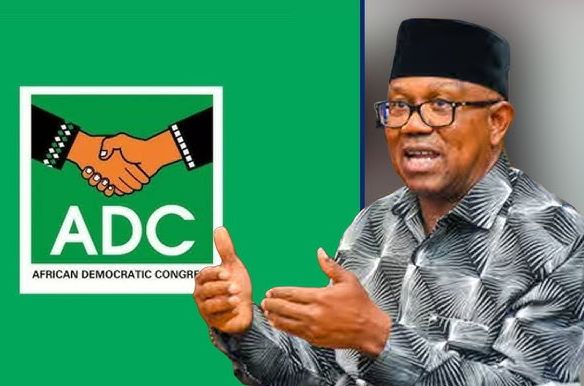
The Labour Party’s emergence as a strong political force in 2023 was largely linked to the presidential ambition of Peter Obi, and his recent move to the African Democratic Congress (ADC) has renewed debate about the party’s stability and future role.
Obi’s departure signalled a major shift for a party that gained national visibility and structure during his campaign, transforming from a fringe platform into a widely discussed opposition force within a short period.
The turning point came in 2022 when he left the Peoples Democratic Party shortly before its presidential primary and joined the LP at a time when his prospects within the PDP appeared limited.
What initially seemed uncertain reshaped the electoral contest, as his message of fiscal discipline and public accountability attracted Nigerians seeking alternatives to the dominant parties.
A strong online-driven support base known as the Obidient movement mobilised many young people and first-time voters, expanding the LP’s reach beyond its traditional base.
When the presidential results were announced, Obi placed third with 6.1 million votes, behind Bola Tinubu of the All Progressives Congress with 8.8 million votes and Atiku Abubakar of the PDP with 6.9 million votes.
He won in Lagos and the federal capital territory, outcomes that disrupted established voting patterns and underscored the scale of the LP’s new influence.
Following the declaration of results, Obi rejected the outcome and described his mandate as “stolen”, stating that he would seek redress through legal and peaceful means, although the courts later affirmed Tinubu’s victory and closed the dispute.
Despite the loss, the LP secured seats in the national assembly and recorded notable performances in several states, shifting attention from campaign momentum to the task of institutional stability.
Leadership disputes and rival claims soon weakened cohesion at the national level, raising concerns about the party’s internal direction after the election cycle.
LP Crisis
In February 2024, Oluchi Oparah, factional national treasurer, accused Julius Abure, national chairman, of misappropriating N3.5 billion, an allegation he denied while threatening legal action, thereby deepening divisions.
Earlier, in April 2023, a high court in Abuja restrained Abure, Farouk Ibrahim, national secretary, Clement Ojukwu, national organising secretary, and Oparah from parading themselves as national officers, adding to the uncertainty.
On September 4, 2024, Nenadi Usman was named head of a 29-member caretaker committee at a meeting convened by the Abia State governor, Alex Otti, an action that reflected attempts to steady the party’s structure.
A federal high court later upheld the Abure-led leadership and the March 2024 Nnewi convention that returned him to office, directing the Independent National Electoral Commission to recognise that leadership, while the court of appeal reaffirmed the position in January 2025.
In April 2025, the supreme court ruled that leadership issues within political parties fall outside judicial authority, leaving rival factions divided and without a final judicial settlement.
Last week, however, a federal high court ordered INEC to recognise the Nenadi Usman-led caretaker committee, a decision reflected on the commission’s website, while the Abure faction indicated plans to challenge the ruling.
The internal disputes coincided with defections by some LP lawmakers to the APC and the ADC, with several legislators citing uncertainty over leadership and direction as reasons for leaving.
These exits reduced the party’s numbers in the national assembly and raised broader questions about its capacity to function as a cohesive opposition bloc.
Obi Moves to ADC
Against this backdrop, Obi announced his decision to join the ADC and declared his intention to contest the 2027 presidential election on its platform.
He also stated that he would serve only a single four-year term if elected, rather than two terms allowed by the constitution, framing the pledge as part of a plan to focus on reforms and national stability within a defined period.
His move removed from the LP its most visible political figure, whose public image and campaign network had largely driven the party’s prominence during the 2023 election cycle.
At present, no other LP member commands similar nationwide recognition, although some party officials maintain that the LP is bigger than any individual and that its structures remain intact under the caretaker arrangement.
They argue that rebuilding unity and strengthening internal processes could reposition the party ahead of future elections.
Others within the political sphere observe that much of the LP’s 2023 support centred on Obi personally rather than on long-standing party loyalty, suggesting that sustaining momentum without a nationally recognised figure may prove challenging.
The ADC has presented Obi’s arrival as evidence of its growing profile before the next election cycle, with opposition figures within the party describing his entry as part of broader coalition efforts.
Observers continue to assess whether his support base will remain consistent under a different party label, noting that electoral success depends not only on popularity but also on organisation, resources and internal stability.
For the LP, immediate priorities include resolving leadership disputes and restoring confidence among members, while its longer-term task is to redefine its identity after the exit of its leading figure.
Obi’s defection has altered the opposition landscape and introduced new alignments ahead of 2027, leaving open the question of whether the LP can consolidate its structure or yield further ground in Nigeria’s evolving political order.


Discussion about this post