
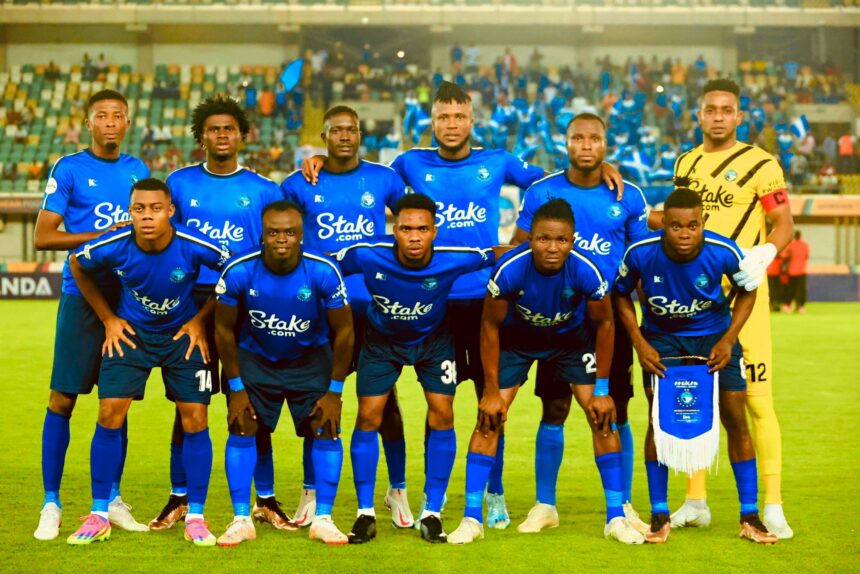
There is something deeply unsettling about watching a club of Enyimba’s stature scramble for survival. The People’s Elephant have won nine NPFL titles, lifted the CAF Champions League twice, and for most of their history, the closest they came to a relegation fight was missing out on continental football. Yet here they are in the 2025/26 Nigeria Premier Football League season, sitting 14th on the table with 32 points from 27 matches, just one point above the relegation zone. That is not a slump. That is a structural crisis, and it has dragged the club’s leadership into the sharpest scrutiny it has faced in years.
- From Title Contenders to Relegation Battlers
- A Season of Revolving Coaches
- Kanu Nwankwo’s Chairmanship Under the Microscope
- Governance Chaos: When the Chairman and the Government Disagree
- What Has Gone Wrong on the Pitch
- The Fan Reaction and the Pressure on Aba
- Can Emmanuel Deutsch Stop the Bleeding?
- Conclusion
This season has exposed Enyimba from every angle: tactically, administratively, and at the board level. Four different coaching setups in a single campaign, a very public power struggle between club chairman Kanu Nwankwo and the Abia State Government, unpaid player allowances, a stadium ban that stripped away home advantage, and fans who are increasingly running out of patience. The question everyone is asking in Aba and across Nigerian football is a straightforward one: how did a nine-time champion end up here?
Why Is Enyimba Fighting Relegation? Understanding the Freefall of a Nine-Time Champion
Enyimba, Nigeria’s nine-time league champion, is suddenly battling relegation, leaving fans shocked. Here’s a look at the factors behind their unexpected struggles this season.
From Title Contenders to Relegation Battlers
The fall has been sharp. Enyimba won their ninth NPFL title in 2023, the last triumph of then-chairman Felix Anyansi Agwu’s 24-year tenure, before Governor Alex Otti appointed Nwankwo Kanu as his successor. The 2024/25 season under Kanu’s leadership saw the club finish sixth, as Remo Stars ran away with the title, leaving Enyimba watching from a distance. Disappointing, but not catastrophic. What has unfolded in the 2025/26 season, however, is something else entirely.
Coming into the current season, Kanu made his intentions clear. The club released 22 players in a sweeping squad overhaul, and the chairman stated publicly that the goal was to either win the league or secure a continental ticket. “We have revamped this team for one purpose, to win,” he said. The ambition was genuine. The execution has been another story.
Enyimba have struggled for consistency from the opening weeks of the season, leaking goals and losing ground at an alarming rate. By the time February 2026 arrived, the club had conceded 27 goals in 26 matches and were sitting in the bottom half of a 20-team league. Ikorodu City, a club making their own history as one of the NPFL’s newer forces, beat Enyimba 1-0 in Aba in mid-February to move to the top of the table. It was Ikorodu City’s first-ever victory over the People’s Elephant. The symbolism was painful.
A Season of Revolving Coaches
The coaching situation at Enyimba this season has been nothing short of chaotic, and it sits at the centre of any serious analysis of why the club is fighting relegation. In the space of a few months, the club has worked through four different technical setups.
Stanley Eguma started the season as head coach. He had taken charge of the team mid-season in 2024/25 and guided them to sixth place, an improvement on the 11th-place standing he inherited. He set bold targets for 2025/26, aiming for the title or, at minimum, continental qualification. The results, however, deteriorated sharply. After Enyimba suffered four defeats in six NPFL matches, including a second home loss of the season against Wikki Tourists in November 2025, the management held an emergency meeting and suspended Eguma along with his two assistants, Ndubuisi Nduka and Joseph Boma. Assistant coach Lawrence Ukaegbu was placed in interim charge.
The club then appointed Deji Ayeni, a 53-year-old coach who had previously managed Sunshine Stars and Akwa United, as permanent head coach in January 2026. He took charge for Enyimba’s Matchday 21 fixture against Barau FC. His tenure lasted less than a month and covered just three competitive matches. Results were poor, including a 3-0 defeat to Shooting Stars and a 2-0 loss to Niger Tornadoes, and he was removed in dramatic fashion, with the announcement coming from the Abia State Government while Ayeni was reportedly still travelling back from the Niger Tornadoes loss.
That exit set the stage for Emmanuel Deutsch Detchoua Gustave, a Cameroonian coach with CAF A, B, and C coaching licences, who was unveiled as Enyimba’s new Technical Adviser in February 2026 through a government-led ceremony at the Enyimba International Stadium. His first match in charge produced a 1-1 draw against Rivers United in Port Harcourt, which moved Enyimba one place up the table to 14th. Defender Paul Odeh described adapting to a new coach mid-season as a necessity, noting that understanding the philosophy of the new manager is now urgent for the team’s survival.
Four coaching setups in one season is extraordinary by any standard. Each change resets tactical patterns, disrupts player confidence, and signals to the dressing room that stability is out of reach. The fans have noticed. As one supporter, Chimaobi Williams, put it after the Ikorodu City defeat, the team had four coaches and still could not find form.
Kanu Nwankwo’s Chairmanship Under the Microscope
The question of why Enyimba is fighting relegation cannot be fully answered without examining what has happened at the top of the club. Kanu Nwankwo arrived as chairman in July 2023 with enormous goodwill and a biography that reads like African football royalty. An Olympic gold medallist in 1996, a two-time African Footballer of the Year, a Champions League winner with Inter Milan, and one of the most celebrated Nigerian footballers in history. His appointment, made by Governor Alex Otti, was celebrated as the beginning of a new era for a club already basking in title glory.
The early signs were encouraging. In his first season, Enyimba qualified for the continent. Kanu hailed the players and coaching staff, and spoke openly about his target of doing better the following season. He backed the decision to bring in Stanley Eguma in December 2024 and presided over the large squad overhaul ahead of the 2025/26 campaign. The ambition seemed matched by the investment, at least in structure.
What has emerged over the course of this season, however, is a picture of a chairman whose authority has been repeatedly challenged, bypassed, and in some cases, publicly contradicted. Fans in Aba have grown increasingly vocal about their frustration, with some calling for Kanu’s removal if results do not improve. After the 1-0 defeat to Ikorodu City in February, supporters spoke openly about their shock that the club was still struggling despite the changes at the top. One fan, Chukwuemeka Onwuka, summed up the mood with a blunt assessment: Enyimba was now giving away points in Aba.
The underlying tension is not just about results. It is about who actually runs the club. And on that question, the 2025/26 season has produced some uncomfortable answers.
Governance Chaos: When the Chairman and the Government Disagree
Perhaps the most damaging aspect of Enyimba’s season has been the governance crisis that played out in public over the coaching appointments. Enyimba, like many state-backed Nigerian clubs, operates under the dual authority of its board and the state government that funds it. In theory, those two entities should work together. In practice, this season exposed significant friction between the Kanu Nwankwo-led club management and the Abia State Government of Governor Alex Otti.
When Eguma was dismissed, the club’s management appointed Deji Ayeni as his replacement. That was a decision made internally, with Kanu’s board presumably driving it. But when Ayeni was removed less than a month later, the announcement came directly from the Abia State Government, not from club management. At the time of the announcement, Ayeni was reportedly still in transit from a match. The government also installed Emmanuel Deutsch as Technical Adviser and named Daniel Eke as Sporting Director, moves that were sanctioned by Governor Otti’s office rather than driven through the club’s own structure. The unveiling ceremony was led by Abia State’s Deputy Governor, with Kanu Nwankwo notably absent.
Reports emerged that Enyimba’s management had simultaneously appointed Uche Okechukwu as Sporting Director in a parallel move, only for the government to install Eke in the same role. For weeks, the club appeared to be operating with conflicting lines of authority, described in some reports as effectively functioning with two technical heads amid boardroom disagreements. Respected former Super Eagles midfielder Mutiu Adepoju weighed in, urging clearer communication between the state and club officials and calling for club management to lead football operations rather than government directives. While he stopped short of calling it political interference, his concern reflected a wider anxiety in Nigerian football circles about the situation.
The government’s intervention also extended beyond appointments. Governor Otti’s office confirmed it would settle all outstanding player and staff salary arrears, allowances, match bonuses, and welfare obligations, an acknowledgement that financial obligations had been falling behind. Whether that signals a genuine reset or a temporary patch remains to be seen.
For Kanu Nwankwo personally, the public absence from the February unveiling of Deutsch and Eke was telling. Reports indicated he was set for talks with Governor Otti over the coaching drama, but the dynamic had already been set: the state government, which funds the club, was prepared to make significant decisions without visible alignment from its chairman.
What Has Gone Wrong on the Pitch
Beyond the administrative turbulence, Enyimba’s performances this season have reflected a team that has lacked cohesion, tactical clarity, and the mentality to grind out results when it matters. The numbers tell much of the story: 27 goals conceded in 26 matches is not the record of a title-challenging side. That figure represents one of the softer defences in a league where physical contests and set-piece vulnerability can quickly define a season.
The home record has been particularly alarming. Losing at the Enyimba International Stadium in Aba has historically been an unusual event. The ground carries an intimidating atmosphere built over decades of title-winning football. But Enyimba have lost at home multiple times this campaign, and the situation was compounded by a stadium ban that stripped the club of crowd support for at least one fixture, removing the factor that made Aba genuinely hostile for visiting teams.
The squad overhaul ahead of the season, while ambitious in its scope, may have been counterproductive in ways that were not immediately obvious. Releasing 22 players in one summer disrupts established combinations, removes experience that cannot easily be replaced in a single transfer window, and places enormous pressure on new signings to hit the ground running in a physically demanding league. Several of the players brought in have not delivered the consistency required to arrest the slide.
There is also the question of morale. Reports have described the players as demoralised by backroom politics and financial disputes. When a dressing room is aware of governance conflict at the top of the club, and when allowances are going unpaid, the effect on performance is rarely positive. These are not abstract concerns. The instability in the dugout, with four coaching changes, means that tactical systems have changed repeatedly, player roles have shifted, and no one in the squad has had the chance to settle into a rhythm under a single voice.
The Fan Reaction and the Pressure on Aba
Enyimba supporters have not been passive observers of this decline. The fan base in Aba carries a distinct sense of identity tied to the club’s history, and the current situation has triggered a visible emotional reaction. After the defeat to Ikorodu City in February, fans who spoke to Nigerian media were blunt. Godwin Kalu and Benet Nwachukwu were among those who expressed surprise that the club was still struggling despite the many changes already made this season. The repeated coaching changes have not provided answers. If anything, each change has reinforced the impression that those in charge do not have a stable plan.
The deeper concern among supporters is not just the points tally. It is the possibility that Enyimba, a club that has never been relegated in its modern history as a top-flight institution, could actually go down. That would be unprecedented and genuinely damaging to the club’s brand, its ability to attract players, and its relationship with sponsors and supporters. Relegation for a club of this size would carry consequences well beyond a single season.
The atmosphere around the Enyimba Stadium reflects this anxiety. A stadium ban deprived the club of the vocal support that has historically made home matches an ordeal for visitors. Without that backing, Enyimba have looked exposed, and results at home have reflected the absence.
Can Emmanuel Deutsch Stop the Bleeding?
With 11 matches left in the 2025/26 NPFL season as of late February 2026, the task facing Emmanuel Deutsch is considerable but not impossible. Enyimba sit 14th with 32 points, just one point above the bottom three. The margins are tight, and every match from here carries direct survival implications.
Deutsch’s opening result, a 1-1 draw at Rivers United, was a reasonable start against one of the league’s top sides. He has spoken with confidence about what Enyimba can achieve, acknowledging the club’s status while being measured about what he can deliver. “I wouldn’t say that I’m the best,” he said after the Rivers United draw, “but I will do my best.” Defender Paul Odeh, who previously played for Rivers United, backed the new coach’s potential while accepting that adapting quickly to a new philosophy was no longer optional.
The structural conditions for a recovery do exist, at least partially. Governor Otti’s confirmation that outstanding welfare payments will be settled removes one source of dressing room tension. The arrival of Uche Okechukwu as Vice-Chairman adds a respected football figure to the leadership structure, someone with credibility among players and fans alike. And the clarity of having a single confirmed coaching appointment, after weeks of conflicting decisions, gives Deutsch at least the foundation to work with.
The key question is whether the players can adapt fast enough. Switching tactical systems mid-season is always difficult, and Deutsch will have little time to implement fundamental changes before results are needed again. The remaining fixtures will test Enyimba’s character, depth, and mental resilience in ways this squad has not yet been asked to demonstrate.
Conclusion
The story of why Enyimba is fighting relegation in the 2025/26 season is not reducible to a single failure. It is the convergence of a massive pre-season squad overhaul that disrupted continuity, a succession of coaching changes that prevented any tactical stability from taking root, a governance dispute between club management and the state government that played out in the open, financial obligations to players that went unmet, and on-field performances that have reflected all of those problems.
Kanu Nwankwo’s chairmanship is under genuine scrutiny, not because the ambition has been absent, but because the execution has fallen apart. A chairman who came in promising to restore Enyimba to glory now faces the prospect of overseeing the club’s most dangerous season in living memory. The government’s decision to bypass the club’s internal processes in making key appointments has not helped the situation, creating confusion rather than clarity at a time when clarity was most needed.
Whether Emmanuel Deutsch can rally the People’s Elephant through the final stretch of the season remains the most pressing question in Nigerian domestic football. But even if Enyimba survive this season, the deeper questions about governance, leadership stability, and long-term planning will need honest answers if the club is to rebuild the kind of platform that made them champions nine times over. Survival would be a relief. A genuine recovery would require something more fundamental.