

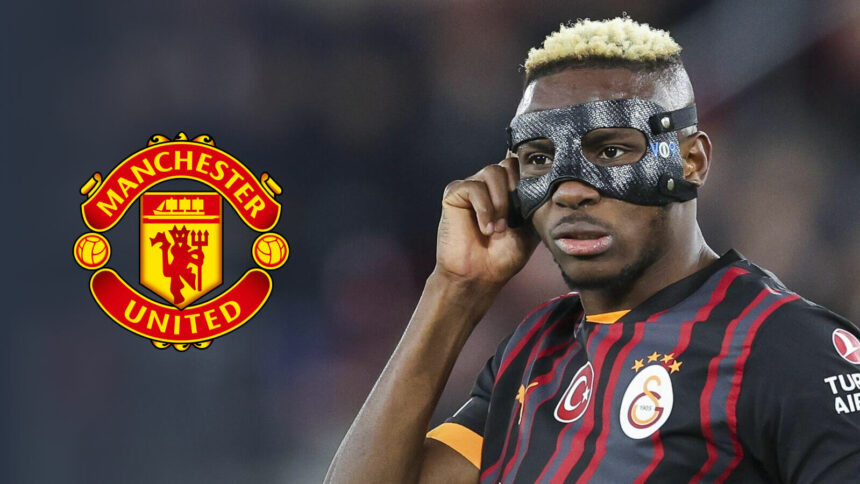
For two full transfer windows, Victor Osimhen sat at the top of Manchester United’s wishlist like an unsolved equation, desired in theory, avoided in practice. The Nigerian striker, who had already rewritten the record books in Serie A and Turkey, seemed tailor-made for what the Red Devils needed: a proven, elite-level centre-forward capable of carrying a struggling attack on his back. Yet every window came and went without a deal, and in early March 2026, French outlet Foot Mercato confirmed what the transfer landscape had quietly been signalling for months: Manchester United have now cooled their interest in Osimhen entirely, leaving Bayern Munich with a clear run at one of the most sought-after strikers on the continent.
- Manchester United’s Long Pursuit of Osimhen: A Transfer Saga in Four Chapters
- Why AFCON Was the First Red Flag for United’s Recruitment Team
- The Sesko Decision: How United Chose the Future Over the Familiar
- Galatasaray’s Price Tag and the Financial Reality at Old Trafford
- A Club in Transition: Amorim Out, Carrick In
- Bayern Munich Step In as United Step Back
- Who Else Is on United’s Summer Radar?
- What United’s Withdrawal Means for Osimhen’s Next Move
- The End of a Transfer Story That Never Quite Began
The reasons behind United’s decision are not simply financial, though money is absolutely part of it. They are structural, tactical, and tied to the rapidly shifting context at Old Trafford, where a managerial sacking, a new interim boss, a costly summer recruitment drive, and a £572 million unamortised transfer balance have all combined to make the Galatasaray striker a problem too complex to solve right now. The club that had Osimhen earmarked as Ruben Amorim’s dream acquisition has now moved on, and it is worth understanding exactly why.
Manchester United and Victor Osimhen: A Transfer Story That Never Quite Happened
The Manchester United Osimhen saga stretches back to the summer of 2024, when Napoli’s relationship with their star striker collapsed dramatically. Since then, the Nigerian has been linked to Old Trafford across multiple windows, with each cycle producing fresh speculation, leaked agreements, and ultimately, nothing concrete. This article traces how that pursuit unravelled, what drove United toward alternative targets, and what the club’s retreat signals about their recruitment priorities heading into the summer of 2026.
Manchester United’s Long Pursuit of Osimhen: A Transfer Saga in Four Chapters
The story begins in the summer of 2024, when Napoli and Osimhen reached a point of no return. After his record-breaking 2022-23 season, 26 goals in 32 Serie A appearances, an African player’s record for top-scoring in a single Italian top-flight campaign, Osimhen had become the most coveted centre-forward in Europe. Napoli inserted a release clause worth £63 million into his contract, and United were among the clubs alerted to his availability. Chelsea held direct talks. Liverpool were linked. Paris Saint-Germain came closest to a deal but ultimately couldn’t agree terms.
With no transfer materialising, Napoli shipped Osimhen out on loan to Galatasaray in September 2024 to avoid the humiliation of fielding a player who had publicly fallen out with the club. What followed was a season of extraordinary production. Osimhen finished the 2024-25 campaign with 37 goals in 39 official appearances for the Turkish side, winning the Süper Lig title and the Turkish Cup, a domestic double, and setting a new record for the most goals scored in a single season by a foreign player in Turkey, surpassing Mario Jardel’s long-standing mark of 34.
That form made him even more difficult to ignore. By June 2025, multiple outlets reported that United and Osimhen had reached what Tuttosport described as an ‘agreement in principle’, with the club prepared to trigger the €75 million release clause in his Napoli deal. There was even talk of a swap arrangement involving Rasmus Hojlund, which would have seen the Danish striker, struggling at Old Trafford, head to Naples while Osimhen moved in the opposite direction. Rio Ferdinand, the United legend and consistent advocate for the signing, said publicly that Osimhen had turned down Al-Hilal’s advances and appeared to be “waiting for United to come.”
Then, in July 2025, Galatasaray made their move permanent, paying Napoli the full €75 million to sign Osimhen on a four-year contract. United had not pulled the trigger. The window had closed on what many at the club still believed was their most transformative available option.
In January 2026, Galatasaray’s president Dursun Ozbek confirmed that Osimhen had no release clause in his new contract, and the Turkish club set an asking price of €140 million, nearly double what they had paid Napoli six months earlier. Reports from the same month indicated United were still tracking him, with Galatasaray’s valuation and Osimhen’s salary demands of around €20 million per year net remaining significant obstacles. Then in early March 2026, Foot Mercato reported that United had stepped back from the race entirely, with Bayern Munich now emerging as the primary suitor.
Why AFCON Was the First Red Flag for United’s Recruitment Team
The most revealing insight into Manchester United’s thinking came from an unexpected source. In late February 2026, Benni McCarthy, the former South African striker who served as part of Erik ten Hag’s backroom staff at Old Trafford, gave an interview to FootballTransfers in which he explained what had pushed Osimhen off United’s radar in the summer of 2025.
“Losing him for so many important matches, the team suffers not having the main striker there,” McCarthy said, referencing the Africa Cup of Nations schedule. “So the decision was made. Literally a big part was because of the AFCON, and Victor Osimhen’s name got scratched off, not a player of interest because of that.”
AFCON 2025 ran from December 21, 2025 to January 18, 2026, with Nigeria participating as one of the continent’s major nations. For a club desperately needing attacking returns from their primary striker in the first half of a Premier League campaign, losing a centre-forward for up to a month during the winter period was considered too high a cost. United had already endured the experience of Bryan Mbeumo and Amad Diallo departing for AFCON earlier in the 2025-26 season, and the prospect of also losing their main striker during that period was viewed internally as unsustainable.
McCarthy’s comments were striking for their candour. He still believed Osimhen would have been an excellent United signing, ‘he scores goals, he works exceptionally hard, and he’s a player immune to the noise’, but confirmed that the AFCON factor had been decisive in the internal deliberations. What is notable is that this judgment was made under the previous manager, Ruben Amorim, whose eventual sacking in January 2026 added yet another layer of complexity to an already difficult situation.
The Sesko Decision: How United Chose the Future Over the Familiar
While Osimhen remained a subject of debate and desire, Manchester United’s recruitment team arrived at a different conclusion over the course of the summer 2025 window. After losing out to Chelsea in the race for Liam Delap, United turned their attention to two remaining targets: Benjamin Sesko and Ollie Watkins. They chose Sesko.
The deal was announced on August 9, 2025. United paid RB Leipzig an initial €76.5 million, with a further €8.5 million in add-ons, for the 22-year-old Slovenian, who became the first player from his country to represent the club. Director of football Jason Wilcox, head of recruitment Christopher Vivell, and chief negotiator Matt Hargreaves were central to the move. Vivell, who had previously worked at Leipzig, played a particularly important role in convincing Sesko to choose United over Newcastle, who had made two bids of their own.
The logic behind the Sesko signing over Osimhen was data-driven and long-term. According to reports from The Mirror and The Times, Sesko’s running metrics and physical attributes made him the preferred fit for United’s project under Amorim’s tactical system. In the two seasons prior to his move, the Slovenian had scored the most goals of any player under 23 in Europe’s top five leagues. He was, in the club’s assessment, a striker they could build around for the next decade.
Osimhen, by contrast, was 26, demanded wages of approximately €20 million per year net, and came with the complication of AFCON absences. The club’s financial position under INEOS meant that committing enormous resources to a player in his late twenties, at a moment when cost control was the dominant priority, required a level of certainty that the Osimhen situation never quite provided.
Sesko’s start at Old Trafford was difficult. He scored just twice in his first 10 Premier League starts under Amorim, and his adaptation period drew concern. But since the turn of 2026 and Michael Carrick’s appointment as interim head coach, Sesko has been transformed. By early March, he had scored nine times in total since joining, with seven goals across eight appearances in all competitions. Only Brentford’s Igor Thiago had scored more Premier League goals in 2026 than the Slovenian, and his match-winning efforts against Fulham, Everton, and Crystal Palace had been worth seven points to United’s push for Champions League qualification.
The club’s recruitment team, which had faced heavy scrutiny earlier in the season, was suddenly looking prescient. Sesko, once considered a consolation prize for missing out on other targets, was now being described in internal conversations at Carrington as an upgrade on Rasmus Hojlund, whose loan to Napoli had, in itself, partially offset the financial weight of the summer’s recruitment drive.
Galatasaray’s Price Tag and the Financial Reality at Old Trafford
It would be a mistake to analyse United’s departure from the Osimhen race purely through the lens of squad priorities. The financial dimension is central to understanding why a transfer that seemed possible in the summer of 2025 became essentially impossible by early 2026.
Manchester United’s most recent financial filings paint a picture of a club managing significant inherited debt while attempting a structural turnaround under INEOS. As of December 31, 2025, the unamortised transfer balance, the total United still owe for players already signed, stood at £572 million. The club also carries $650 million in non-current USD borrowings on its balance sheet, representing legacy debt from the Glazer era. Sir Jim Ratcliffe’s capital injections since acquiring his stake total approximately £328 million, but the club’s operating position remains constrained.
The summer 2025 window saw United spend a total of £232.4 million including add-ons across all signings, Sesko, Bryan Mbeumo, Matheus Cunha, and goalkeeper Senne Lammens among the arrivals. Sales brought in only £61.7 million, producing a net spend of minus £170.7 million. That figure represented the third-worst net spend in the Premier League that summer, behind only Liverpool and Arsenal.
Against this backdrop, Galatasaray’s €140 million valuation for Osimhen, combined with wages that would likely approach or exceed £350,000 per week, represented a transfer that would require United to make him the most expensive player in their history by some distance, at a time when financial prudence was the stated goal of the board. Ratcliffe had been explicit about the club’s need to return to profitability, and an outlay of that scale for a single player, in a summer already carrying heavy amortisation charges, simply did not align with that framework.
Finance analyst Adam Williams, writing for United In Focus, noted that while United technically have the capacity to spend under Profit and Sustainability Rules, the real-world cash constraints and outstanding transfer installments mean the club must weigh each major investment against the compounding cost of previous deals. The Osimhen price, even if Galatasaray softened their asking figure, would have consumed a disproportionate share of the available budget, budget that United believe is better distributed across multiple priority positions.
A Club in Transition: Amorim Out, Carrick In
Any discussion of United’s transfer priorities in the first quarter of 2026 must account for the seismic change in the dugout. Ruben Amorim was sacked on January 5, 2026, following a public breakdown in his relationship with the club’s hierarchy. The Portuguese manager had been critical of the recruitment department after a 1-1 draw at Wolves, telling his bosses in a press conference to ‘do their job.’ A subsequent draw at Leeds on January 4, during which Amorim again publicly aired his frustrations about his role and authority at the club, made his position untenable.
After a brief period of caretaker management under Darren Fletcher, which included a defeat to Brighton in the FA Cup, United appointed Michael Carrick as interim head coach on January 13, 2026. The decision to turn to the 44-year-old former midfielder, who had won two and drawn one from three games as caretaker following Ole Gunnar Solskjaer’s sacking in 2021 and had since built a credible managerial record at Middlesbrough, was driven by the need for stability, familiarity with the club’s systems, and a willingness to work within the sporting director model that Amorim had struggled to accept.
The results under Carrick have been remarkable. By late February 2026, the Red Devils had accumulated 18 points in the 2026 calendar year, more than any other Premier League side over that period. Wins over Manchester City, Arsenal, Fulham, Tottenham Hotspur, Everton, and Crystal Palace had propelled United from seventh, where they sat when Amorim was dismissed, to third in the table, with a genuine prospect of securing Champions League football for 2026-27.
This context matters for the Osimhen question. With Carrick now in charge, and with no confirmed permanent appointment for the summer, the club cannot effectively commit to a striker of Osimhen’s cost and profile without first establishing what the new manager wants. Carrick uses a 4-2-3-1 that shifts to a 4-3-3 in possession, built around positional discipline and fast transitions, a system that Sesko, with his explosive pace and hold-up ability, suits well. Whether a future permanent appointment would want Osimhen, even if the finances were available, is entirely unclear.
Bayern Munich Step In as United Step Back
With United’s pursuit cooling, Bayern Munich have moved to the front of the queue. Foot Mercato, the French outlet that first reported United’s withdrawal, also confirmed that Bayern have added Osimhen to their shortlist as a potential long-term replacement for Harry Kane.
Kane, who is 32 as of now, remains one of the most productive forwards in the Bundesliga, but planning for succession is sensible. Osimhen, at 27, represents an almost ideal profile for what Bayern would need: proven at the highest level across three major leagues, physically dominant, technically sophisticated, and capable of leading a high-pressing system with the relentless intensity that Vincent Kompany’s coaching philosophy demands.
Osimhen’s 2025-26 season with Galatasaray, while not matching the astonishing output of the previous year, has still been productive. He has contributed 23 goal contributions across all competitions and played a crucial role in Galatasaray’s Champions League group stage campaign, scoring seven goals in eight appearances at that level with an average of nearly one goal per match. In the Champions League, his performances drew widespread attention from European scouts, including Juventus, who are tracking him through a separate lens, complicated by a clause in Galatasaray’s deal with Napoli requiring a €70 million penalty payment if they sell him to a Serie A club this summer.
Bayern’s financial capacity makes them a genuine candidate. Their ability to move at pace in the summer window, without the debt burden and ownership uncertainty that clouds Old Trafford, gives them a structural advantage that United simply cannot match right now.
Who Else Is on United’s Summer Radar?
Manchester United’s retreat from Osimhen does not mean they are done in the market. Quite the opposite. With Casemiro’s departure confirmed at the end of the season and a significant midfield rebuild required, United’s summer 2026 priorities appear to centre primarily on central midfield rather than the striker position.
Morgan Rogers of Aston Villa has been identified as a priority target in midfield, with FootballTransfers confirming the 23-year-old England international is in the process of switching agencies, a move widely interpreted as preparation for a major transfer. Elliot Anderson of Nottingham Forest has also been a consistent United target, though reports in March 2026 suggest Manchester City have effectively won the race for the 23-year-old, with sources telling TEAMtalk that Anderson knows his destination.
Bruno Guimaraes of Newcastle has also been mentioned, with United described as the most prominent suitor for the Brazilian’s signature. A move for the 28-year-old, who has been one of the Premier League’s best midfielders over the past two seasons, would represent a significant financial commitment, Newcastle have shown little willingness to sell, but it is the profile of player that United’s hierarchy believes can help close the gap to the top.
In attack, the picture is more complex. Sesko’s form makes a like-for-like striker less urgent than it appeared three months ago, but the squad still lacks depth and variety in wide areas. Borussia Dortmund’s Karim Adeyemi has been linked, with reports from Fichajes and Bild suggesting the 24-year-old German international is stalling on a new contract at Signal Iduna Park and has expressed interest in a Premier League move. Chelsea are also in the picture for Adeyemi. Mateus Mane of Wolverhampton Wanderers remains on United’s shortlist, a more affordable domestic option that Carrick or his successor could deploy in a versatile forward role.
What United’s Withdrawal Means for Osimhen’s Next Move
For Victor Osimhen, United stepping aside is not quite the setback it might appear. There is no shortage of elite clubs tracking his situation, and Galatasaray, despite their lofty €140 million valuation, are not a club that can indefinitely hold a player of his ambition if better opportunities arise.
Juventus remain deeply interested, and manager Igor Tudor has Osimhen as a priority target. However, the Napoli clause, which requires Galatasaray to pay Naples €70 million on top of the transfer fee if Osimhen moves to an Italian club this summer, effectively prices Juve out of the deal unless they are willing to structure a creative financial arrangement. That penalty drops to €60 million in 2027 and expires in September of that year, meaning the clock is ticking in Juventus’s favour if they exercise patience.
PSG are ruled out on wage grounds, with the club reportedly unwilling to match Osimhen’s €20 million annual salary demand. Al-Hilal, who were close to a deal in 2024 before Osimhen reportedly held out for a European move, remain in the background, but Osimhen’s public desire to compete at the highest level in Europe makes Saudi Arabia a last resort rather than a destination of choice.
Bayern Munich, then, emerge as the most credible landing spot if a move happens this summer. They have the financial resources, the competitive ambition, and the obvious footballing logic for the deal. Osimhen’s Champions League pedigree, his ability to adapt across different tactical systems, and his record of sustained goal-scoring in elite environments make him precisely the player a club of Bayern’s standing would target when planning for the post-Kane era.
The End of a Transfer Story That Never Quite Began
Manchester United and Victor Osimhen were always a transfer story in tension with itself. The football argument for the signing was compelling, articulated passionately by figures ranging from Rio Ferdinand to Benni McCarthy to respected analysts across Europe. The Nigerian striker is one of the best centre-forwards of his generation, and there was a period not long ago when the only question seemed to be how soon, not whether, he would end up at Old Trafford.
But timing is everything in football transfers, and the timing never aligned. In 2024, Napoli’s asking price was prohibitive. In 2025, AFCON availability, wage demands, and Galatasaray’s move to make the deal permanent closed the window. By early 2026, a new managerial era, a significant unamortised transfer debt, and the emergence of Benjamin Sesko as a genuine option had shifted United’s thinking entirely.
What Foot Mercato’s March 2026 report confirmed is not that United made a mistake, but that their calculus had changed. The club under INEOS is operating with a clearly defined financial discipline that its predecessors lacked, and in that context, pursuing a €140 million transfer for a 27-year-old striker on €20 million wages, without a permanent manager in place, would have been the kind of reactive, unstructured decision-making that got United into trouble in previous windows.
Bayern Munich will likely have the final say on where Osimhen plays his football next season. For United, the focus has shifted to rebuilding the midfield, securing Champions League qualification under Carrick, and then making the most consequential decision of all, who permanently replaces Amorim in the Old Trafford dugout. The Osimhen chapter is closed, at least for now. The next one is only the beginning.