
Nigeria’s elimination from the 2026 World Cup qualifying race did not end on the pitch in Rabat last November. It may not end there at all. When the Super Eagles lost on penalties to DR Congo in the African playoff final, the Nigeria Football Federation chose to take the fight into FIFA’s disciplinary chambers, filing a formal petition that has since consumed Nigerian football discourse and left the country’s World Cup fate dangling in procedural uncertainty. As of late February 2026, no verdict has been delivered. The intercontinental playoffs in Mexico are weeks away. The clock is running.
- How Nigeria Got Here: The Playoff Defeat That Started It All
- What the NFF Petition Actually Claims
- The Players at the Centre of the Eligibility Dispute
- The Legal Framework: FIFA Rules vs Congolese Domestic Law
- DR Congo’s Response and the Political Undercurrents
- What FIFA Can Actually Do: Possible Verdicts and Outcomes
- The Broader Implications for African Football
- Where Things Stand Heading Into March
- Conclusion
At the centre of the Nigeria vs DR Congo FIFA petition 2026 is a legal argument that touches on dual nationality, domestic law, FIFA’s own eligibility framework, and whether the Congolese federation submitted accurate documentation when seeking clearance for its diaspora-based players. It is a genuinely complicated case, made more chaotic by a wave of fake rulings circulating on social media, political lobbying allegations from both sides, and a prolonged silence from FIFA that has tested the patience of millions of Nigerian supporters. Understanding what is actually being claimed, who the players involved are, what FIFA can realistically do, and what the different outcomes mean requires separating fact from speculation in a case where both have blurred together badly.
Nigeria vs. DR Congo FIFA Petition 2026: Key Facts Ahead of the Verdict
Nigeria’s appeal against DR Congo national football team at FIFA over a disputed 2026 World Cup qualifying fixture has grabbed headlines, not just for the stakes on the pitch, but for the potential consequences off it. Before the ruling is delivered, here’s what every fan needs to know about the timeline, the arguments from both sides, and what the verdict could mean for Nigeria national football team’s path to the tournament.
How Nigeria Got Here: The Playoff Defeat That Started It All
Nigeria’s road to the African playoffs was itself a story of near-collapse and partial recovery. The Super Eagles started their 2026 World Cup qualifying campaign poorly, collecting just three points from their first four group matches under managers Jose Peseiro and Finidi George. The appointment of Eric Chelle as head coach changed the trajectory, with Nigeria winning 14 points from a possible 18 in their final six qualification matches. A helping hand arrived when Eritrea withdrew from the qualifiers, leading CAF to strip points earned against the bottom-placed teams from group standings. Nigeria edged Benin on head-to-head record and squeezed past Burkina Faso on goal difference to secure a playoff berth.
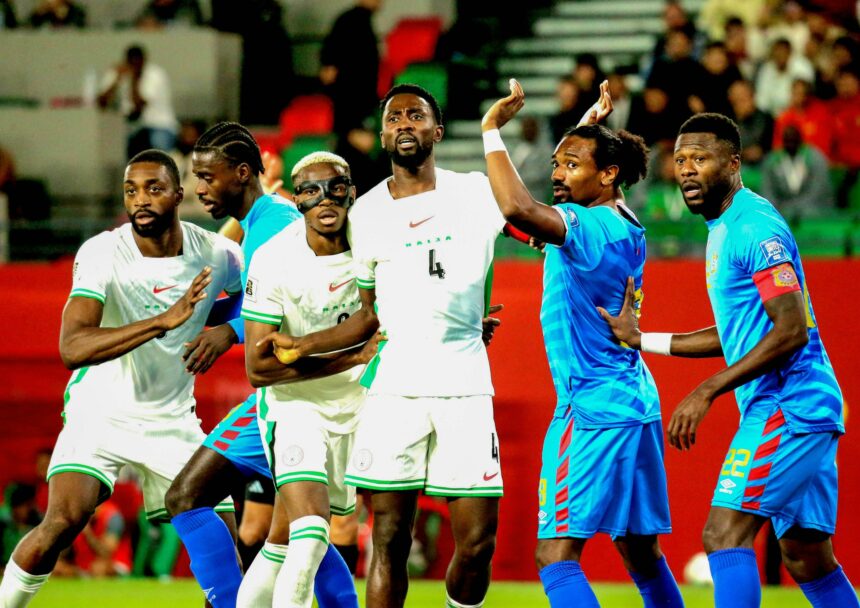
In the two-legged African playoff semi-finals, Nigeria defeated Gabon 4-1 to advance to a final against DR Congo, played as a one-legged tie on neutral ground in Rabat, Morocco, on November 16, 2025. The match ended 1-1 after extra time. DR Congo prevailed 4-3 in the penalty shootout, sending the Leopards into the intercontinental playoffs scheduled for March 2026 in Mexico and ending Nigeria’s qualification campaign on the pitch.
For a country that has not appeared at a World Cup since 2018, the defeat was painful. But the NFF’s response within weeks of the match suggested the federation believed there were legal grounds to challenge the outcome. On December 15, 2025, Nigeria filed a formal petition with FIFA, alleging that DR Congo had fielded players who were ineligible under both FIFA’s own regulations and Congolese domestic law.
What the NFF Petition Actually Claims
The petition rests on two related but legally distinct arguments, and understanding the difference between them matters for assessing how strong Nigeria’s case actually is.
The first argument concerns FIFA’s own eligibility procedures for players who switch international allegiance. FIFA’s regulations require a defined process for any player who has previously represented one nation and wishes to switch to another. This includes having received formal clearance from FIFA, satisfying residency or ancestry requirements, and not having played a competitive senior international for the first country after the age of 21. The NFF argues that several DR Congo players who featured in the playoff did not complete this process properly, and that FECOFA, the Congolese Football Federation, may have submitted incomplete or misleading documentation when requesting their clearances.
NFF General Secretary Mohammed Sanusi put it this way in statements to the media: “Our contention is that FIFA was deceived into clearing them. It is not FIFA’s responsibility to enforce Congolese law. FIFA relies on what is presented to it. We are saying what was presented was fraudulent.”
The second argument is grounded in Congolese domestic law. DR Congo’s constitution reportedly does not recognise dual citizenship for adults. The one notable exception applies to individuals born abroad, who must choose between nationalities before the age of 21. Nigeria’s position is that several of the players in question hold or retained European passports, and because Congolese law does not permit dual nationality, those players cannot legally be Congolese nationals. If they are not legally Congolese nationals under their own country’s laws, the NFF argues, they should not have been eligible to represent DR Congo in competitive international football.
The petition was filed with reference to six players, though some reports placed the number as high as nine. The NFF formally asked FIFA to disqualify DR Congo from the intercontinental playoff and reinstate Nigeria in their place.
The Players at the Centre of the Eligibility Dispute
The names attached to Nigeria’s petition are not fringe players. Several of them were prominent contributors to DR Congo’s playoff campaign, which makes the case significantly more consequential than a routine registration dispute.
Aaron Wan-Bissaka is the most recognisable figure. The former Manchester United right-back spent years in the England setup, including youth-level representation, before deciding to commit his international future to DR Congo, the country of his heritage. He received FIFA clearance and made his senior debut for the Leopards against South Sudan in September 2025. Nigeria’s argument regarding Wan-Bissaka centres on the fact that he retains his English nationality. Under Congolese law, which does not recognise dual citizenship, that creates a potential conflict about whether he can be legally considered a Congolese national in the formal sense required for international representation.
Axel Tuanzebe’s situation carries similar complications. Born in DR Congo but raised in England, Tuanzebe represented England at youth level before switching international allegiance to the Leopards in 2024. His case is considered particularly complex because the switch was relatively recent and the question of whether Congolese law requirements were fully satisfied has not been publicly resolved.
Other players flagged in the petition include Arthur Stroeykens, a Belgian youth international who reportedly received FIFA clearance for his nationality switch in November 2025, and Edo Kayembe Balikwisha, born in Belgium, who converted the penultimate penalty in the shootout against Nigeria. Emmanuel Epolo, a goalkeeper born in Belgium who represented the Belgian youth setup and received his first DR Congo senior call-up in November 2025, is also among those whose eligibility Nigeria questioned, along with Tephy Mavididi.
DR Congo’s position across all these cases has been consistent. FECOFA maintains that each player received the appropriate FIFA clearance before participating and that FIFA’s own regulations on sporting nationality, rather than domestic citizenship laws, govern who is eligible to play international football. This is not an unreasonable position. FIFA does operate its own eligibility framework independently of national citizenship laws, and the governing body formally cleared these players before they featured.
The Legal Framework: FIFA Rules vs Congolese Domestic Law
The legal tension in this case comes from a real and persistent gap between how FIFA approaches nationality in football and how individual countries define citizenship in their domestic laws. FIFA’s eligibility rules are designed to accommodate a global football environment where players of diaspora heritage regularly represent countries they have personal connections to, even if those countries have citizenship laws that might not formally accommodate dual nationality. Under FIFA’s statutes, what matters is that a player holds a passport from the country they wish to represent, satisfies the relevant connection requirements, and goes through the formal switch-of-allegiance process if applicable.
The Congolese constitution sits in tension with this approach. The restriction on dual nationality for adults means that, in theory, a player who retains a European passport is not fully recognised as a Congolese citizen under their own country’s laws. Nigeria’s argument is that FIFA’s clearance process, which relies on documentation provided by the member federation, was potentially undermined if FECOFA did not disclose that these players were retaining foreign passports in violation of domestic law.
There is genuine legal grey area here. FIFA does not typically act as an enforcement body for domestic citizenship laws. Its Disciplinary Committee considers what was presented during the clearance process and whether any rules within FIFA’s own framework were violated. Sanction is most likely if evidence of deliberate fraud or falsification of documents can be established, rather than a technical inconsistency between domestic law and FIFA’s regulations. Cameroon had reportedly filed a similar complaint about some of the same DR Congo players prior to Nigeria’s petition, which suggests this is not an argument the NFF invented in the aftermath of a painful defeat.
That said, the strength of Nigeria’s case likely depends heavily on what the investigation has actually uncovered about what documentation FECOFA submitted and whether it accurately reflected the dual-nationality status of the players concerned.
DR Congo’s Response and the Political Undercurrents
FECOFA has not engaged with Nigeria’s petition quietly. The Congolese federation dismissed the claims quickly and publicly, with their official social media account posting a message that became widely shared: “If you can’t win on the pitch, don’t try to win from the back door. The World Cup has to be played with dignity and confidence. Not with lawyers’ tricks.”
Beyond the public statements, there have been reports of political lobbying attempts by both sides. A number of Nigerian outlets reported allegations that DR Congo was seeking to leverage the influence of Veron Mosengo-Omba, the CAF Secretary General who is Congolese-Swiss, to help secure a favourable FIFA outcome. According to Sports 247, sources alleged that Mosengo-Omba and officials from Congo and some Francophone countries were using their contacts within FIFA to lobby for DR Congo. These are allegations, not established facts, and they should be read as such.
From the Congolese side, a section of the DR Congo media reported that the NFF, backed by the Nigerian federal government, was applying inappropriate pressure on FIFA to deliver a favourable verdict. DR Congo accused Nigeria of making the situation worse by the constant stream of media updates and public comments from Nigerian officials, including National Sports Commission Chairman Shehu Dikko, who made several public statements expressing confidence in Nigeria’s case.
Dikko told the media: “World Cup is a closed chapter for us competitively, but the legal matter is pending. The relevant independent bodies within FIFA will decide.” His acknowledgement that competitive qualification was effectively done and that only the legal route remained open was perhaps the most candid official Nigerian statement on the matter.
What is clear is that this case has been fought on two fronts simultaneously: inside FIFA’s disciplinary process and in the court of public opinion across both countries. The noise from the latter has occasionally complicated the former.
What FIFA Can Actually Do: Possible Verdicts and Outcomes
Setting aside the speculation, there are a limited number of concrete outcomes FIFA’s disciplinary bodies can deliver, and they do not all carry the same implications for Nigeria’s World Cup participation.
The most straightforward outcome is that FIFA dismisses Nigeria’s petition for insufficient evidence. If the investigation finds that FECOFA complied with FIFA’s regulations and that the clearance documents were accurate and properly submitted, the result stands, DR Congo advances to the intercontinental playoffs, and Nigeria’s qualification campaign ends definitively. This is the outcome Congolese officials and fans are confident will occur.
A second outcome involves FIFA finding procedural violations but treating them as administrative rather than fraudulent. In that case, FECOFA could face financial penalties or warnings without the match result being affected. This would be a partial win for Nigeria in terms of establishing that irregularities occurred, but it would not return the Super Eagles to the qualification pathway.
The most consequential outcome for Nigeria would be FIFA finding that players were fielded fraudulently, with documentation intentionally falsified or materially misleading. In that scenario, FIFA has the authority to award the match to Nigeria by forfeit, typically a 3-0 result, which would open the door to Nigeria being reinstated in the intercontinental playoff draw. However, even a favourable ruling at this level does not guarantee Nigeria a World Cup place. It would mean the Super Eagles enter the intercontinental playoffs in Mexico in March, where six nations compete for two spots at the expanded 48-team tournament. Nigeria would still need to win that playoff.
Importantly, even if FIFA rules in Nigeria’s favour at the disciplinary level, DR Congo can appeal to the Court of Arbitration for Sport. That process takes time, and with the intercontinental playoffs just weeks away, timing becomes a practical complication regardless of the verdict.
The Broader Implications for African Football
Whatever FIFA decides, the Nigeria vs DR Congo FIFA petition 2026 has already forced a wider conversation about something African football has been grappling with for years: the growing number of Europe-based players who represent African nations through heritage eligibility, and whether the documentation and legal frameworks surrounding their switches are consistently robust enough.
Several African national teams have built competitive squads substantially by drawing on diaspora talent. DR Congo are not unique in fielding players who were developed in European football systems and received nationality switches. Morocco, Senegal, Algeria, Ivory Coast, and others have all done the same to varying degrees. What makes DR Congo’s situation specific is the constitutional prohibition on dual nationality, which creates a formal tension that many other African nations with similar diaspora-heavy squads do not face to the same extent.
The case raises the question of whether FIFA’s clearance process adequately accounts for domestic legal requirements when those requirements could affect the validity of a player’s eligibility. If a federation provides documentation indicating a player has a Congolese passport without disclosing that the player has retained a European passport in violation of domestic law, at what point does that become a material misrepresentation rather than a technicality? These are not simple questions, and FIFA’s answer in this case will likely set a reference point for future disputes.
There is also the precedent question of retroactive result changes in knockout competitions. FIFA has overturned results in group-stage competitions based on eligibility violations, but it is significantly rarer for such rulings to affect knockout results, particularly when the violation involved formally cleared players rather than unregistered ones. The evidentiary bar for proving fraudulent intent is higher, and the disruption to tournament planning that would follow a result reversal at the playoff stage is substantial.
Where Things Stand Heading Into March
As of late February 2026, FIFA has not issued any official ruling on the Nigeria vs DR Congo FIFA petition 2026, and both federations have confirmed they have received no formal communication from the governing body. A decision had been widely anticipated around February 16, following what was reported to be a scheduled Ethics Committee meeting, but that deadline passed without any announcement.
FIFA’s silence has been notable. The governing body published its CAS and Football Annual Report 2025 in mid-February without any reference to the Nigerian petition. Only FIFA’s Executive Committee, chaired by Gianni Infantino, is authorised to make a formal announcement on the case.
The NFF has consistently reacted to the delay by urging patience and dismissing social media rumours. When fabricated documents purporting to show FIFA awarding Nigeria a 3-0 victory circulated online, the federation’s Director of Communications Ademola Olajire stated clearly: “There is no decision from FIFA at this time. Any claims that a ruling has been made are false. FIFA has not communicated any verdict to us or to the Congolese federation.”
The NFF has also announced a four-nation invitational tournament for the Super Eagles during the March international window, which has led some observers to interpret that as a signal the federation does not expect to be entering the intercontinental playoffs. However, context is important: Nigeria had friendly matches lined up during the November window too, which were cancelled when the Super Eagles qualified for the African playoff. The invitational tournament, on its own, is not conclusive evidence of how the NFF expects FIFA to rule.
Former Super Eagles defender Ben Iroha was among those who publicly criticised FIFA’s handling of the timeline, pointing out that the intercontinental playoff is approaching rapidly and a prolonged delay benefits neither federation’s ability to plan.
Conclusion
The Nigeria vs DR Congo FIFA petition 2026 is not a simple case of a team trying to overturn a penalty shootout loss through administrative appeals. It rests on a genuine legal argument about player eligibility, the integrity of the documentation process, and whether FIFA’s clearance framework creates space for member federations to obscure dual-nationality complications that exist under their own domestic laws.
The strength of Nigeria’s case ultimately depends on what FIFA’s investigation has found about how those six players were cleared, and whether FECOFA’s documentation was complete and accurate. If it was, the result stands. If it was not, FIFA has meaningful tools to impose consequences, though reversing the match result is the highest bar to clear and the least likely single outcome.
What the dispute has already accomplished, regardless of the verdict, is to put the question of diaspora player eligibility squarely on African football’s agenda. Nationality switches have become routine in the modern game, but the legal frameworks surrounding them, particularly in countries with dual-citizenship restrictions, are not always as clean as the clearance stamps suggest. FIFA’s verdict, whenever it comes, will carry weight well beyond Nigeria and DR Congo.
For Nigerian supporters, the waiting is the hardest part. Millions of people who watch the Super Eagles have been through this emotional cycle before, the near-qualification, the penalty defeat, the hope of a reprieve. Whether that hope survives contact with FIFA’s disciplinary process is a question that, as of this writing, remains genuinely open.