

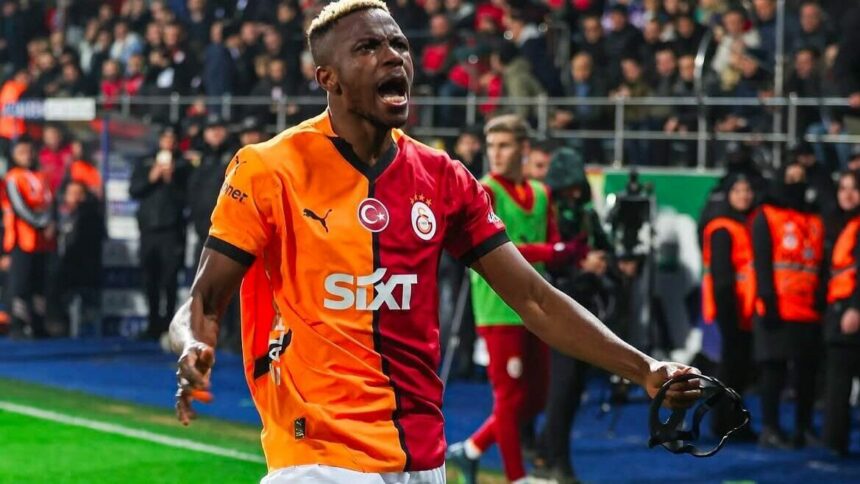
When Galatasaray triggered Victor Osimhen’s €75 million release clause in the summer of 2025, the reaction across European football was largely sceptical. Critics questioned whether a Turkish club had overextended itself on a striker whose relationship with his previous employers had turned sour, whose best years at the highest level of Serie A were arguably already behind him, and whose price tag carried the inflated residue of a contentious contract renegotiation. Seven months later, Galatasaray vice president Abdullah Kavukcu was sitting before the Italian press and calmly stating that the man who cost €75 million is now worth twice that figure.
- The Transfer That Divided Opinion
- A Loan Season That Changed Everything
- Making It Permanent: The Summer 2025 Deal
- The Numbers Behind the Valuation Claim
- A European Stage That Changed the Conversation
- The Turin Test: Qualifying for the Round of 16
- Interest From Europe’s Elite
- What €150 Million Actually Means
- Conclusion
The claim that Victor Osimhen market value in 2026 has reached €150 million is extraordinary in isolation. In context, it is defensible. Osimhen has scored 10 league goals and 4 assists in the Super Lig this season, contributed seven Champions League goals, helped eliminate Juventus from Europe’s premier club competition, and drawn reported interest from Barcelona, Paris Saint-Germain, Bayern Munich, and Atletico Madrid. For a club that operates outside the top six European leagues, engineering that kind of valuation spike in under a year represents a remarkable piece of transfer business, however the number is ultimately interpreted.
Factors Behind Victor Osimhen’s Market Value Increase from €75m to €150m at Galatasaray
When Galatasaray vice president Erol Kavukcu publicly suggested that Victor Osimhen could now be worth as much as €150 million, it instantly sparked debate across Europe. How does a player’s valuation double within months? Was it pure numbers, Champions League impact, transfer politics, or something deeper in the market dynamics?
The Transfer That Divided Opinion
The background to Osimhen’s permanent arrival at Galatasaray cannot be separated from his fractious final chapter at Napoli. After helping the Neapolitan club end a 33-year wait for the Serie A title in 2022/23, scoring a league-high 26 goals that also set a new benchmark for an African player in a single Italian top-flight season, Osimhen became embroiled in a protracted transfer saga that dragged through the summer of 2024 without resolution.
Al-Ahli agreed a deal in principle, then Napoli shifted the price. Chelsea entered discussions, then withdrew. On the final day of August 2024, with Osimhen excluded from Napoli’s Serie A squad and his number 9 shirt handed to Romelu Lukaku, Galatasaray moved quickly to bring him to Istanbul on a season-long loan. It was an unconventional solution to a complicated situation, but the Nigerian forward treated it as a fresh start rather than a fallback.
That initial loan arrangement carried a release clause of €75 million embedded in Osimhen’s Napoli contract, a figure that had been written into his December 2023 extension. At the time, many observers considered it a steep price for a player whose market had grown uncertain through the chaos of that summer. When Galatasaray made the move permanent by triggering that clause in the summer of 2025, the commentary was largely the same. The investment was described, as Kavukcu himself later recalled, as a “crazy” one.
A Loan Season That Changed Everything
Before the permanent deal could make financial sense, the loan season had to justify the belief. And Osimhen’s 2024/25 campaign at Galatasaray did far more than that. He scored 37 goals and provided eight assists across all competitions for the Istanbul side, setting a new record for the most goals scored in a single season by a foreign player in Turkey’s top division. The previous record, 34 goals by Brazilian striker Mario Jardel during his peak years at Galatasaray, had stood for over two decades.
Osimhen finished as the Super Lig’s top scorer and won a domestic double with the club, claiming both the league title and the Turkish Cup. In the cup final against Trabzonspor, he scored twice in a 3-0 victory to cap off a season that had silenced virtually every piece of early scepticism. Perhaps as significantly, Osimhen made clear he was not treating Istanbul as a temporary shelter from the storm of Napoli politics. When permanent transfer interest came from Premier League clubs and Saudi Arabia offered financial packages worth significantly more, he chose to stay. Kavukcu later noted that Osimhen had turned down offers with a salary difference of between €93 million and €105 million to remain at Galatasaray.
That decision spoke to the environment the club had built around him and the ambition of the project he had bought into. Okan Buruk’s tactical setup suited his profile precisely: a high line, a team that presses aggressively and creates transitions at pace, and teammates capable of delivering the kind of service that lets a physically dominant centre-forward operate in space rather than against packed defences. Osimhen thrived.
Making It Permanent: The Summer 2025 Deal
The formal announcement of Osimhen’s permanent transfer in the summer of 2025 came with considerable detail. Galatasaray confirmed they had paid €75 million to Napoli, structured in two installments: €40 million upfront and the remaining €35 million due by the end of the 2025/26 season. Napoli retained a 10% stake in any future profit from a sale above the purchase price, though some reports disputed the precise terms of that profit-share arrangement. The player himself signed a four-year contract carrying a net annual salary of €15 million, a loyalty bonus of €1 million per season, and €5 million in image rights annually.
At the time of the permanent transfer, Osimhen was welcomed back to Istanbul with the kind of reception reserved for returning heroes rather than newly acquired assets. Thousands of fans gathered near the airport; the club broadcast his arrival live on their official YouTube channel. For Galatasaray, it marked the completion of a project that had begun with a calculated gamble on a player many considered damaged goods. For Osimhen, it represented the first time in two years that his professional situation felt genuinely stable.
One notable clause in the agreement was a two-year restriction on Osimhen’s transfer to any Italian club. Should Galatasaray breach it by selling him to a Serie A side within that window, they would be required to pay double the total transfer fee in penalties. The clause reflected the remaining friction of Osimhen’s Napoli departure and also Galatasaray’s desire to control the terms of any future exit on their own timeline.
The Numbers Behind the Valuation Claim
Kavukcu’s assertion that Victor Osimhen market value 2026 has reached €150 million was made publicly in an interview with La Gazzetta dello Sport ahead of Galatasaray’s Champions League playoff second leg against Juventus in Turin in late February. The claim was strategic in its timing and context, but it was not without statistical foundation.
At the point Kavukcu spoke, Osimhen had recorded 10 goals and four assists in the Super Lig this season. Across all competitions, including eight goals and seven assists in the Champions League, his output had continued at roughly the same rate as his record-breaking loan year. His Champions League tally placed him joint fourth among the competition’s top scorers, level with Erling Haaland at that stage, a remarkable context for a striker playing out of Turkey rather than one of football’s traditional power leagues.
It is worth noting that independent market benchmarks do not automatically align with Galatasaray’s figure. Transfermarkt, which remains the most referenced tool for player valuations despite its limitations, had Osimhen at €70 million as recently as March 2025 during his loan season. That figure was almost certainly undervalued even then, reflecting the platform’s structural conservatism rather than realistic market conditions. The reported interest from PSG, who were described in multiple outlets as prepared to meet a €150 million asking price, provides a more credible reference point for what clubs operating at the top of the market consider appropriate.
Football valuations are always partly performative. When a vice president of a selling club states a price publicly before a major European match, it is simultaneously a negotiating signal to interested parties and a demonstration of institutional confidence. But Kavukcu was not operating in a vacuum. The infrastructure of elite interest was already in place before he made his statement.
A European Stage That Changed the Conversation
One of the more consequential aspects of Osimhen’s season at Galatasaray has been what it has done to perceptions of the Super Lig itself. Turkish football has historically been difficult to translate into European transfer valuations; players who dominate domestically often see their market worth discounted precisely because they are doing so in a league perceived to be below the top tier of European competition. Osimhen’s Champions League performances have directly challenged that discount.
Galatasaray entered the 2025/26 Champions League campaign as one of the competition’s more intriguing inclusions. Their first leg against Juventus in Istanbul on February 17, 2026 produced a 5-2 win for the Turkish side, a result that sent shockwaves through the competition. Osimhen was part of a forward unit that dismantled Juventus, a side containing Kenan Yildiz, Jonathan David, and Francisco Conceicao, with a brand of attacking football that confounded expectations about what a Super Lig club should look like at this level.
The victory also produced the context in which Kavukcu gave his interview to the Italian press. Galatasaray had just beaten Juventus at home in a Champions League knockout game by three goals. Whatever scepticism had attached itself to the permanent transfer was difficult to maintain at that point.
The Turin Test: Qualifying for the Round of 16
If the first leg established the statement, the second leg on February 25, 2026 at the Allianz Stadium in Turin tested Galatasaray’s resolve under sustained pressure. Juventus, knowing they needed to overturn a three-goal deficit, came out with the kind of urgency that produced a remarkable spectacle. Manuel Locatelli opened the scoring from the penalty spot in the 37th minute, awarded after Lucas Torreira fouled Khephren Thuram in the box. Four minutes into the second half, Juventus had a Lloyd Kelly red card confirmed by VAR for catching Baris Alper Yilmaz dangerously on the Achilles, a decision that complicated the hosts’ task considerably.
Reduced to ten men, Juventus still managed to score twice more. Federico Gatti headed in a second in the 70th minute, and Weston McKennie forced the ball home eight minutes later to level the aggregate at 5-5 and force extra time. The comeback had been extraordinary, and for a period in normal time it appeared that Galatasaray might lose their three-goal advantage entirely.
Osimhen settled the matter in the first half of extra time. Receiving a pass from Yilmaz in the left channel with Juventus defenders stretched from chasing the game, the Nigerian striker finished low through the legs of goalkeeper Mattia Perin to restore the aggregate lead. It was a composed, technically precise finish under the highest possible pressure, the kind of moment that reinforces why clubs of PSG’s standing are prepared to pay nine-figure sums for proven performers in this category. Yilmaz added a second in the 119th minute to confirm a 7-5 aggregate victory and send Galatasaray into the Champions League Round of 16 for the first time since the 2013/14 season.
Osimhen was named Player of the Match. His seventh Champions League goal of the campaign had proved the decisive intervention of a two-legged European tie.
Interest From Europe’s Elite
The clubs circling Osimhen as of late February 2026 represent a cross-section of European football’s wealthiest and most ambitious operations. PSG, who have built their attack around Kylian Mbappe’s departure and subsequent signings, are reportedly the most serious suitors and the most willing to meet Galatasaray’s asking price. Barcelona, Bayern Munich, Atletico Madrid, Chelsea, and Manchester United have all been mentioned in various reports, though the credibility and intensity of those links varies considerably.
PSG’s interest carries particular weight for a specific reason. The French club’s spending power is effectively unconstrained compared to most European sides, and their need for a reliable, physically dominant centre-forward in the mould of Osimhen aligns directly with the profile they have historically targeted. The Ligue 1 context would also give Osimhen’s value additional European legitimacy in the eyes of market benchmarks like Transfermarkt, potentially raising the base figure from which any future sale would be calculated.
Barcelona’s reported interest reflects a different kind of logic. The Catalan club has been navigating financial fair play restrictions while simultaneously trying to strengthen their attacking options. Whether they could fund a move approaching €150 million in a single window remains genuinely questionable, though the reported interest itself signals Osimhen’s standing among the sport’s most talent-rich environments.
For Galatasaray, the ability to sell Osimhen at a significant profit in any summer window from 2026 onwards would represent the completion of a business model as much as a football one. The club’s broader ambition, articulated publicly by Kavukcu, is to transform themselves into a genuine European powerhouse within five years. Retaining Osimhen keeps them competitive and visible at the highest level. Selling him at a substantial profit provides the capital to reinvest in the squad and sustain the project without relying on speculative valuations remaining static.
What €150 Million Actually Means
The €150 million figure deserves some contextualisation. Modern football’s top striker market is concentrated and expensive. Erling Haaland and Kylian Mbappe sit at the peak, with transfer values and contract costs that most clubs cannot contemplate. Below that elite tier, a small number of forwards command fees in the range Galatasaray is now claiming for Osimhen.
Harry Kane moved from Tottenham to Bayern Munich for €100 million in the summer of 2023. Romelu Lukaku, who replaced Osimhen’s number at Napoli, has been valued considerably lower. Dusan Vlahovic and Viktor Gyokeres have circulated in the €75 million to €100 million range in recent transfer windows. At €150 million, Galatasaray are positioning Osimhen above that tier entirely, placing him in a category closer to Haaland’s estimated market value than to his peers in the second rank of elite strikers.
The case for that premium rests on several factors. Osimhen is 27 years old, born in December 1998, which places him in the window generally considered prime years for a centre-forward at the top level. He has demonstrated sustained, elite production across multiple seasons and multiple competitive contexts, from Serie A to the Champions League to the Super Lig. His physical profile, combining genuine pace, aerial authority, and clinical finishing, is exceptionally rare among strikers at his level. And he has shown no signs of the injury vulnerability that periodically blighted his time at Napoli.
The counterargument is structural. Playing in the Turkish Super Lig, even while performing brilliantly in the Champions League, carries a perception discount that no amount of European goal-scoring fully erases for some clubs and analysts. A run to the Champions League quarter-finals or a sustained knockout phase campaign could shift that calculus further, but as of late February 2026 the sample size from European competition remains relatively small. Kavukcu’s €150 million is also a vice president’s stated asking price, not a formally agreed market transaction. Real valuations are established when money changes hands.
None of which makes the trajectory any less remarkable. Twelve months ago, Osimhen was a player whose situation at the highest level looked precarious. A collapsed move to Saudi Arabia, a public falling-out with Napoli, and a loan to a league outside the traditional European elite had created legitimate questions about where his career was heading. The answers he has delivered, both statistically and in terms of the quality of his performances in the highest-profile matches available to him, have been comprehensive.
Conclusion
The story of Victor Osimhen’s market value at Galatasaray is partly about a footballer rediscovering his best form in an environment that suited him, and partly about a Turkish club executing a piece of transfer strategy that looks, in retrospect, more sophisticated than the initial criticism suggested. Triggering a €75 million release clause for a player in a complicated situation required conviction that the clubs watching from England, France, and Germany lacked. Galatasaray backed their conviction with a long-term contract, a squad built around Osimhen’s strengths, and a European campaign that provided the visibility needed to substantiate a nine-figure valuation.
Whether the final number is exactly €150 million when a buyer eventually emerges matters less than the directional truth: Galatasaray have created real and substantial equity on a transfer that the market initially dismissed. Osimhen, meanwhile, has re-established himself firmly among the small group of centre-forwards for whom the biggest clubs in European football are prepared to compete seriously. The Round of 16 awaits, and with it the next set of performances that will either reinforce or complicate everything that Kavukcu claimed in Turin.