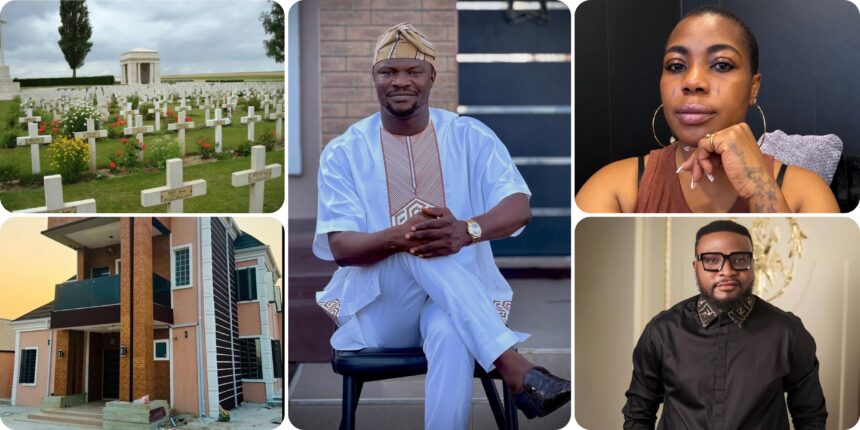
For a family mourning the loss of a loved one, deciding how to say the final goodbye can be difficult. But what happens when the people left behind cannot agree on what that goodbye should look like?
For Toluwanisings, the questions surrounding his final resting place have drawn attention beyond his immediate family, turning a private decision into a public conversation.
How The Burial Controversy Began


The disagreement over where Toluwanisings should be buried became public following comments by his father, Muniru Adekunle Olayemi, about the family’s differences with the late singer’s widow, Elizabeth.
According to reports, his father wanted his son buried at the house he built in Ibadan. Another option he reportedly considered was Ikirun, Osun State, where Toluwanisings’ late mother was buried. The father’s reported preference reflected his wish to have his son laid to rest at home, where family members could gather to pray in his memory.
However, the widow reportedly preferred a cemetery or a church-owned burial ground. According to the father’s account, she was uncomfortable with the idea of living in a house where her husband was buried. Reports also indicated that the proposed burial in Ikirun was a point of disagreement, with the widow reportedly concerned about the distance.
The differing positions brought a difficult family decision into the public eye. While one side reportedly favoured keeping the singer close to the family home, the other was said to prefer a separate burial ground.
Kudirat Ogunro Speaks Against Home Burials


As the disagreement attracted attention, Nollywood actress Kudirat Ogunro joined the conversation, sharing her opinion on the practice of burying people in residential properties. In a post shared on Instagram on Tuesday, October 27, the actress wrote:
“I said it last month, and I’ll say it again: burying people at home isn’t a good idea.”
Ogunro explained that her concern centred on what could happen to a property after the death of its owner. She questioned whether a future buyer would be comfortable purchasing a house where someone had been buried. She also raised the possibility that a new owner might want the remains exhumed.
Her comments brought another dimension to the debate. Beyond the family’s wishes and the emotional importance of a burial place, she highlighted the practical questions that could arise when a residential property also becomes a burial site. The actress made it clear that she was expressing her personal opinion. Her position, however, added to the growing public discussion about whether a family home is an appropriate place for a loved one to be laid to rest.
Wale Jana Defends Widow, Questions Home Burial Plan


Businessman Wale Jana has also weighed in on the controversy, expressing support for Toluwanisings’ widow and questioning the family’s reported insistence that the singer should be buried in the house he built before his death.
In an Instagram post on Tuesday, October 27, Wale Jana shared a photo of the late gospel singer with his family, alongside a photo of the house at the centre of the disagreement. He began by explaining why he had initially avoided following reports about the singer’s death. He wrote:
“I deliberately blocked out all stories about Toluwanisings because it was just too painful; I couldn’t deal until I began to see that his family members were antagonizing his wife and they are insisting he should be buried in the house he just built.”
Wale Jana argued that the house should be seen as an important investment for the singer’s surviving family, particularly his widow and their two daughters. Quoting Proverbs 13:22, which speaks about a good person leaving an inheritance for future generations, he said the property was Toluwanisings’ biggest investment and questioned whether the late singer would have wanted it to become a burial site.
According to Jana, the property could provide financial security for the family in the years ahead. He suggested that the widow could rent it out, convert it into apartments or sell it, depending on what best suited her circumstances. He warned that burying the singer in the house could limit those options. He continued:
“If he had 3 houses or more, he would have had the luxury of being buried in one of those houses but don’t bury a man in the only house he has built, you will make it very difficult for his widow and children to enjoy the investment the man left behind.”
Jana also raised concerns about the financial responsibilities that could fall on the widow as she raises their two daughters and maintains the property. He asked:
“Would Toluwani want his wife and children to suffer?”
The businessman further questioned the intentions of relatives who had spoken publicly about the disagreement, alleging that some did not have the singer’s interests at heart. He recommended that the family consider a private luxury burial ground instead of burying Toluwanisings at the house. He concluded:
“Death is so cruel. May God continue to show all of us mercy.”
Jana’s intervention shifted attention to another aspect of the dispute: what happens to the assets a person leaves behind, and how decisions made after their death might affect their children.
His Grandmother Wants Him Buried At Home


These comments came as another member of Toluwanisings’ family, his paternal grandmother, Sabitiyu Olayemi, publicly expressed her own preference.
In an interview shared online, the grandmother opposed the idea of burying the singer in a cemetery. She reportedly insisted that he should be buried at the house he built in Ibadan. Her position reflected the preference expressed by his father, adding another voice to the family’s side of the disagreement.
However, the grandmother’s interview also touched on her relationship with the late singer. She alleged that she had not seen him for more than five years and claimed that he had provided her with limited financial support. Despite these claims, she spoke about the pain of losing him.
Family Calls For Burial Postponement And Investigation
Just as the debate over the burial location was drawing attention, another development emerged on Tuesday, October 27. Reports said members of Toluwanisings’ paternal family were calling for his burial to be postponed until the circumstances surrounding his death had been investigated.
His uncle, Lawal Ademola Rauf, reportedly appealed to the government, community leaders and law enforcement authorities to ensure that the matter received proper attention. The family also indicated that it was prepared to continue paying the mortuary fees while waiting for an investigation.
The uncle reportedly maintained that the family wanted Toluwanisings to be buried at his Ibadan home once the necessary issues had been addressed.
What Happened Before Toluwanisings’ Death?


Following his death, his personal assistant, Babadunni Gbolabo, gave an account of the efforts to obtain medical treatment for the singer. According to the assistant, Toluwanisings suddenly slumped and was taken to several hospitals. He alleged that they encountered difficulties getting him admitted and receiving treatment at about seven or eight hospitals.
The account raised concerns about the challenges they reportedly faced while seeking emergency medical care.
Tribute Night Holds Amid The Controversy
While questions about the burial remain, arrangements were announced for a Night of Tributes and Service of Songs in honour of the late gospel singer.
The event is scheduled for Tuesday, October 27, 2026, at 3 p.m. at the Hall of Grace, Jogor Centre, Ibadan. Attendees were asked to wear white.
The gathering is intended to bring together family members, friends, colleagues and members of the Christian community to remember his life and ministry.
Its timing places the memorial event against the backdrop of the growing public debate. Those gathering to honour Toluwanisings are doing so while his relatives’ differing burial preferences and the family’s request for an investigation remain part of the public conversation.
The tribute night and the burial are separate matters, however. The announcement of the memorial event does not, on its own, confirm that the burial will proceed as originally planned. For now, the family’s call for a delay has added uncertainty to arrangements for the singer’s final farewell.
Conclusion
Death often leaves families with decisions that must be made while grief is still fresh. Where a loved one should be buried can carry deep emotional, cultural and personal meaning, particularly when relatives have different expectations.
In Toluwanisings’ case, the discussion has grown beyond the walls of his family home. His father’s preference, his grandmother’s position, his widow’s reported concerns and the opinions of public figures have all become part of a conversation that continues to unfold.
Yet the most important questions remain tied to the family itself: how the disagreement will be resolved, whether the requested investigation will take place and when a final decision about his burial will be made.
As friends, colleagues and admirers pay tribute to the late gospel singer, the question of where he will finally rest remains unresolved in the reports available.