


At dawn, the sea at Ibeno does not rush; it vibrates. The tide, steady and ancient, moves as if obeying a rhythm known only to the spirits who have kept watch there since the first canoes touched this shore. The white sand glows even before the sun fully arrives — grains so pale they seem to carry their own memory of light. A fisherman bends to scoop a handful, lets it fall between his fingers, and mutters something about the ancestors still being awake. He does not smile. To him, this sand is not decoration. It is a living witness.
Ibeno, stretched along the Atlantic coast of Akwa Ibom State, looks like paradise in every travel brochure. But those who know it — truly know it — speak of something else beneath the beauty. They say the beach whispers at night, that the tide rises not because of the moon but because of voices that remember. Here, land is never really owned; it is negotiated with — by those who walk it and those who came before.
This is the land where oil companies built terminals, where governments marked boundaries, and where fishermen still pour libations before setting out. Beneath the modern hum of industry and tourism lies a question that no court or corporate lease has been able to silence: Who truly owns Ibeno’s white sand — the living or the dead?
The question does not have an easy answer, and perhaps that is why the story of Ibeno is not told often. It begins before maps, before deeds, before the word “rent” meant currency. It begins when land was a covenant — between people, spirits, and sea.
Before the Map Had Lines: Ibeno and the Ancestral Shoreline
Long before the oil rigs or survey pegs, Ibeno existed as an unbroken communion between land and lineage. The people who first settled here were part of the Ijaw-speaking tribes, migrating through mangrove rivers and creeks that stretched like veins across the Niger Delta. The Ibeno people built their lives around the tides, carving small hamlets out of sandbanks and fishing the creeks with nets woven from raffia and ritual.
In their world, the sea was mother and judge. Land was not inherited by documents but by memory and ritual affirmation — if your ancestors were buried in a place, you belonged there; if your libation sank gently into the soil, the spirits accepted your presence.
Every parcel of sand carried a name. Some patches of beach were known to echo footsteps; others, it was said, could reveal when someone lied about ownership. A fisherman might refuse to fish on certain days because “the land is thinking.” In these beliefs, ownership was sacred and temporary — an act of stewardship that continued as long as respect endured.
Then came the missionaries in the late 1800s, bringing schools, hymns, and new ideas about property. To them, the ancestral language of land was “superstition.” To the Ibeno, the foreign gospel could save the soul, but not the soil. They continued their rituals quietly, even as colonial officers arrived to draw maps.
Each line those officers carved into the earth carried a silent wound. Where the spirits once settled disputes, courts began to intervene. Where the ancestors once collected tribute, clerks began to collect taxes. And thus began the slow disinheritance of an entire cosmology — the displacement not only of people, but of belief itself.

The Arrival of the Surveyors: When the Crown Claimed the Coast
By the early 1900s, the Royal Niger Company and later the British Crown had taken formal control of much of what became southern Nigeria. Ibeno’s coast — rich in mangrove timber, palm oil, and fish — caught their eye early. With their arrival came land ordinances, English words like “lease,” “concession,” and “crown grant,” which no one in Ibeno fully understood but everyone would eventually feel.
Under the Land and Native Rights Proclamation of 1910, the British declared all “waste and unoccupied land” as property of the Crown. To them, Ibeno’s marshes and dunes were precisely that — “waste.” To the people, they were alive, breathing with ancestors.
The first real conflict came when mission stations and trading posts began to expand inland. Chiefs were asked to sign documents, often with thumbprints, ceding “unused” land for the Queen’s government. The concept of selling land was alien; how could one sell what belonged to one’s ancestors? But refusal was dangerous. The Crown had soldiers and the law.
Over time, Ibeno’s boundaries were redrawn to fit colonial cartography, slicing through fishing grounds and sacred groves. The “White Sand” became an administrative strip — mapped, taxed, and slowly alienated. The spiritual landlords of the land faded from public memory, surviving only in whispers and ceremonies at nightfall.
Yet even in silence, the land remembered. Oral historians recall that when the first colonial courthouse was built, the tides flooded the site repeatedly, as if the sea itself protested the intrusion. Elders said the spirits had rejected the exchange; the land, they warned, would collect its rent — one way or another.
Oil, Rent, and the Sacred Lease
If the colonial period wounded Ibeno, the oil era opened the scar. In 1958, Shell-BP struck oil in Oloibiri, not far from the Niger Delta’s heart. Soon after, Mobil Producing Nigeria Unlimited (now ExxonMobil) began exploration in Ibeno. They built the Qua Iboe Terminal, an industrial port where crude oil would flow from inland wells to offshore tankers.
To the Ibeno people, this project was both promise and betrayal. It brought jobs, electricity, and modernity — but also noise, pollution, and displacement. Villages were cleared. Sacred sites vanished under pipelines. And when the company paid compensation, it was to individuals, not the community’s ancestors.
It was here the metaphor of “spirits collecting rent” reemerged with haunting clarity. Elders began saying that though the company paid in dollars, the land was still owed something deeper — respect, acknowledgment, balance. When oil spills blackened the shoreline in the 1990s and early 2000s, they said it was the spirits’ way of reclaiming unpaid dues.
Court cases followed. ExxonMobil faced repeated suits over pollution and land rights, including one filed by Ibeno communities in 2001, which dragged through Nigerian courts for years. In 2021, the Federal High Court in Abuja ordered the company to pay N81.9 billion in compensation to the Ibeno people for environmental damage. The ruling was celebrated not only as a legal victory but a spiritual vindication — the land, at last, had collected its rent.
Yet even this triumph was layered with irony. The compensation, while monumental, could not restore the eroded coastlines or the lost shrines. For many, the white sand remained the final witness — pure, silent, but unyielding in memory.
The Beach That Refused to Die
Walk the beach today and you will see two Ibenos. One lives in brochures: a paradise of clear waters, resorts, and laughter. The other lives in memory: a landscape of mourning, endurance, and reclamation. Between them lies a thin line of white sand — always shifting, never erased.
After decades of oil exploration, Ibeno’s environment bears scars. Erosion eats away at its coast, mangroves die off, and fish populations decline. Yet somehow, the sand remains startlingly white, as though nature insists on keeping one part of the land untouched. Geologists say it’s because of the region’s silica composition; locals say it’s the ancestors refusing to stain.
Community activists like those from Ibeno Youth Forum still hold vigils by the shore, blending prayers with protests. They tell stories of fishermen who vanished after trying to dredge the “forbidden stretch,” of oil tanks that mysteriously leaked despite maintenance. These tales blur myth and memory, but each carries the same undertone: the land is awake.
In moments like this, the idea of rent transcends law. It becomes a reckoning. When nature demands its due, no balance sheet can settle it. The tide comes for all debts — spiritual and material alike. Ibeno’s white sand, unmoved by decades of human ambition, stands as witness to this eternal transaction between greed and grace.
In the Shadow of the Terminal: When the Sea Remembers Names
Behind the oil terminal, where security fences rise and engines roar, old fishermen still gather. Their canoes are patched and faded, their nets frayed. But they return every day, casting lines not just into water, but into history.
Each man carries a story — of how his father’s hut once stood where the refinery now hums; of how women once fetched water from the same spot now fenced off by guards. They speak of Ekene’s shrine, a small mound once used for ancestral rites, buried beneath the compound’s foundation. “The spirits,” one says, “never left. They only wait.”
To an outsider, these may sound like superstitions. But within Nigeria’s coastal communities, this belief is not mere folklore — it’s a framework of justice older than law. In a place where government titles can change overnight and court judgments vanish into bureaucracy, the unseen world remains the only constant custodian of truth.
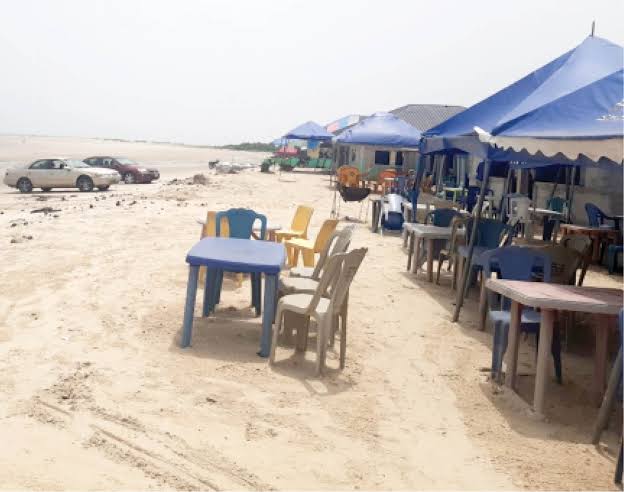
When storms hit, the elders say the sea remembers. They believe the Atlantic, patient and sentient, still recognizes names — of the families who once offered palm wine and salt before fishing, of the children buried near the dunes. Each wave is both blessing and reminder: the land has a ledger longer than any government’s file.
In that sense, Ibeno is less a location than a covenant. Those who walk its sands without respect may not be cursed in the traditional sense — but they are always, inevitably, unsettled.
Where Spirits Still Collect Rent
Every society decides what land means. To some, it is capital — to be bought, leased, developed. To others, it is identity — to be preserved, venerated, and feared. Ibeno stands precisely at the fault line between these meanings.
Here, the “rent” that spirits collect is not metaphor alone. It’s a continuing negotiation between modern governance and spiritual memory, between oil and ancestry. When compensation flows, elders pour libations; when pipelines burst, they interpret it as a call to balance the scales.
Certain beachfront stretches and mangrove zones are believed to belong to ancestral or water spirits, locally known as mami wata or ekpo idit emi in older dialects. Before any development, dredging, or major fishing season, traditional rites are performed to appease the land — symbolic offerings of rent or tribute to the unseen custodians of the coast. Libations, palm oil, and sometimes a fowl or goat are offered not out of fear, but respect. It is a covenant of coexistence: the living acknowledging the unseen owners of the tide.
This idea — that land is sentient, conscious, responsive — may sound distant from modern economics, yet it is deeply ecological. It insists that ownership carries responsibility, that taking without giving back invites consequence. The Ibeno worldview is not anti-modern; it simply refuses amnesia.
For decades, Nigeria’s land policies, from the 1978 Land Use Act to oil exploration decrees, have prioritized state control and corporate leases. Yet Ibeno’s story reveals what those documents omit — that land is never truly vacant. Every inch has a memory, every grain of sand an inheritance.
So when elders say “spirits still collect rent,” they’re reminding the nation that the land itself has agency. And that someday, every unpaid debt — environmental, moral, or spiritual — must be reconciled.
Closing Reflection: The Shore Beyond Ownership
As evening falls over Ibeno, the light bends low, coating the beach in a pale glow that looks almost sacred. The waves, ceaseless and soft, erase footprints as fast as they appear. It’s as if the sea is reminding everyone — oilman, tourist, fisherman, journalist — that permanence is an illusion.
This is what makes Ibeno’s white sand more than a destination. It is a metaphor for Nigeria’s unfinished dialogue with its own land — how to live upon it without wounding it, how to profit from it without erasing its past. The spirits of Ibeno are not ghosts in the western sense; they are memory made manifest. They exist in the wind that shapes the dunes, in the echo of the tides, in the silence between generations.
When you leave the beach, you carry its grain unknowingly — in your shoes, in your bag, between your fingers. It travels with you, quietly insisting that ownership is temporary, but belonging is eternal.
And maybe that is the truest rent the spirits collect — not in money, not in fear, but in remembrance. So long as someone returns to tell their story, Ibeno endures. The white sand remains unburied. The spirits, still paid.
Discussion about this post