
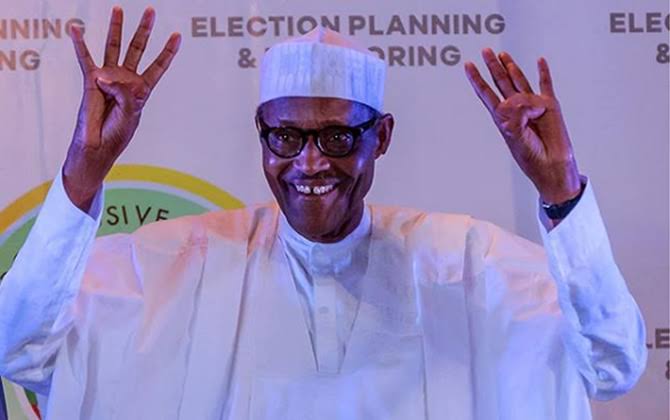
82-year-old former President, Muhammadu Buhari, yesterday breathed his last at a clinic in London, United Kingdom. Before his demise, he served as Military Head of State between December 31, 1983, and August 27, 1985, and as President of Nigeria between 2015 and 2023. Within Nigeria has identified three major events that Nigerians will remember under his leadership as president.
Insecurity Worsened Under Buhari
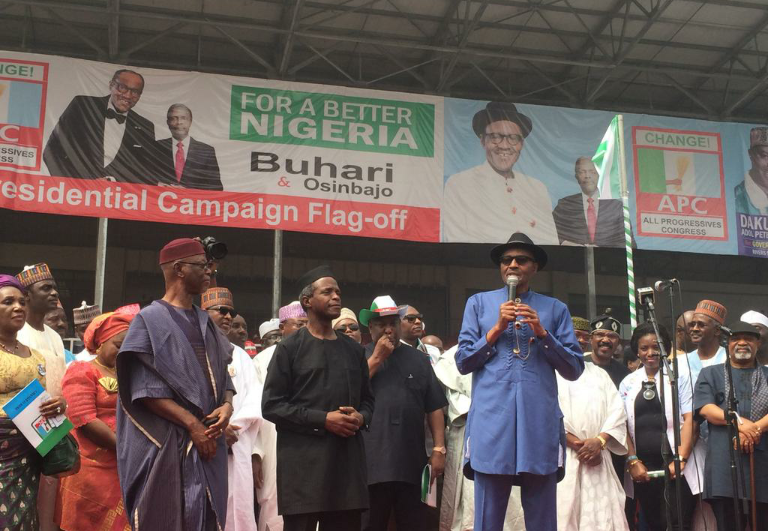
At the time Buhari decided to contest again for president in 2015, he made fighting insecurity the top priority of his campaign. He promised that his party would protect the lives and property of Nigerians and would bring change to the country. He blamed the Peoples Democratic Party (PDP) for 16 years of misrule, describing it as an “unthinking government hell-bent on ruling and stealing.”
Also, during his campaign in 2015 at Lafia, the Nasarawa State capital, he said his administration would address the issue of the Boko Haram insurgency to ensure security in the country.
“The fundamental challenges facing this country now are insecurity and the problem of the economy – which are worsened by corruption. I pledge to tackle insecurity in the North-East caused by the Boko Haram sect,” he said.
After he emerged as president and was officially sworn in, 808 people lost their lives to insecurity, according to data from the Council on Foreign Relations’ Nigeria Security Tracker (NST). Findings revealed that Buhari’s eight years as president recorded 63,244 deaths between June 2015 and May 2023.
Also, the civic space shrank. Several journalists were killed, and press freedom suffered grave violations under Buhari’s watch as president.
A 2021 press freedom report revealed that the media industry recorded seven unresolved killings, 300 violations and abuses, affecting 500 journalists, media workers, and media houses since 2015 under the administration of President Muhammadu Buhari.
End SARS Protests – Lekki Toll Gate Shooting
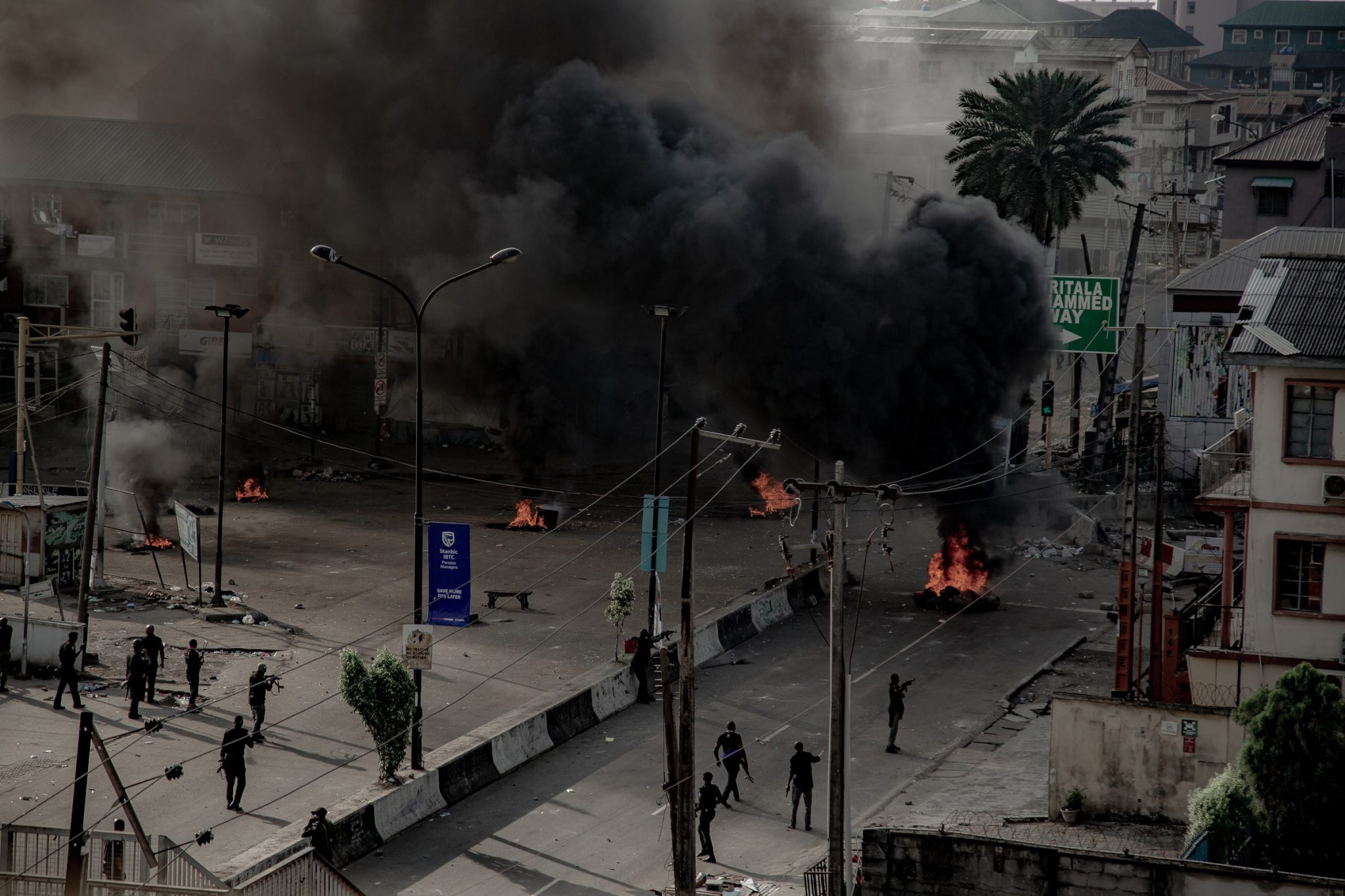
On Oct. 8, 2020, Nigerians protested nationwide against the Special Anti-Robbery Squad (SARS), accused of extrajudicial killings and extorting young Nigerians. The call to end SARS began in 2017 when citizens shared reports of abuse, prompting the then Inspector General of Police, Ibrahim Idris, to order an immediate reorganisation of the unit. At that time, out of 127 countries measured in the 2016 World Internal Security and Police Index, Nigeria’s police force ranked as the worst, just below DR Congo, Kenya, and Uganda, which made up the bottom four.
This abuse continued despite several organisations raising concerns about the abuse of power by SARS officers. Amnesty International documented at least 82 cases of torture, ill-treatment, and extrajudicial execution by SARS between January 2017 and May 2020.
Citizens took to the streets for two weeks to protest this abuse in several cities, and many lives were lost. At the Lekki Toll Gate in Lagos State on October 20, soldiers opened fire on unarmed protesters, who held nothing but Nigerian flags. Amnesty International reported that at least 12 people were killed at Alausa and the Lekki Toll Gate, with hundreds severely injured.
A year later, after several calls for justice and accountability, a panel of inquiry was set up, and its report found the Nigerian military culpable in the shooting and killing of unarmed protesters. However, the Buhari government denied these killings and termed them “fake news.”
“That report is nothing but the triumph of fake news and the intimidation of a silent majority by a vociferous lynch mob,” said the then Information Minister, Lai Mohammed.
Naira Scarcity and Currency Redesign
On November 23rd, 2022, Buhari unveiled new naira notes. The redesigned N200, N500, and N1,000 denominations were unveiled at Aso Rock. The then Governor of the Central Bank of Nigeria, Godwin Emefiele, said the move was to give the apex bank enough control over the amount of money in circulation.
Buhari, who supported the move, said the new banknotes would help the Central Bank design and implement better monetary policy objectives as well as enrich the collective memory of Nigeria’s heritage. The government implemented a deadline of two months for the old currency to phase out, alongside a cashless policy that brought hardship to Nigerians.
Citizens, including business owners, were unable to access cash. The CBN placed a limit on cash withdrawals at N100,000 and N500,000 for individuals and organisations, respectively, per week. Individuals were restricted from accessing more than N20,000 daily.
The Nigerian naira was bought and sold, as only those who could afford to get the new naira notes were able to continue their businesses. The National President of the Association of Mobile Money and Bank Agents in Nigeria, Victor Olojo, said that over 1.4 million people would lose their jobs if the policy was not suspended or reviewed upward.
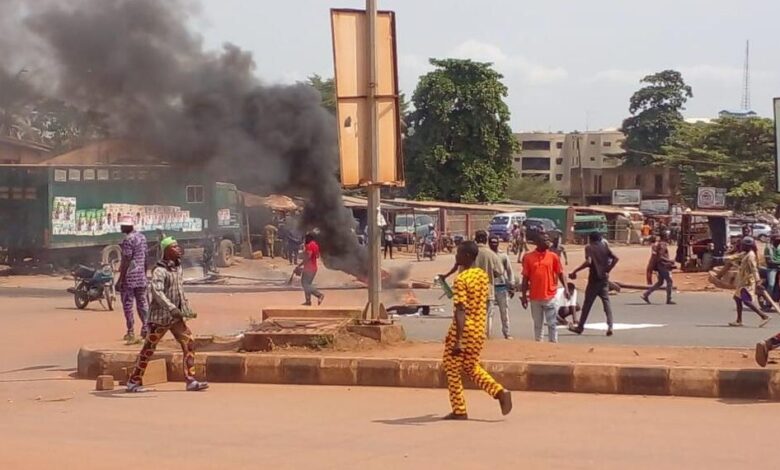
This increased hardship and cash crunch led to several violent protests across Nigeria, with protesters burning several banking structures and restricting movement. These protests led to the deaths of at least four people in different locations. Several others also lost their lives afterwards.
Baba Bintin, a presenter at Fresh FM Nigeria, died after collapsing on his way to the radio station for his show when efforts to get cash were abortive. Also, a member of staff at Lagos State University, Ademola Adesola, was reported to have slumped and died while waiting in a queue at a Wema Bank branch in Ojo, Lagos.
In another case, a pregnant woman in Kasuwan Magani, Kajuru LGA, Kaduna State, who was due for delivery, died after her husband’s efforts to withdraw money from the bank failed.



Discussion about this post