

The Super Eagles’ dream of reaching the 2026 World Cup ended on the penalty spot in Rabat. What began with early optimism dissolved into disappointment as tactical errors, missed opportunities, and clinical Congo execution defined the match. Nigeria’s early lead raised hopes nationwide, but within minutes, cracks in strategy and execution began to show. By the final whistle, it was clear: Congo had seized the moment, leaving Nigeria to confront the bitter reality of a World Cup dream slipping away.
Fans across Nigeria watched in silence, aware that this was more than just a game. The stakes were immense, the pressure unbearable, and the Super Eagles’ performance would shape perceptions of the team and its leadership for months to come. Every pass, every substitution, every tactical decision was magnified under the Moroccan lights, each misstep echoing across living rooms and streets back home.
Congo’s resilience and calculated approach contrasted sharply with Nigeria’s inconsistencies. While the Super Eagles started strong, maintaining possession and creating early chances, the precision required to secure victory remained elusive. In such knockout encounters, a single lapse could undo an entire game plan—and for Nigeria, that lapse arrived sooner than anyone anticipated.
The night in Rabat became a test not only of skill but of composure, preparation, and mental strength. For Congo, it was an opportunity to assert themselves; for Nigeria, it was a reminder that past achievements provide no immunity against carefully executed opposition. The match would end in heartbreak, but its lessons and implications would echo long after the stadium emptied.
Early Goal and False Security
Nigeria took control almost immediately. Frank Onyeka’s early strike in the third minute ignited a wave of hope. For a brief moment, it seemed the Super Eagles had set the tone, combining speed and aggression in attack. Fans celebrated across Nigeria, confident that a World Cup berth was within reach.
But early dominance can conceal underlying issues. Defensive spacing began to falter as players overcommitted to attack, leaving gaps for Congo to exploit. Midfield transitions were rushed, and the cohesion required to control a match of this magnitude started to erode. The initial goal created an illusion of control, masking tactical vulnerabilities that Congo would soon expose.
Congo, patient and disciplined, began to test Nigeria’s backline. Each intercepted pass and measured counterattack chipped away at the Eagles’ confidence. By the 32nd minute, Meschack Elia’s equalizer erased Nigeria’s early advantage and shifted momentum subtly but decisively. The stadium, once buoyant with Nigerian hope, now sensed the fragility beneath the surface.
Despite some bright moments, Nigeria struggled to maintain the balance between aggression and caution. The early lead had provided a false sense of security, leaving the team vulnerable to Congo’s methodical approach. By halftime, questions about substitutions, defensive discipline, and tactical adjustments had already begun to shape the narrative of a match slipping beyond Nigeria’s control.
Tactical Errors Exposed
The second half brought a turning point. Victor Osimhen, Nigeria’s star striker, was forced off at halftime due to injury. His absence disrupted the Super Eagles’ attacking rhythm, leaving gaps that the team struggled to fill. Substitutions failed to recreate the balance necessary to sustain offensive pressure, and Congo seized the opportunity.
Congo’s setup exploited Nigeria’s misalignments. Defenders were drawn out of position, leaving open spaces in critical channels. The Super Eagles had moments to regain control, but hesitation and miscommunication allowed Congo to maintain defensive composure while threatening on the counter. Every misjudged pass and delayed challenge revealed tactical fragility that Congo capitalized on with precision.
The penalty shootout, which followed a scoreless extra time, magnified these errors. Calvin Bassey missed the opening kick, setting the tone for the Super Eagles’ struggle. Semi Ajayi and Moses Simon could not convert, while Congo executed each attempt with clinical efficiency. The contrast in mental composure between the two teams exposed a gap beyond just tactics—it highlighted the psychological toll of high-stakes pressure.
By the end, it was not just a failure to score that defined Nigeria’s defeat; it was the cumulative effect of tactical miscalculations, injury disruptions, and an inability to adapt mid-game. Congo’s strategic patience and execution had exploited every weakness, turning what began as a promising performance into a story of heartbreak.
Penalties, Pressure, and Mental Game
Penalty shootouts are a psychological crucible, where composure is often more decisive than skill. For Nigeria, early misses compounded anxiety, creating an invisible weight that each subsequent kicker carried. Congo, conversely, maintained calm, with Sadiki, Mayele, Balikwisha, and Mbemba converting each attempt and demonstrating remarkable mental resilience.
The failure to manage the mental aspect of the game by Super Eagles coach Eric Chelle was as critical as the tactical errors. Pressure was visible in body language, hesitation in shots, and miscommunication in defensive organization. Each miss deepened the Super Eagles’ frustration, leaving fans and players alike to grapple with the consequences of a game that hinged on moments smaller than a heartbeat.
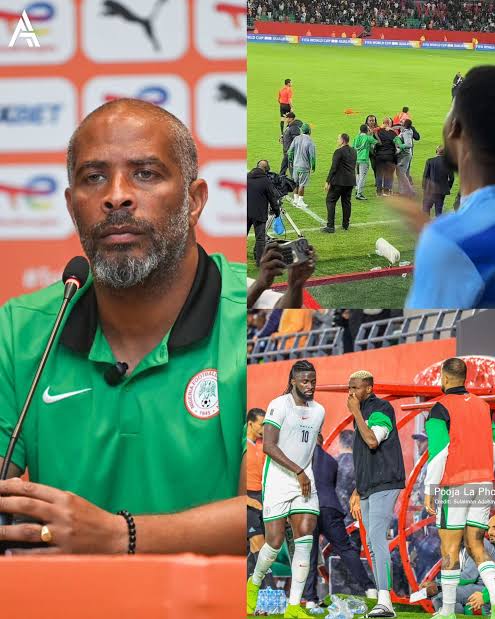
Nigeria’s penalty heartbreak served as a reminder that preparation extends beyond physical and tactical readiness. The mental dimension, the ability to absorb pressure and execute under stress, is equally critical. Congo’s execution reflected not just skill but a psychological mastery that allowed them to seize the World Cup play-off victory.
Emotional Fallout: Fans and the Nation React
Across Nigeria, the aftermath of the Congo play-off loss was palpable. Streets that had once vibrated with hope and chants of “Super Eagles!” were now subdued. Fans in Lagos, Abuja, and Port Harcourt replayed the match in their minds, dissecting each moment with a mix of disbelief and frustration. Social media platforms became arenas of debate and disappointment, with reactions ranging from anger at tactical missteps to sympathy for the players who gave everything on the pitch.
Supporters who had traveled to Morocco carried not just the weight of national pride but personal investment—time, money, and emotional energy dedicated to witnessing a historic night. For them, the stadium was both a sanctuary and a crucible, where hope met harsh reality. Interviews with fans after the match revealed a common sentiment: pride in the players’ effort mixed with a sense of betrayal by missed opportunities and tactical errors.
Even within homes across Nigeria, the emotional toll was intense. Families gathered around televisions to watch, only to experience the slow erosion of joy as penalties went awry. Children who idolize stars like Osimhen and Onyeka witnessed heartbreak that transcended sport, understanding at a young age how fragile national dreams can be in the face of precision and mental pressure from the opposition.
For some, the loss prompted reflection on broader issues—management of Nigerian football, preparation for high-pressure matches, and the recurring frustration with knockout-stage failures. The collective grief was not simply about missing a World Cup spot; it was about what it symbolized: the nation’s aspirations colliding with human limitations and the unforgiving nature of competitive sport.
Historical Context: Nigeria in World Cup Qualifiers
Nigeria’s history in World Cup qualifiers is a tapestry of triumphs, near-misses, and heartbreak. The Super Eagles have been African football powerhouses for decades, frequently progressing to final qualifying stages and appearing on football’s global stage. Their journey has included moments of historic brilliance, such as the 1994 qualification to the USA World Cup and the 2018 near-miss against Argentina in the group stages.
However, knockout encounters in play-offs have often revealed vulnerabilities. The pattern is clear: early promise and technical skill sometimes falter under pressure, exposing tactical inflexibility or over-reliance on star players. The Congo loss in 2025 reflects this recurring theme. Historically, Nigeria has occasionally struggled to translate domestic and continental dominance into consistent World Cup qualification success.
DR Congo’s resurgence in the same historical frame is also notable. While not traditionally considered a footballing heavyweight on par with Nigeria, Congo has had periods of strength and unpredictability in African qualifiers. This play-off victory underscores a shift in African football dynamics, where careful preparation, tactical discipline, and psychological composure increasingly define outcomes over raw talent or reputation.
Looking back at Nigeria’s previous qualifiers, one can trace lessons and patterns. Injuries to key players, tactical rigidity, and mental pressure have repeatedly affected results. The Rabat play-off is thus not an isolated incident but part of a historical continuum of challenges for the Super Eagles—challenges that will require strategic reflection and evolution if Nigeria is to reclaim its place on football’s most prestigious stage.
Final Thoughts
The Super Eagles’ defeat to Congo in the World Cup qualifier play-off is more than a lost match; it is a stark reminder of the unforgiving nature of high-stakes football. Early promise and fleeting moments of brilliance cannot compensate for tactical errors, mental lapses, and the pressure that defines knockout encounters. Nigeria’s journey ended not for lack of talent, but for the fragile combination of timing, preparation, and composure that separates victory from heartbreak.
Fans, players, and the nation are left to process the emotional weight of this outcome. The celebrations that began with an early goal dissolved into collective disappointment, reflecting the broader pattern of Nigeria’s challenges in translating potential into consistent World Cup qualification success. Each missed penalty, disrupted attack, and defensive misstep became a symbol of opportunity lost, leaving a lingering sense of “what could have been.”
Yet the story is not solely one of failure. It also highlights resilience, lessons, and the urgency for introspection. For Nigeria, tactical reassessment, mental conditioning, and strategic planning are now imperatives if the Super Eagles are to reclaim their status on the global stage. For Congo, the victory is a moment of triumph, a demonstration of patience, discipline, and mental fortitude that can inspire other emerging African teams.
History will remember this night in Rabat not only for the scoreboard but for the emotional and psychological truths it revealed. Early goals cannot guarantee victories, and tactical brilliance must meet mental readiness to succeed. The Super Eagles’ heartbreak is both a cautionary tale and a call to evolve, leaving fans, players, and the nation with the bittersweet knowledge that dreams, no matter how fervently pursued, are fragile—and redemption lies ahead only through reflection, adaptation, and perseverance.




Discussion about this post