
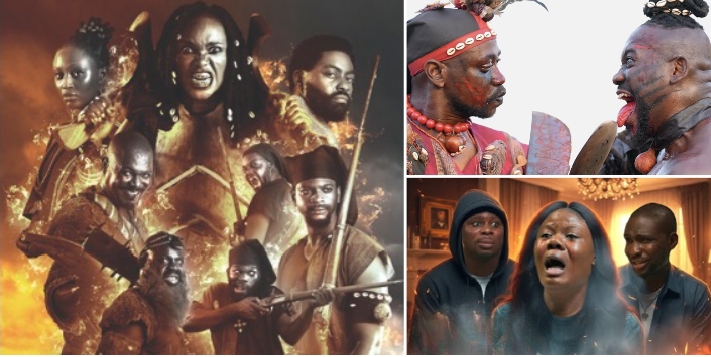
2025 began with the kind of buzz you don’t always get for Nollywood. In Lagos, Ibadan, Abeokuta, and across Yoruba speaking towns, there was chatter. On buses, in markets, online, people asked when the next Yoruba language film would drop. And it felt real. After a stretch where English language Nollywood had dominated big screens, a wave of producers and directors seemed to be leaning back into Yoruba identity, letting stories rooted in culture, tradition, struggle, hope, and memory find space again.
The appetite was visible, and early film launches showed that maybe this appetite was more than nostalgia. It looked like 2025 might go down as the year Yoruba cinema tried to reassert itself.
Labake Olododo: A Big Splash, A Bold Statement
Labake Olododo hit cinemas on March 28, 2025. The film is directed by Biodun Stephen and produced by Iyabo Ojo. The story puts at its centre a heroine named Labake, in a Yoruba community, battling injustice, societal pressure, traditional expectations, and political intrigue.
What made Labake Olododo stand out was how it fused tradition and ambition. The visuals, the costumes, the Yoruba language dialogue, the setting, it felt rooted in heritage, but shot with energy. It did not look like a quick or cheap movie. When it opened, it reportedly grossed over ₦50 million in its first weekend. As of mid 2025, it was still among top grossers, with a reported gross of ₦262.6 million.
For many viewers, Labake Olododo became more than entertainment, it felt like a statement. That a Yoruba language film with cultural roots could draw big crowds, spark conversations, and hold its own among mainstream Nollywood releases.
Lisabi, A Legend Is Born: History, Pride, Identity on the Big Screen
Just as the year opened, on January 9, 2025, the premiere of Lisabi, A Legend Is Born took place at the John Randle Centre for Yoruba Culture and History in Onikan, Lagos. The film, directed by Niyi Akinmolayan, produced by Lateef Adedimeji, retells the story of the legendary Yoruba hero Lisabi Agbongbo Akala, known for leading the Egba people to resist oppression in pre colonial times.
Lisabi was released widely in Nigerian cinemas, and also dropped internationally on Netflix on January 10, 2025. The movie is entirely in Yoruba, and aims to reconstruct historical settings, costumes, and languages with respect and care.
The ambition here is different from a crowd pulling commercial drama. Lisabi trades in heritage, memory, identity, and struggle. People saw the film not just for entertainment, but as reclaiming a history. Critics and cultural watchers described it as a bold effort to bring Yoruba history alive for new generations.
Even if it does not show up among the highest box office hits in 2025, its value lies elsewhere, in cultural weight, community conversation, and the symbolic message that Yoruba stories deserve epic treatment.
Other Names You Should Know: Showing the Range of 2025 Yoruba Cinema
Beyond Labake Olododo and Lisabi, 2025 gave us a spread of other Yoruba, or partly Yoruba films, drama, romance, comedy, and everyday stories, hinting that the industry might be opening up again. Among titles flagged by media watchers are IBASEPO and Ale Ariwo.
Ibasepo is described as a romantic drama set at an Ekiti resort, where marital tensions, secrets, and emotional dilemmas play out in a way that many viewers found relatable. Ale Ariwo is more of a comedy, a night in Ibadan gone chaotic for a young couple, mix of laughter and life lessons, pure Yoruba humor, local flavor.
These films may not come with epic ambitions or historical weight, but they matter because they reflect what everyday Yoruba cinema has always been, stories of love, struggle, laughter, heartbreak, and survival. In that sense, they keep the tradition alive, closer to grassroots, to regular people’s lives, to relatable experiences.
What This Mix Means for Yoruba Cinema in 2025, It Is Not Monolithic Anymore
When you look at 2025’s output, from grand historical drama to heroine led community justice, from romantic retreat stories to simple comedies, you realize Yoruba cinema this year is trying on many hats. It is not boxing itself into a single genre or promise.
This diversification suggests that filmmakers and producers are experimenting. They are asking, can Yoruba cinema appeal to history lovers, to romantics, to comedy seekers, to regular people who just want to see their lives on screen in their language. The mix signals an industry that is stretching, exploring, trying to find where the demand and passion meet.
If sustained, this could mean Yoruba cinema stops being a niche subset of Nollywood, and becomes a vibrant stream on its own.
Why Critical Acclaim Remains a Moving Target
Even with this spread of films, and the bold projects of 2025, it is still too early to point at a stable list of definitively “critically acclaimed” Yoruba films. Here is what still holds things back
First, the formal structures for critique remain thin. Unlike Hollywood or global cinema, there’s no big catalog of academic film critics reviewing indigenous language Yoruba films for posterity. Published journalistic or academic reviews remain rare.
Second, many films rely on box office or streaming popularity as proxies for success. But popularity does not always equal quality, a film may entertain, draw crowds, but still fall short on narrative depth, technical craft, cinematographic ambition, or historical authenticity.
Third, there is the issue of classification, some films mix English, pidgin, Yoruba, or multiple languages, making it hard to say if they qualify as “pure Yoruba cinema.” That blurs the lines when compiling a “Yoruba only” list.
Finally, deeper recognition, cultural impact, diaspora reception, long term influence, often shows only with time. Some 2025 films may age well, others may fade quickly. We need a few years to see which hold.
But 2025 Feels Like a Turning Point: A Moment of Renewal, of Possibility
If things align, 2025 could be seen years from now as a kind of reboot for Yoruba cinema. The energy is there. The ambition, the variety, the willingness to tell stories in Yoruba or rooted in Yoruba history is strong.
With audiences willing to show up, with streaming platforms globally accessible, with filmmakers starting to invest in quality and cultural authenticity, there is room. Room for growth, for experimentation, for reinvention.
If critics emerge, if distribution improves, if follow through happens, Yoruba cinema might shift from being peripheral to being central to Nollywood’s future.
For now, 2025 stands as a year of promise, of seeds sown, of potential.
What You Should Watch if You Want to Feel 2025’s Yoruba Film Energy
If you want to sample what’s happening now, watch Labake Olododo, for social drama, culture, and power struggles
Check out Lisabi, A Legend Is Born, for history, heritage, pride
If you want something light and close to everyday life, try Ibasepo or Ale Ariwo
Expect surprises, maybe from other emerging titles as the year unfolds
Keep your eyes on what comes after, follow up stories, streaming drops, audience reactions, word of mouth. Because movies that matter don’t just hit, they echo.
My Take: 2025 Is a Beginning Not an End
At the end of the day, I think 2025 is less about delivering perfect classics, and more about opening doors. Yoruba cinema needed a push back into focus, into identity, into variety. With the films of this year, that push seems to be happening.
If you ask whether we already have “the most critically acclaimed Yoruba films of 2025,” I will say not yet. We have hope. We have motion. But acclaim needs time, reflection, critique, memory.
What we have now are stories trying to reclaim space. Stories rooted in language, in tradition, in change. And that is worth watching.




Discussion about this post