
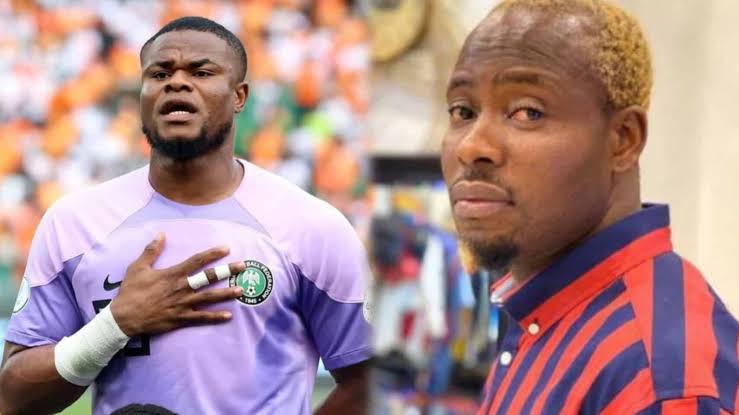
Crowds rarely remember context; they remember moments. And sometimes, one moment is enough to drag a man’s name through weeks of noise. That was the mood around Stanley Nwabali after the Super Eagles stumbled in the 2026 World Cup qualifiers. People who normally joked on Twitter suddenly carried heavy opinions, as if handed microphones and a national duty to speak.
Nobody warns a goalkeeper that applause is soft but blame hits like a freight train. Nwabali knew the stakes, yet nothing could prepare him for how quickly adoration flips to scrutiny. Some fans wanted answers. Some demanded release. Some sought blood. And in the middle of that frenzy, Lege Miami, social media actor and commentator, switched on his camera and added his voice to the uproar.
Lege doesn’t speak like someone rehearsed; his words tumble out like a sputtering generator. Humor, heat, and provocation collide in his delivery, leaving listeners unsure whether he’s correcting, mocking, or confronting. That was precisely why his message to Nwabali struck a nerve—no one could tell if it was correction or disrespect. And that uncertainty opened the floodgates for what followed.
STANLEY NWABALI — THE GOALKEEPER WHO REPRESENTS NIGERIA
Stanley Bobo Nwabali was born on 10 June 1996 in Port Harcourt, Rivers State. He grew up in a disciplined Igbo Christian household, where the ethos of hard work and quiet perseverance was drilled into him early. Football wasn’t a birthright; it was a ladder, and he began on the lower rungs as a striker. The boy who once chased the ball across muddy pitches eventually discovered the goalpost and found that his hands, not feet, could tell stories of resilience.
By 2018, Nwabali had started his professional career with Go Round FC, slowly building a reputation for quick reflexes and situational awareness. From there, he moved to Wikki Tourists (2019–2020), then Enyimba (2020–2021), cementing himself as a goalkeeper capable of anchoring any defense. Each club taught him lessons: patience, timing, and the weight of expectation.
In 2022, he made the leap abroad to Chippa United in South Africa. The transition was more than geographical; it tested his adaptability and resilience. Week after week, he proved he could shoulder the pressure of foreign leagues while still carrying the dreams of Nigerians.
Internationally, Nwabali earned his first cap in July 2021 against Mexico. He cemented himself during AFCON 2023 in Côte d’Ivoire, where four consecutive clean sheets and a decisive penalty shootout performance against South Africa made him a household name. For many, he became not just a goalkeeper but a symbol — a man who stood between Nigeria and collective heartbreak.
Behind the stats, the human story runs deeper. Nwabali’s father passed away in November 2024, and his mother followed on 1 January 2025. Even amid personal loss, he remained in goal, the team’s final barrier, the quiet anchor in chaos. Later, he would be awarded the Member of the Order of the Niger (MON) for his exceptional contributions. Nwabali’s story is not just about football; it’s about the endurance of the human spirit under pressure.
LEGE MIAMI — THE VOICE THAT STIRS CHAOS
Adams Kehinde, professionally known as Lege Miami, was born on 1 July 1987 in Lagos State, Nigeria, of Yoruba heritage with roots in Ilorin, Kwara State. Unlike Nwabali, whose world revolves around measured saves and silent preparation, Lege’s stage is immediate, loud, and unfiltered. His rise through Yoruba Nollywood — performing in Aseju, Omo Shomolu, Dead Wood, Agidi Okan, Kilofe, and Olamiotan — showcased his ability to combine humor, critique, and spectacle in one breath.
Digital platforms expanded his reach exponentially. A clip of Lege is never just entertainment; it’s a statement, a spark, a provocation. Off-camera, he is deliberate but private, a father to David and Mercy Adams. Yet public perception often overshadows private life: he is the personality who teeters between commentary, comedy, and confrontation, unafraid to speak boldly, aware that every word carries heat.
Lege’s method is metaphorical electricity: bright, crackling, capable of sparking conversation — or a full-blown storm. His style is part actor, part provocateur, part social critic. That combination, celebrated by some and condemned by others, sets the stage for moments like the confrontation with Nwabali.
THE SUPER EAGLES’ HEARTBREAK IN RABAT
The night air in Rabat didn’t just hum with tension; it felt heavy, like millions of hopes had flown in with the Super Eagles. This was the CAF play‑off final for the 2026 World Cup, and Nigeria’s future lay in the balance.
Stanley Nwabali stood between the posts — not just as a goalkeeper, but as the emotional barometer of a nation’s dream. Early in the match, Nigeria seized a shock lead: Frank Onyeka scored in the third minute, his shot deflecting off a defender and past the Congolese goalkeeper.
But DR Congo responded. In the 32nd minute, Meschak Elia pounced on a loose moment in Nigeria’s defense and slotted in the equalizer. From that point, both sides traded blows. Nigeria looked for control through Alex Iwobi and tempo on the wings, but DR Congo stayed disciplined, compact, and dangerous.
Extra time came. Fatigue set in. Two teams, heavy with emotion, pushed without breaking; the score remained 1–1. Then came penalties.
By the time the penalty shootout arrived, Nigeria faltered: Calvin Bassey and Moses Simon misfired, while Semi Ajayi saw his effort saved. Nwabali had made some key saves, showing why the coaching staff trusted him under pressure. Yet, even when the ball was safely punched away or a shot parried, the creeping doubt of “what if?” — both his own and the public’s — lingered.
When DR Congo converted the winning penalty, the entire stadium, broadcast audience, and social media nation collectively exhaled — disappointment spilling over like a river through a broken dam.
For Nwabali, the loss stung deeply. Not because he had failed in skill — he hadn’t — but because football in Nigeria isn’t only about goals or saves. It’s about pride, identity, and the fleeting possibility of national joy. And in moments like this, the spotlight rarely lands softly; it cuts sharp, searching for someone to blame.
LEGE MIAMI’S REACTION — PRAISE, CRITIQUE, AND THE CONTROVERSIAL DIG
Hours after the match, Lege Miami recorded his video reaction. His style is unmistakable: equal parts comedian, social commentator, and provocateur. He began by praising Victor Osimhen, Calvin Bassey, and Benjamin Frederick — calling their efforts “electric, tireless, carrying the nation’s heart on their backs.” His voice conveyed genuine admiration, and for a moment, it seemed like a simple post-match highlight reel.
Then came the pivot. Lege’s tone shifted, sharper now, laced with pointed commentary. He singled out Nwabali, calling attention to “the mistakes that cost Nigeria dearly.” And in the same breath, he referenced Nwabali’s late father — a remark that immediately sparked outrage. For many viewers, the comment crossed a line: professional critique had been merged with personal history, bringing grief into public discourse.
Lege later defended his approach, claiming the intention was corrective, not disrespectful. But the delivery mattered as much as the intent. Tone, timing, and context collided, creating a social media firestorm. Comments flew like sparks: some defended Lege as a candid, unfiltered voice; others condemned him for what they perceived as an unnecessary and hurtful attack on a grieving athlete.
NWABALI’S RESPONSE — FIRM, PERSONAL, AND PUBLIC
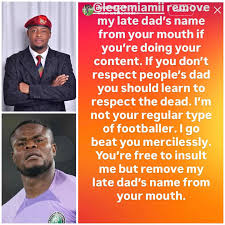
Stanley Nwabali did not react in the immediate hours following the clip. But when he finally addressed the situation, his message was unmistakable: he demanded boundaries. On social media, he wrote, “Remove my late dad’s name from your mouth. My grief is not public debate.” His words weren’t just defensive; they were human, raw, and resonant with anyone who has felt personal tragedy exploited or misrepresented.
Nwabali’s reaction highlighted the tension between public scrutiny and private pain. As a national figure, he had learned to handle criticism about on-field performance. But comments about family — particularly parents no longer alive — struck differently. They crossed from professional critique into territory he wasn’t willing to accept in silence.
Lege Miami later issued an apology, clarifying that his goal had been to critique Nwabali’s match performance, not to bring personal loss into discussion. But by then, the clip had circulated widely, retweeted and debated across every platform. The narrative had taken on a life of its own, and what might have been a 30-second post-match opinion became a question about respect, boundaries, and the human cost of public commentary in Nigerian sports culture.
CORRECTION OR DISRESPECT? THE LASTING LESSON
When the dust settles and the posts fade into the archives, the Nwabali–Lege Miami episode leaves more than opinions—it leaves a mirror. It forces us to reckon with the fragile intersection of public performance, personal grief, and the almost unavoidable hunger for commentary. One man’s attempt to correct another becomes a nation’s debate on respect, timing, and empathy.
The incident reminds us that in a country like Nigeria, where football isn’t just a game but a collective heartbeat, words carry the weight of more than their letters. A critique meant as instruction can ripple into perceived insult; humor can mutate into hurt; correction can cross into controversy.
Stanley Nwabali’s dignity under scrutiny, Lege Miami’s unapologetic style, and the swirling national conversation all combine into a lesson about humanity in public life: people watch, people judge, people feel. And sometimes, even the smallest spark—one video, one phrase—can ignite a conversation that reaches far beyond the original intent.
In the end, was it correction or disrespect? Maybe it was both, maybe neither. Maybe it was the inevitable clash of talent, expectation, and humanity on display. What remains clear is this: a nation witnessed, a man stood firm, and a public voice reminded everyone that with influence comes responsibility, and with passion comes consequence.
And for Nigeria, the story lingers—not as a headline, not as a viral clip, but as a quiet reflection of what it means to speak, to watch, and to care in a world that never stops judging.




Discussion about this post