
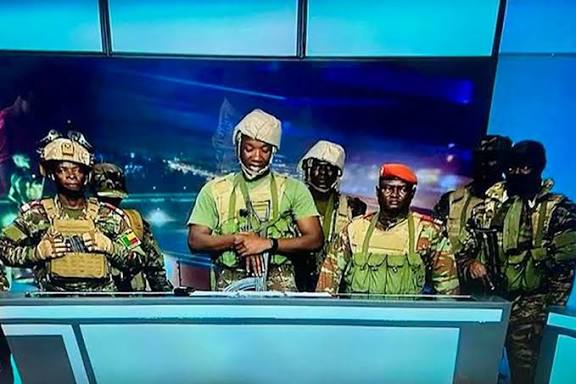
The Republic of Benin recently survived a military coup. It was a story of force, power play, and tension. The country nearly joined the list of African countries under the control of military dictators before the intervention of troops deployed by President Bola Tinubu. Forces loyal to President Talon, with the support of Nigerian air and ground troops, foiled the coup.
However, at least 13 people—12 active-duty soldiers and one former member of the armed forces—have been arrested in connection with the failed coup attempt in Benin.
As of the time of filing this report, the leader of the coup, Lieutenant Colonel Pascal Tigri, is currently on the run and has sought refuge in neighboring Togo, with Benin requesting his extradition.
BACKGROUND?
On a Sunday morning at exactly 8:00 a.m., a group of soldiers under the platform of “Committee for Refoundation” attacked President Talon’s residence around 5 a.m. These soldiers neutralized two military officials as hostages, but President Talon escaped the attack.
Another group of soldiers under the platform of “Committee for Refoundation” invaded the national television station in Cotonou. The aggrieved soldiers, led by Lieutenant Colonel Pascal Tigri, stormed the station on December 7, 2025, and announced the removal of President Patrice Talon and the dissolution of the government.
CAUSE OF THE COUP?
Lieutenant Colonel Pascal Tigri, the leader of the coup plotters, in his speech disclosed that the insecurity in the North owing to jihadist attacks prompted their decision.
According to Tigri, the situation of Northern Benin remains tense and worse despite efforts of troops under Operation Mirador to stabilize the area.
He also complained about neglect of fallen soldiers and their families, as well as perceived favoritism in promotions.
Aside from Tigri’s concerns, WITHIN NIGERIA learned that the main opposition party in the country was excluded from the upcoming presidential election, which fueled discontent. It also learned that the recent wave of coups in West Africa, particularly in Niger and Burkina Faso, might have inspired the coup attempt.
NIGERIA’S ACTION?
President Bola Tinubu deployed Nigerian Air Force fighter jets to conduct airstrikes, which helped to thwart the coup plotters led by Lieutenant Colonel Pascal Tigri.
It was learned that ground troops from Nigeria, Ghana, Ivory Coast, and Sierra Leone joined the effort under ECOWAS (Economic Community of West African States).
However, some political analysts accused President Bola Tinubu of abusing the process in his intervention because he did not seek the consent of the Nigerian Senate before deploying troops to the Benin Republic.
24 hours after, President Tinubu forwarded a letter of consent to the Nigerian Senate, asking the legislative house to approve his deployment of troops to the Benin Republic.
The Nigerian Senate approved Tinubu’s troop deployment, citing the need to protect democracy and regional stability, especially given Benin’s border with Nigeria.
It was also gathered that ECOWAS condemned the coup, declaring a “state of emergency” in West Africa, and deployed its standby force to Benin to preserve constitutional order while France, the colonial country of the Republic of Benin, provided logistical and intelligence support to Benin during the operation.
BURKINAFASO RIPPLE?
Burkina Faso detained 11 Nigerian soldiers after a Nigerian Air Force C-130 aircraft made an emergency landing in Bobo Dioulasso on December 8, 2025.
Recall that the Nigeria Air Force claimed that the plane, carrying two crew members and nine military personnel, was en route to Portugal when it landed due to technical issues.
The NAF further claimed that the landing was a safety precaution, following international protocols, and the crew is safe and treated cordially.
However, the Alliance of Sahel States (AES), which includes Burkina Faso, Mali, and Niger, accused Nigeria of violating their airspace without authorization, calling it an “unfriendly act.”
The AES has launched an investigation, citing a breach of sovereignty. There are concerns about Nigeria’s intervention, highlighting a growing rift between Nigeria, Burkina Faso, ECOWAS, and AES, citing sanctions and foreign influence.


Discussion about this post