
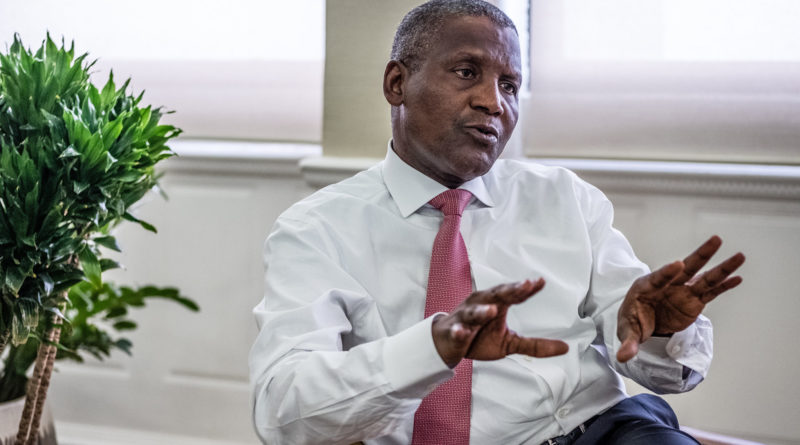
In early 2024 and again publicly in 2025, Aliko Dangote did something Nigeria’s business elite rarely do, he stopped masking his frustration behind corporate language. Standing inside the vast concrete and steel complex of the Dangote Petroleum Refinery in Lekki, Lagos, he described a force he said was actively working against Nigeria’s energy future, he did not call them competitors, he did not call them pressure groups, he called them an oil mafia.
“I told you that drug mafia, they’re actually smaller than the people who are in oil and gas. Because most of the people who are in the drugs, you know yourselves, but in the oil sector, there are so many people,” he said in recent statement
Then he went further, Dangote said these oil cartels were more powerful than international drug cartels.
The statement landed heavily because of who said it and where it was said, this was not an activist or opposition politician, this was Africa’s richest man speaking from inside a twenty billion dollar refinery that was built to end Nigeria’s dependence on imported fuel.
Dangote was not speculating, he was recounting what he said had already happened.
Sabotage, theft, regulatory resistance, financial losses running into tens of millions of dollars. And a system he believes is designed to keep Nigeria importing fuel no matter the cost.
This is not noise, this is a builder talking from inside the fight
Dangote did not wake up one morning and decide to antagonise the oil industry, his comments came after more than a decade of building what is now the largest single train refinery in the world. Construction began around 2016, by 2023 and 2024, the refinery was moving through commissioning phases and preparing to supply the domestic market.
That is when the tone changed. According to Dangote, what should have been a moment of national celebration turned into a struggle for survival, he said his company began to encounter organised resistance that went beyond normal commercial competition.
He described coordinated actions aimed at weakening local refining, he spoke about people who profit more when Nigeria imports fuel rather than refines it at home.
In his words, these groups were not just businessmen, they were a cartel.
Why Dangote seemingly reached for the drug cartel comparison
Dangote’s comparison to drug cartels was deliberate, he was not suggesting that oil traders are selling cocaine or heroin, he was making a point about power and structure.
Drug cartels are feared not only because of violence but because of how deeply they embed themselves into formal systems, they influence institutions, they distort markets, they survive because too many people benefit from their existence.
Dangote said the oil mafia operates in a similar way.
He argued that oil sector cartels are even more dangerous because they sit closer to legitimacy, they operate through contracts, they influence regulation, they shape policy outcomes, and unlike drug cartels, they can hide behind paperwork. This is why he said they are stronger.
The eighty two million dollar wound
One of the most striking details Dangote mentioned was money, not projected losses, not hypothetical damage, actual losses.
He said the Dangote Refinery had suffered about 82 million dollars in losses due to theft and sabotage.
This figure was not framed as a one off incident, Dangote described a pattern, equipment going missing, infrastructure being attacked, operations disrupted in ways that could not be explained as accidents.
For a project of that scale, sabotage is not random, you need access, you need timing, you need people who know what matters and what does not.
Dangote made it clear he believed these acts were connected to interests threatened by local refining.
When sabotage becomes a business strategy
In Dangote’s telling, sabotage is not just vandalism, it is economics.
Nigeria has spent decades importing refined petroleum products despite being one of Africa’s largest crude oil producers, this system created a web of importers, marketers, traders, shipping firms, middlemen, and rent seekers.
Every cargo of imported fuel is profit for someone. A fully operational local refinery threatens that chain.
Dangote suggested that for those who benefit from imports, stopping local refining is not optional, it is existential, and when money of that scale is at stake, resistance becomes organised.
The regulator problem
Dangote did not limit his criticism to unnamed cartels, he directly accused Nigeria’s oil regulators of playing a role, intentionally or not.
Specifically, he pointed to the Nigerian Midstream and Downstream Petroleum Regulatory Authority, he said regulatory decisions had made it easier for imported fuel to enter the market at prices that undercut local production.
From his perspective, this was not neutral policy, it was an active barrier to domestic refining.
Dangote called for an investigation into alleged corruption within the regulatory system, he argued that Nigeria was prioritising imports over local production even when domestic capacity existed.
That accusation shifted the debate from business rivalry to institutional failure.
Why cheap imports are not really cheap
One of Dangote’s central arguments is that cheap imported fuel is an illusion.
He has repeatedly said that imports appear cheap only because the full costs are hidden, foreign exchange pressure, shipping costs, port inefficiencies, subsidy distortions, economic leakage.
Local refining, he argues, keeps value inside the country. But for import dependent players, these broader costs do not matter, what matters is margin.
Dangote’s accusation is that the oil mafia prefers short term private profit over long term national benefit.
The deeper reason this statement shook Abuja and Lagos
Dangote’s words resonated because they echoed what many Nigerians already believe but rarely hear articulated at that level.
For decades, Nigeria’s oil sector has been described as opaque, reform efforts have stalled repeatedly, refineries have failed, import bills have ballooned.
When Africa’s richest industrialist says the system is captured by cartels, it confirms suspicions that reform is not just technically difficult but politically resisted.
His statement also forced policymakers into an uncomfortable spotlight, if there is no oil mafia, then why is local refining so hard, if there is an oil mafia, then who is protecting them.
Not everyone is buying Dangote’s version of events
Industry groups did not stay silent. The Depot and Petroleum Products Marketers Association of Nigeria publicly rejected the idea of an oil mafia, they argued that what Dangote describes as cartel behaviour is simply normal competition between market actors with vested interests.
From their point of view, disagreement over pricing and supply does not equal organised crime.
Some analysts also suggested Dangote’s frustration reflects the realities of entering a complex market, Nigeria’s fuel pricing environment is distorted, competing interests clash, regulation is inconsistent.
In that reading, Dangote’s language is sharp but strategic.
Why the pushback has not killed the story
Despite the criticism, Dangote’s statement has not faded. The reason is simple, he did not make vague claims, he attached numbers, he named consequences, he pointed to structures.
Eighty two million dollars in losses is not rhetoric, sabotage is not theory, regulatory disputes are on record.
Even those who disagree with his framing accept that Nigeria’s oil sector is deeply dysfunctional.
The argument is no longer about whether there are problems, it is about what to call them.
The refinery as a symbol not just a factory
The Dangote Refinery has become more than an industrial project, it is now a symbol of whether Nigeria can break free from structural dependence.
If it succeeds, it rewrites the story of fuel imports, if it fails or is crippled, it confirms that entrenched interests always win.
That is why Dangote’s statement matters beyond him.This is not a billionaire complaining, it is a stress test of Nigeria’s political economy.
Why Dangote believes oil cartels outlive drug cartels
Drug cartels collapse when the state confronts them decisively, oil cartels, Dangote suggests, survive because they operate within the state.
They influence regulation, they fund lobbying, they shape narratives, they wear suits.That is why he believes they are stronger.
Not because they are violent, but because they are normalized.The uncomfortable question Nigeria must answer
Dangote’s statement leaves Nigeria with a question it cannot avoid. Is the country serious about local refining or not.
If the answer is yes, then policies must align, regulators must be transparent, sabotage must be punished, imports must stop being the default.
If the answer is no, then the country must admit it prefers the comfort of dysfunction. Dangote has already chosen his side.
What happens next is bigger than Dangote
This story is no longer about one man or one refinery.It is about whether Nigeria can confront powerful interests that profit from failure.
Dangote has put his credibility on the line, he has named a problem others whisper about.
Whether the system responds or retaliates will shape Nigeria’s energy future for decades.
Final word
Aliko Dangote did not compare Nigeria’s oil mafia to drug cartels for shock value.
He did it because he believes both thrive on control, distortion, and protection from consequence.
One sells illegal substances, the other sells legal fuel through illegal influence.
And in Dangote’s view, the second one is harder to defeat.




Discussion about this post